
Multimedia exhibition weaves together scientific past and present
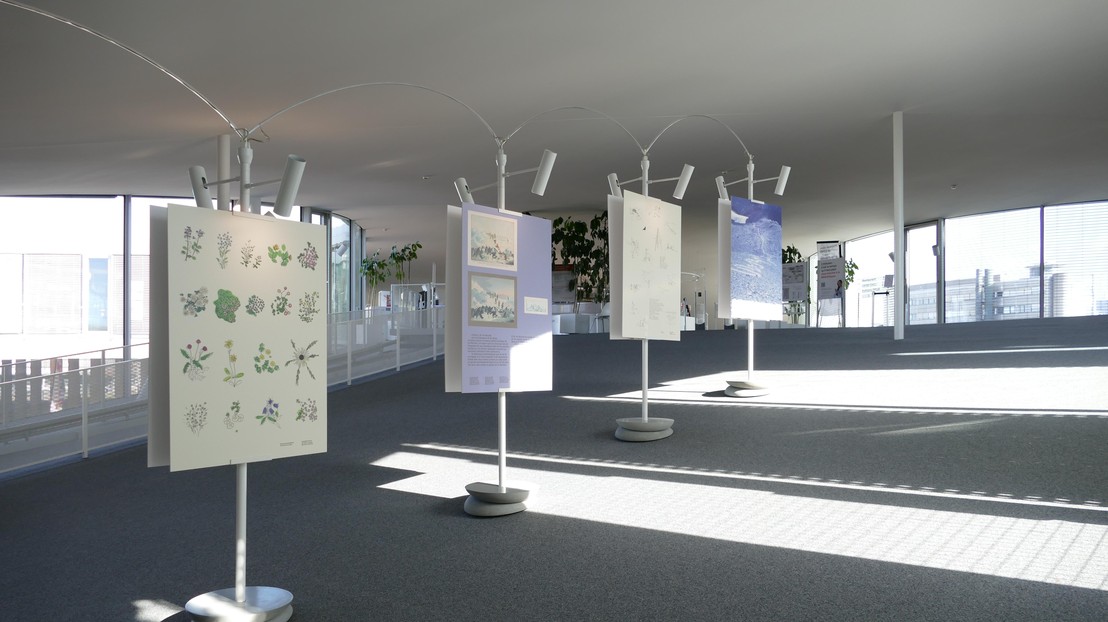
The exhibition “Le sommet qui cache le montagne” at the RLC © EPFL CDH LHST
Researchers from the Laboratory for the History of Science and Technology (LHST) have retraced the steps of two 18th-century Swiss scientists on an alpine journey. They combined historical scientific instruments, modern digital tools, data collection, and artistic creation to produce a unique experience of nature that can be viewed at the Rolex Learning Center until April 10th.
The exhibition “Le sommet qui cache le montagne” ("The peak that hides the mountain"), curated in collaboration with Véronique Mauron of CDH Culture, interweaves archival documents with notes, drawings, paintings, photographs, and audio samples from the LHST’s trek up Mont Buet in the French Alps last August. It is the fruit of a project funded by the Swiss National Science Foundation Agora program.
“One of the initial motivations for the project was to extend the so-called ‘experimental’ method in the history of science to places beyond the laboratory,” explains LHST head Jérôme Baudry.
“‘Experimental’ historians try to reproduce past scientific experiments, artifacts and processes, but so far, they have mostly focused on laboratory science. But science also takes place in the field, which poses specific challenges in terms of instrumentation and skills. With this in mind, we started to look around us, and we naturally set our sights on the mountains!”
Inventing new ways of seeing
Baudry and researchers Simon Dumas Primbault and Ion Mihailescu were accompanied on their scientific mission by collaborators Nicolas Chachereau, Marianna Fenzi, and Nicolas Nova, visual artists Olga Cafiero and Pascale Favre, sound artist Joell Nicolas, and museum curator Stéphane Fischer. They followed in the footsteps of brothers Jean-André and Guillaume-Antoine Deluc: scientists from Geneva who undertook several similar ascents starting in 1765. They even carried with them a replica of the barometer that was used by the brothers on their original journey.
The goal was not only to mirror the Delucs’ meticulously documented expedition, but to create a multidisciplinary, collective experience of nature, using artistic and scientific tools that allowed the team to record data as well as their own perceptions.
“Faced with the challenge of describing this unknown environment, the Genevan scientists had to invent new languages and forms of representation, such as the famous circular view of the mountain. We wanted to reproduce this experience of creating new ways of seeing, which is why we invited artists,” Baudry says.
Like their predecessors, the team took several different routes up the mountain. Throughout the journey, they gathered geographic, ecological, biological, sociological, and meteorological samples and documents, took photographs and audio recordings, and created paintings and sketches. The resulting documentation complements and extends the Delucs’ own collection of notes, maps, and drawings.

A digital archive
After April 10th, “Le sommet qui cache le montagne” will travel from the EPFL campus to the Café littéraire in Vevey, and then to the Musée d’histoire des sciences in Geneva. In addition to these exhibitions, the LHST has ensured that the public can experience their “interdisciplinary adventure” via the website www.montbuet.net: an interactive multimedia archive that allows users to view and listen to materials and data from key points along the journey. Visitors can also enrich the archive by contributing their own documents.
CDH Culture
Swiss National Science Foundation
Origin'bois, carpentry, Grangettes
The Museum of History of Science, Geneva
The Museum of Natural History, Geneva
The Conservatory and Botanical Garden, Geneva
The Library of Geneva
The Archives of the State of Geneva
Chloé Pannatier, graphic designer, Lausanne
Espacemontagne, assembly of the exhibition, Ecublens