Mission on board Léxplore to study greenhouse gases in Swiss Lakes
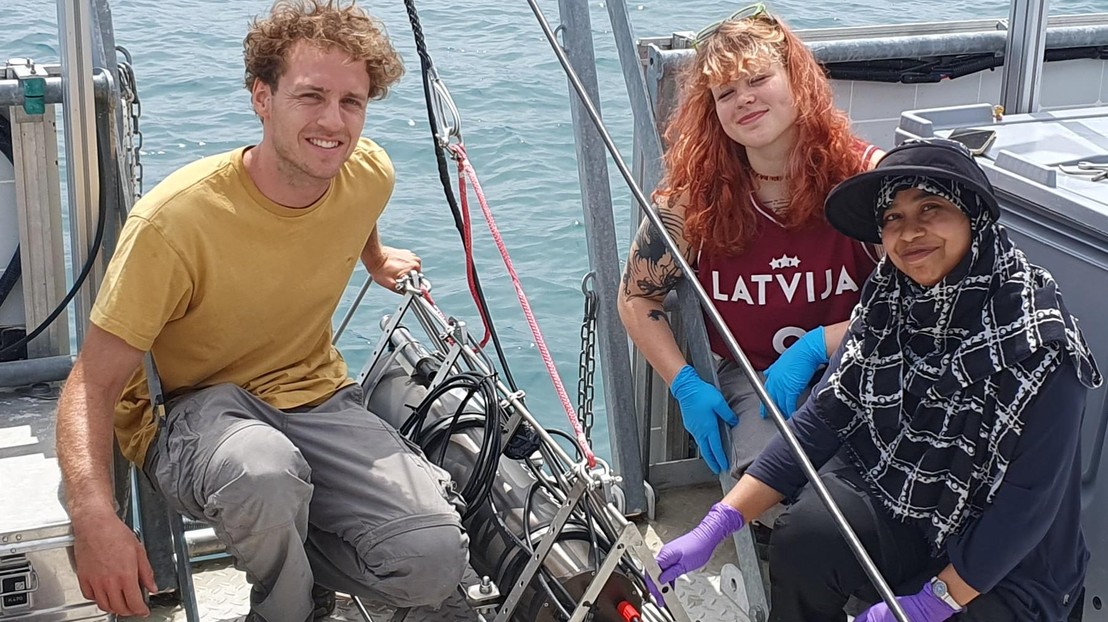
From left to right: SENSE engineer Hugo Cruz, postdoctoral researcher Santona Khatun, and EPFL Bachelor intern Beate Klepere © 2025 EPFL/Koami Gafan
On July 23, 2025, the EPFL SENSE team embarked from Pully aboard the Léxplore platform to conduct in-situ measurements of methane (CH₄) and nitrous oxide (N₂O), two potent greenhouse gases, in Lake Geneva. Led by postdoctoral researcher Santona Khatun, this mission is part of a broader seasonal monitoring program initiated in February 2025, aimed at unraveling the biogeochemical processes governing gas production, distribution, and release in Swiss lakes.
A team of microbiologists and technicians
EPFL microbiologist Santona Khatun was in charge of the operations today, accompanied by SENSE Engineer Hugo Cruz and EPFL Bachelor intern Beate Anna Klepere. Dr. Khatun, a postdoctoral researcher at SENSE who completed her PhD in Japan from 2016 to 2020, has been conducting greenhouse gas research on Lake Geneva since 2022. Her work focuses on understanding how methane and nitrous oxide are produced and distributed in Swiss lakes, with particular interest in their potential release to the atmosphere and contribution to greenhouse effect.
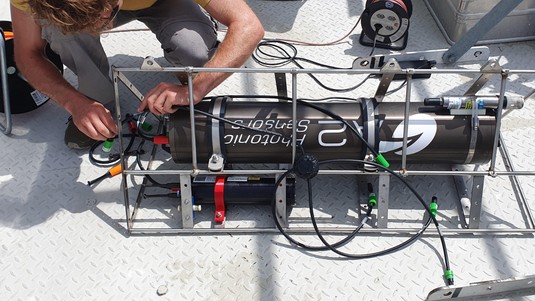
A measurement made possible by the "SubOcean" aboard the Léxplore platform
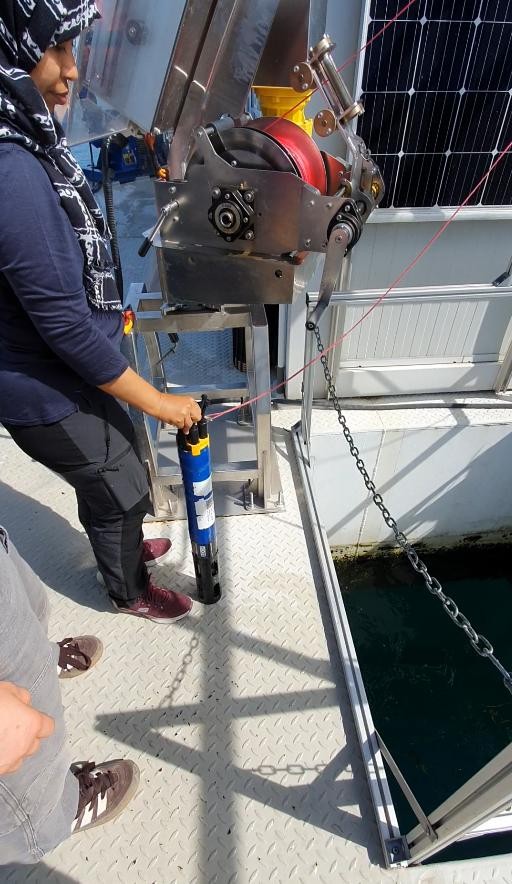
The SubOcean is a sophisticated underwater instrument that enables real-time, in-situ measurements of dissolved gases in water. Developed at the Institut des Géosciences de l'Environnement (IGE) in Grenoble, France, this innovative probe combines laser spectroscopy with a patented gas extraction system using membrane diffusion.
The instrument's key advantages include its fast response time of approximately 30 seconds, continuous measurement capability, and high sensitivity - capable of detecting methane concentrations as low as 0.05 nanomolar. This allows researchers to create detailed 3D maps of dissolved gas concentrations throughout the water column, something that would be impossible with traditional discrete sampling methods.
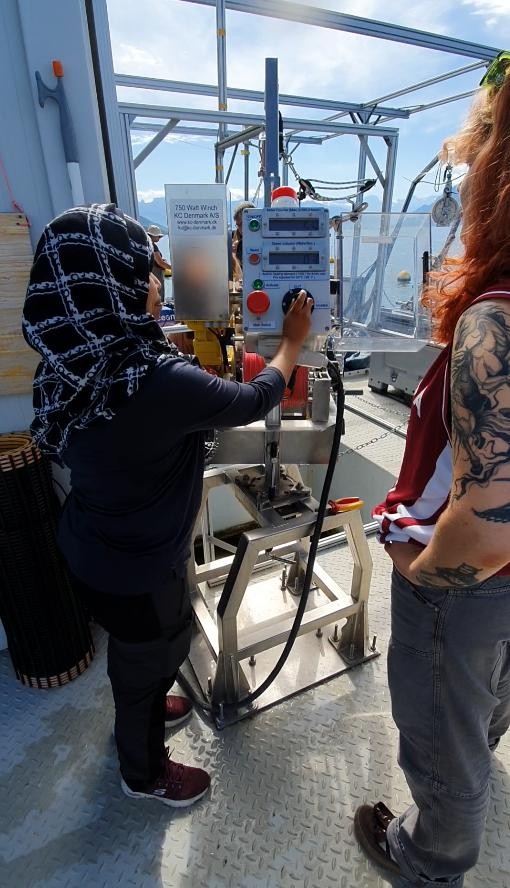
During today's mission, the SubOcean probe was deployed to depths of up to 100 meters, continuously measuring methane and nitrous oxide concentrations while simultaneously collecting environmental data including temperature, conductivity, and dissolved oxygen levels.
Methane and nitrous oxide profile
The team's primary objective is to understand the vertical distribution of these two powerful greenhouse gases in Lake Geneva. Methane is approximately 25 times more potent than CO2 as a greenhouse gas, while nitrous oxide is approximately 300 times more potent than CO2.
Dr. Khatun explained that during summer stratification and mixing season, different gas profiles emerge;
In the upper part of the lake, we typically see higher methane concentrations, while in the lower part, we observe increased nitrous oxide concentrations.
The research suggests that methane may originate from river delta sediments and be transported into the lake through inflows, rather than being produced directly in the water column by microbes.
Additionally, the team collected water samples at various depths - including surface waters, the thermocline zone (around 8-20 meters), and deeper waters - to validate the SubOcean measurements and conduct detailed laboratory analysis.
Nutrients analysis in the lab
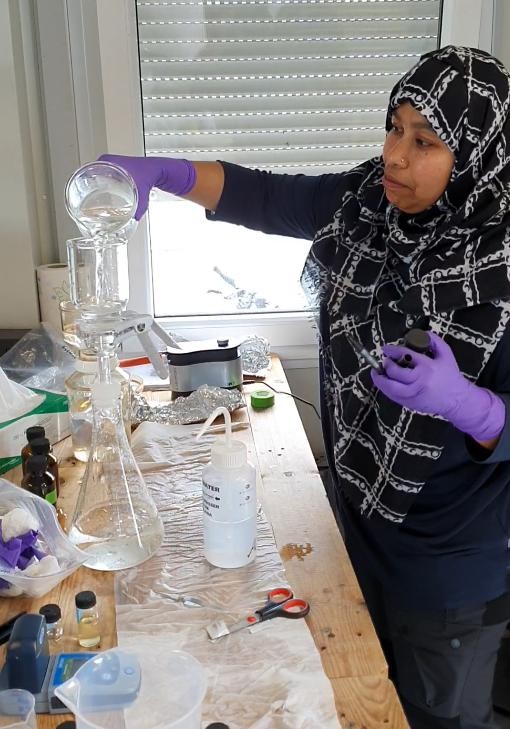
To understand the biogeochemical processes driving gas production, the team also analysed key nutrients, particularly nitrogen and carbon compounds. Using portable field kits, they measured nitrate and ammonium concentrations directly on the platform. These nutrients are crucial for understanding the microbial processes that either produce or consume methane and nitrous oxide.
Water samples were carefully collected using specialized vials with sodium hydroxide to preserve the samples and prevent bacterial activity during transport. The samples will undergo filtration to separate particulate matter from dissolved nutrients, allowing researchers to understand both the dissolved and particulate phases of the nitrogen cycle.
A successful measurement session
The day's fieldwork was successful, with the team completing both EXO profiling (measuring environmental parameters like temperature, conductivity, and turbidity) and SubOcean gas measurements. The data collected will help validate previous findings and contribute to the ongoing seasonal study of greenhouse gas dynamics in Swiss lakes.
This monthly monitoring program, which began in February 2025, aims to capture seasonal variations in gas production and release. The ultimate goal is to determine whether these deep alpine lakes serve as significant sources of greenhouse gases to the atmosphere, particularly during mixing seasons when stratified layers break down.
The research has important implications for climate science, as understanding the role of inland waters in global greenhouse gas budgets is crucial for accurate climate modeling and prediction.
Logistical support was provided by Guillaume Cunillera and Sebastian Lavanchy, a SENSE engineer responsible for planning field activities in Swiss lakes, who is currently participating in a mission aboard the Forel in Greenland.

Sub-Ocean: Subsea Dissolved Methane Measurements Using an Embedded Laser Spectrometer Technology
Roberto Grilli, Jack Triest, Jérôme Chappellaz, Michel Calzas, Thibault Desbois, Pär Jansson, Christophe Guillerm, Bénédicte Ferré, Loïc Lechevallier, Victor Ledoux, and Daniele Romanini
Environmental Science & Technology 2018 52 (18), 10543-10551
DOI: 10.1021/acs.est.7b06171
Links
Images to download