
MeshSDF: a breakthrough driving future intelligent product design
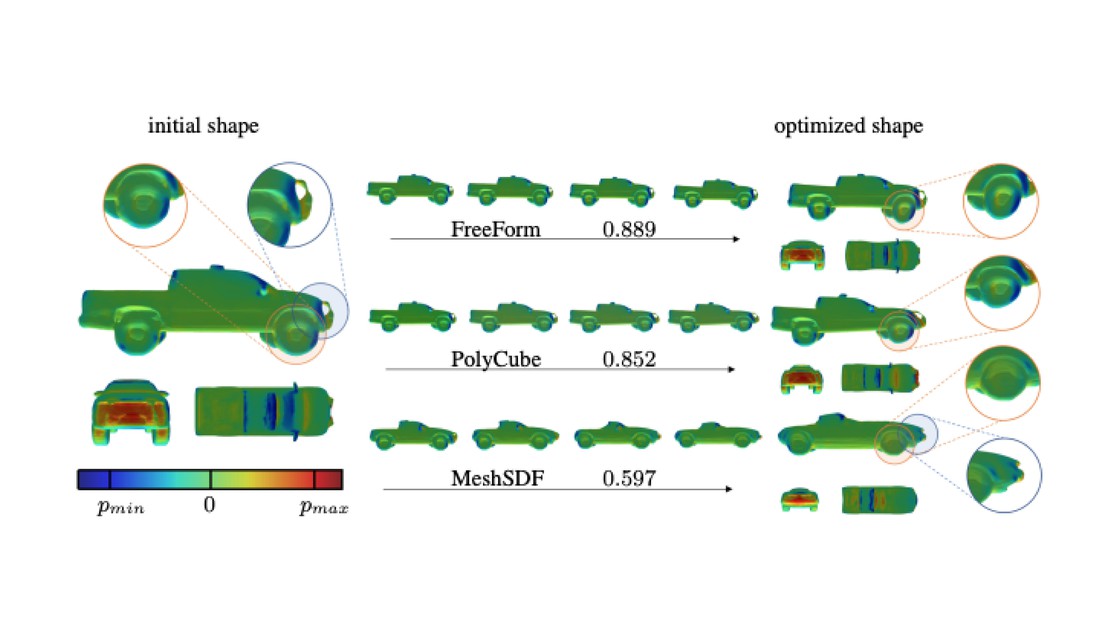
From an initial shape Ltask is minimized using three different parameterizations: FreeForm, PolyCube, and MeshSDF. © 2020 Neural Concept/EPFL
EPFL spin-off, Neural Concept makes Deep SDF-based 3D generative models differentiable.
How do you make the most aerodynamic car in the best and fastest way? Or how do you design the best possible ergonomic chair without changing thousands of parameters of input, one by one, to see how they impact a final product?
Most product designers these days use CAD (Computer Assisted Design) software and then work with a simulation team to ensure the designs work. One growing trend in the industry has been the use of Deep SDF (Sign Distance Function), an algorithm that is able to generate 3D shapes or objects more quickly and efficiently. However, one challenge with the Deep SDF algorithm is that it is not differentiable. What does this mean?
“In computer graphics you have 3D generated shapes and a designer looks for the input parameters that create these shapes. Take, for instance, a chair. A designer wants to find the latent parameters that correspond to this chair so it matches the image or visual aspect they are aiming for. With a non-differentiable algorithm, you need to search many, many parameters randomly and it’s very difficult to converge,” said Pierre Baqué, CEO of EPFL start-up Neural Concept.
Now, Neural Concept and EPFL’s Computer Vision Laboratory (CVLAB), led by Professor Pascal Fua, have published research on their new algorithm MeshSDF, that makes Deep SDF-based 3D generative models (VAEs) differentiable.
“This means that it’s possible for the software to follow a path that always improves and gets closer to the final shape through prediction and learning. You always know how changing your input will influence your output, so instead of searching parameters randomly, MeshSDF creates the right pathway to help you achieve the right shape. This is very efficient,” said Edoardo Remelli, a doctoral student with the CV Lab and one of the lead authors of the new research paper.
“At Neural Concept we are using this to look for 3D shapes that have superior physical properties. For example, take a car with a low drag, we can now easily find the input parameters that will make this car as aerodynamic as possible,” added Neural Concept’s Artem Lukoianov, the paper’s other lead author.
Neural Concept is already using MeshSDF with its clients and Baqué says the approach goes beyond optimized design or performance, “Most of our customers today are in the aerospace and automotive industries, with projects that are dedicated to new generations of hybrid, electric and hydrogen transportation. We also work on electronic device design or data center cooling. In all of these cases, the aim is to use less energy and create less carbon pollution. MeshSDF can enhance design and performance to achieve these types of sustainability objectives and help Neural Concept’s clients stay ahead of the curve in their fields.”
The joint paper from Neural Concept and the CVLab will this week be featured in a Spotlight presentation at the Neural Information Processing Systems Conference (NeurIPS) 2020, recognized as a key annual event on machine learning with more than 10,000 attendees. The team will demonstrate “MeshSDF: Differentiable Iso-Surface Extraction”, introducing a differentiable way to produce explicit surface mesh representations from Deep Signed Distance Functions by removing the limitation of the Marching Cubes algorithm.