
Lost on campus? A navigation app makes getting around easier
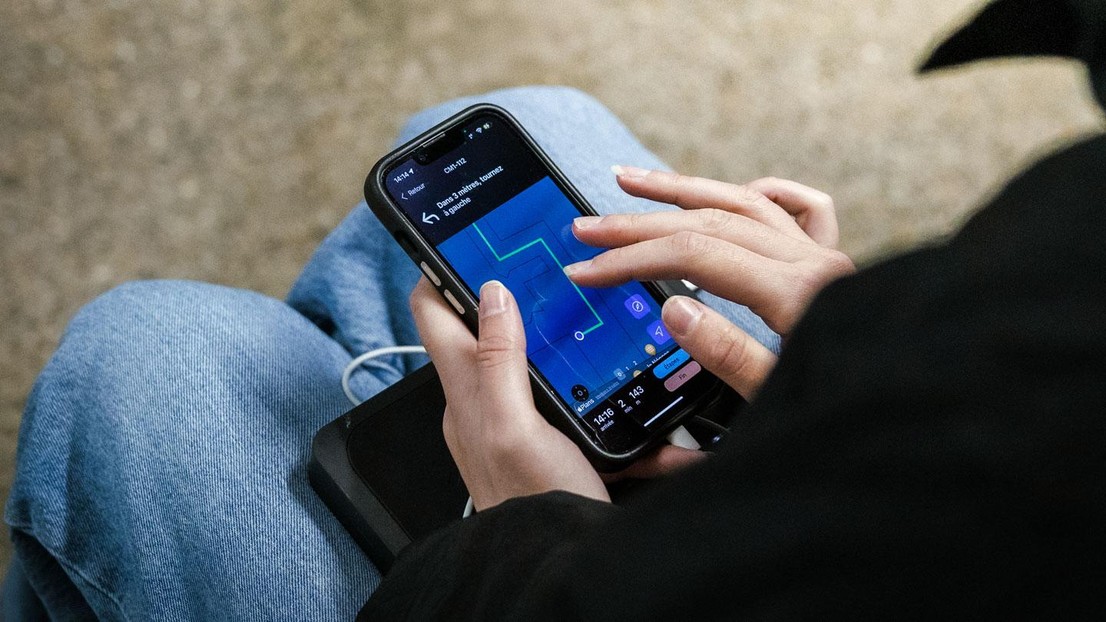
Application StreetNav - 2026 EPFL/Mathias Udriot - CC-BY-SA 4.0
The Double Deck construction project has made moving around the EPFL campus an altogether different proposition. A navigation app, named StreetNav, helps community members – including those with disabilities – find their way from the metro station to the Rolex Learning Center and beyond.
Gabriella, a mechanical engineering student at EPFL, has experienced the campus from three different vantage points. The first was as a young woman, when she was free to move about as she pleased. Then, she had to navigate the campus after a long period of rehabilitation following a devastating 10-meter fall that left her with almost no use of her legs. And more recently, since construction work began on the Double Deck project in 2025, she’s had to find new routes around the enormous hole at the very center of the site.
Gabriella and Hervé, a visually impaired EPFL staff member, volunteered to test StreetNav, a navigation app developed for use during the construction work, which is scheduled to run until 2029. Conceived as a temporary solution, it will eventually be replaced by the EPFL Plan app, which is being upgraded as part of a wider project. StreetNav stands out for its ability to tailor route guidance to nine user profiles: able-bodied pedestrians; people with limited mobility; pregnant women; manual wheelchair users; electric wheelchair users; people pushing strollers and those wheeling suitcases; people who are blind; people visually impaired; and those who require an “easy-to-read” mode, such as non-native speakers of French.
The app is now up and running, after the team behind it spent several weeks mapping indoor spaces across multiple floors, putting the tool through its paces and ironing out bugs. In some covered areas, for instance, beacons had to be installed so the signal could switch smoothly from outdoor GPS to the indoor system in the CM building, where the central corridor was fully scanned. That corridor now provides a way around the construction site, linking the EPFL metro stop to the Rolex Learning Center. With the new app, users can easily find a specific room inside the CM building, as well as reach any building entrance or major destination on campus.
I’d even recommend the app to able-bodied friends who come to visit me and aren’t familiar with the campus, because it’s very easy to get lost.
“I’d even recommend the app to able-bodied friends who come to visit me and aren’t familiar with the campus, because it’s very easy to get lost,” says Gabriella. For her, one of StreetNav’s main advantages is that, because it recognizes her profile, it steers her wheelchair away from gravel paths and cobblestones.
“A great product”
Hervé agrees that it’s “a great product,” even if the early tests involved a fair amount of trial and error. “The audio didn’t always match what was displayed on the screen,” he explains. “And sometimes, it didn’t quite get the location of an elevator right or failed to flag an obstacle.” Those were the kinds of fine adjustments that Seedgrowth Accessibility, the company that worked with the project team, had to make so the app would align with user expectations.
Quentin Delval, a project manager at EPFL’s Equal Opportunity Office and head of EPFL Without Barriers – the program the app was developed under – is particularly pleased with the end result: “When you have a disability, you have to plan much further ahead. You get up earlier. You have to map out your routes, set off early in case something unexpected happens and, sometimes, rely on other people for help. That’s a huge additional mental load. And it drains the energy you need to handle the usual stresses of everyday life. People with disabilities are at greater risk of becoming socially isolated, dropping out of school or quitting work – all because the environment they’re in doesn’t allow them to function properly. Yet the law requires organizations to do everything they can to help people with disabilities maintain their independence.”
The law requires organizations to do everything they can to help people with disabilities maintain their independence.
Later this year, the EPFL Without Barriers project is set to present a detailed action plan to the School’s upper management, building on the findings of an earlier consultation phase in which people facing sensory or mobility challenges were asked about their views. The plan will include some particularly ambitious measures with hefty cost implications. But StreetNav is an example of a measure that, while more modest in scope, still makes a difference.
To get the whole EPFL community involved in supporting their peers with physical impairments, there’s also a companion app called StreetCo, which lets anyone flag accessibility issues around campus – from a broken elevator or a blocked staircase to a construction barrier that’s been moved. Together, the two apps act like a kind of Waze for pedestrians – something that ends up being useful for everyone, whether they’re in peak physical condition or hobbling back from a ski trip with a broken leg.