
LIMNO develops new understanding of photocatalyst surface chemistry
© 2026 EPFL
Researchers from the LIMNO laboratory at EPFL have uncovered how different halides modify the surface chemistry of organic semiconductor nanoparticle photocatalysts. By controlling these phenomena, they have significantly improved the solar hydrogen production efficiency of these materials.
Solar-driven hydrogen production from water can provide a means to reliable clean energy storage, but it currently suffers from high costs. Organic semiconductor nanoparticles are an emerging alternative to conventional hydrogen production technologies, offering visible light activity and processability using earth-abundant elements, with the potential to reach the green hydrogen cost targets necessary for industrial viability. The incorporation of small amounts of platinum is essential for the catalytic activity of these materials, yet the surface chemistry of this photodeposited Pt co-catalyst remains poorly understood.
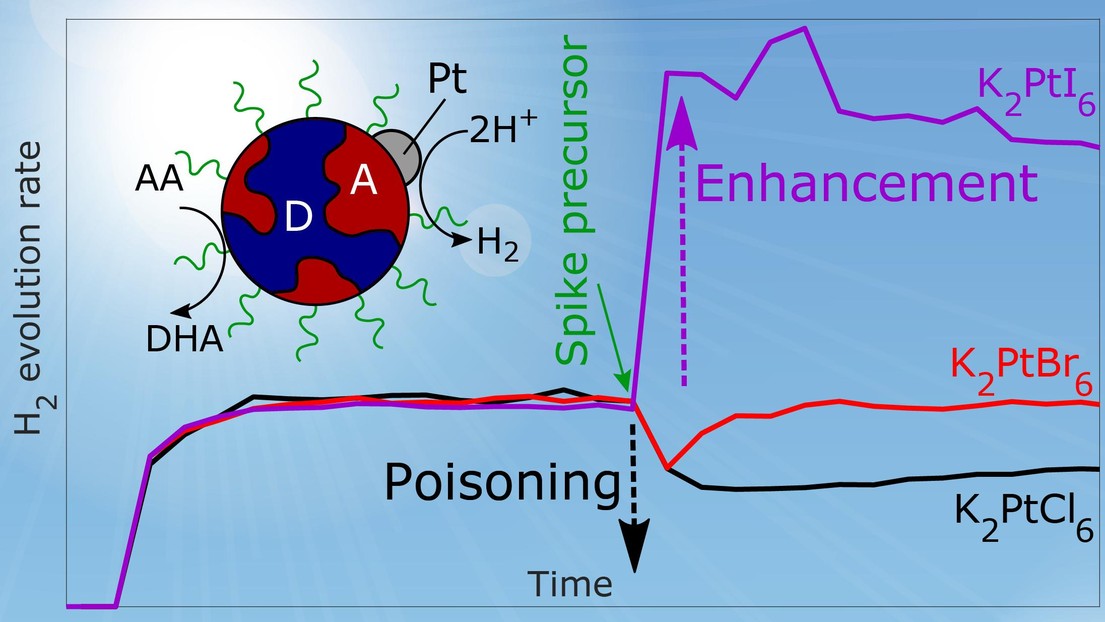
In a study recently published in ACS Energy Letters, researchers from the LIMNO laboratory at EPFL have shown that the halide ligand in hexahaloplatinate(IV) precursors (K2PtX6, X = Cl, Br, I) critically governs both the kinetics of Pt photodeposition and the resulting photocatalytic performance. Chloroplatinate precursors leave partially reduced Pt–Cl species adsorbed on the Pt surface, poisoning active sites and severely suppressing H2 evolution rates in organic semiconductor systems that generate low photopotential. Conversely, bromo- and iodoplatinate precursors reduce more readily, largely avoiding this poisoning. By modifying the Pt surface with iodide ions, the researchers boosted the hydrogen evolution rate, reaching an apparent quantum yield of 17% at 700 nm, among the highest reported for this type of materials.
These findings highlight the importance of co-catalyst surface chemistry as a critical and often overlooked design parameter in photocatalytic systems.
The work was performed as part of NCCR Catalysis (grant number 225147), a National Centre of Competence in Research funded by the Swiss National Science Foundation. This research was also funded in part by the Swiss National Science Foundation (SNSF) [Grant Number 200021-236603]. The authors thank Dr Mounir Mensi for the XPS measurements and analysis.