
Light-Based Method Produces Photocatalyst Nanoparticles in Seconds
© 2026 EPFL
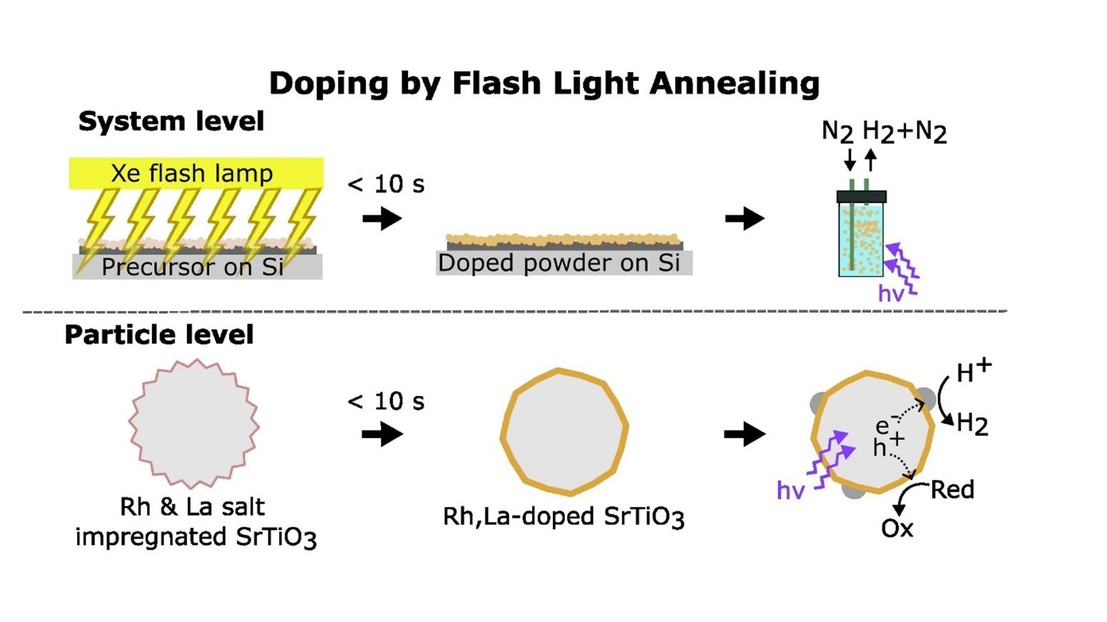
Scientists from LIMNO, EPFL, and HES-SO Valais-Wallis in Sion have developed a new way to produce Rh/La-doped SrTiO3 photocatalyst nanoparticles in seconds by using intense light pulses as the heat source. The resulting particles generate hydrogen more efficiently than materials produced with conventional heat treatments that require several hours.
Our 4th year PhD student Melanie Johanning collaborated with researchers from HES-SO Valais-Wallis to develop a new rapid method to synthesize a promising photocatalyst material for hydrogen production under visible light.
The material, strontium titanate (SrTiO₃) co-doped with rhodium (Rh) and lanthanum (La), is considered a strong candidate for photocatalytic hydrogen production. Until now, the best-performing particles were typically produced through long thermal annealing processes at temperatures around 1100 °C. While this creates a desired undoped-core/doped-shell structure, it can also cause surface area loss and chemical inhomogeneities.
The research team hypothesized that shorter processing times could preserve the particle surface area while introducing the dopants closer to the particle surface, where they are considered most effective. To test this idea, LIMNO partnered with researchers at HES-SO Valais-Wallis in Sion to use photothermal flash light annealing. In this process, the required heat is generated directly inside the material by absorbing high-intensity light pulses emitted by a Xenon flash lamp.
The results, recently published in the RSC journal Catalysis Science & Technology, demonstrate that effective doping can be achieved in just 7,5 seconds. The resulting particles showed significantly higher photocatalytic performance than materials produced by conventional oven annealing.
The study demonstrates a fast and effective route for producing well-performing Rh,La:SrTiO₃ photocatalysts and could open new possibilities for rapid core/shell-doping of other metal oxide nanoparticles for energy and catalytic applications.
This work was funded by Toyota Motor Europe.