
"Justice should be the moral driver behind climate action"
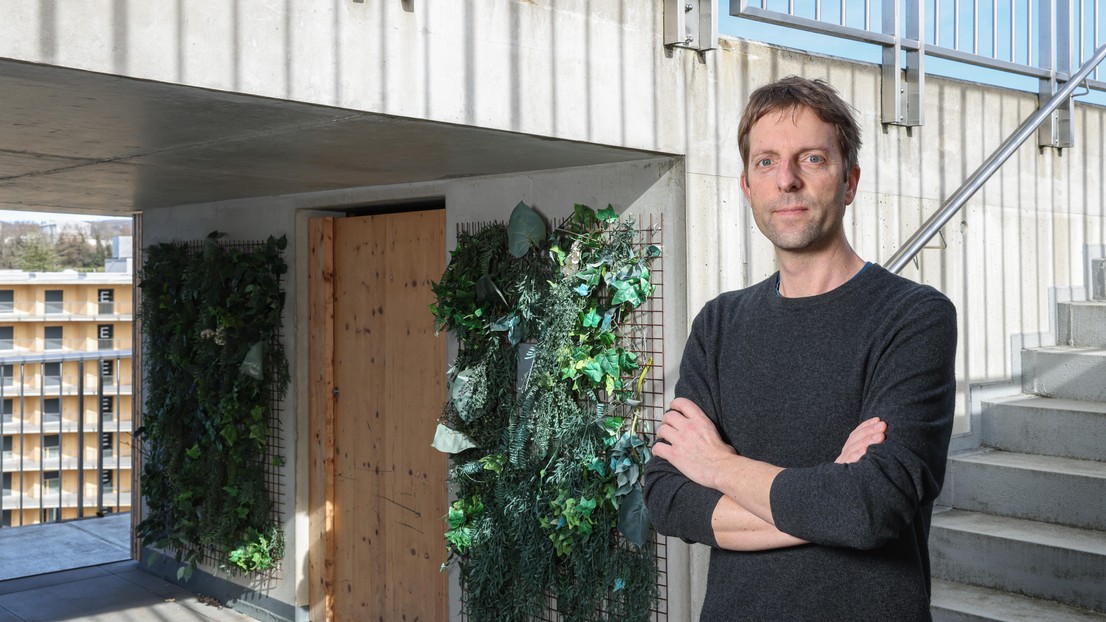
© Augustin Fragnière 2026 EPFL/Alain Herzog - CC-BY-SA 4.0
A new book by five experts sets out to explain climate change “in a fact-based way that’s easy for everyone to understand.” We spoke with Augustin Fragnière, a coauthor of the book and lecturer at EPFL and the University of Lausanne (UNIL).
The latest global warming figures demolish several records. To give just one example, the atmospheric concentrations of the three main greenhouse gases are the highest they’ve been in 800,000 years. Global warming is changing the world we live in at just about every level. Yet amid the onslaught of information on this topic, it can be hard to filter out the noise, grasp what the stated figures really mean and, most of all, know what concrete steps we can take.
To help us see more clearly, five climate experts – Augustin Fragnière, Jacopo Grazioli, Samuel Jaccard, Christophe Randin and Philippe Thalmann* – teamed up on a new book called Le changement climatique : climat, écologie, société et politique (available in French). They provide an overview of the latest findings and give a straightforward explanation of the science behind climate change along with its effects on the environment and society. The book also spells out possible solutions – solutions that will necessarily require a collective effort. Interview with Augustin Fragnière, a lecturer in EPFL’s humanities and social sciences (SHS) program and at UNIL’s Faculty of Geosciences and Environment, as well as the deputy director of UNIL’s Competence Centre in Sustainability.
At EPFL, you teach a class on climate change. Why do you think it’s important to train future engineers on sustainability?
We’ve known about the climate crisis for years, along with what we need to do – drastically reduce our consumption of raw materials and energy. What’s less clear is how to achieve that. Engineering students tend to focus on finding technical solutions, but that’s only part of the answer. They need to consider the human, political and economic factors at play as well. Developing new technology is great, but we must also consider the broader context it will be used in, whether the technology can be deployed on a large enough scale and whether it’s sustainable over the long term.
Around one-third of the global population thinks that climate change either doesn’t exist or isn’t caused by humans. Studies and meta-analyses have found a correlation between people’s political ideology or affiliation and their climate-change beliefs.
What do you feel are the most important messages to get across?
Students need to understand the scale of the problem, in its full societal scope, and consider the complex behavioral issues behind climate change. My class also looks at climate skepticism, although I prefer to call it denial of climate science because skepticism is healthy – it’s the basis of the scientific method, that is, refusing to draw a conclusion in the absence of evidence. Around one-third of the global population thinks that climate change either doesn’t exist or isn’t caused by humans. Studies and meta-analyses have found a correlation between people’s political ideology or affiliation and their climate-change beliefs. For instance, people who believe in free-market principles are more likely to deny that global warming is the result of human activity. This trend is particularly salient in the US.
I try to teach my students how to analyze why people reject the climate science and what rhetorical strategies they use. One such tactic is cherry picking, or selecting only those bits of information that align with your perspective. Another is the use of fallacies or faulty reasoning. Once you’ve grasped those tactics, you’re better able to deconstruct that discourse.
Where can we take action to help fight global warming?
For one thing, we can make people aware of the orders of magnitude involved. In Switzerland, for example, the biggest problem is indirect emissions: two-thirds of our emissions are generated outside the country. Also, policymakers could introduce financial incentives like the carbon tax that Philippe Thalmann describes in our book, and they could cut the cost of low-carbon alternatives such as train travel. Another focus area could be technical standards, with the goal of introducing more energy-efficient devices on the market.
Lastly, we could encourage a shift in consumer habits, prompting people to live with less instead of living with just as many goods while using less energy. To effect this kind of change, we need to adapt prevailing narratives. We live in a society where people think that happiness means buying as much as you want. But numerous studies have shown that, beyond a certain level, well-being gains from additional consumption level off. We can be happy and live well with fewer, well-chosen goods. At UNIL, we’re conducting a research project on these kinds of transition narratives.
Can you tell us more about this project?
It starts with the idea that there are two predominant narratives about the climate transition. The first is based on technological fixes, which is the belief that technology will solve today’s problems. The second is built around the fatalist, apocalyptic view that there’s nothing we can do to stop global warming. Our research looks at how these narratives are built and subsequently spread across the business world, in our educational system and in the cultural sphere. Then, we plan to harness these findings in order to deconstruct those narratives and form new ones based on an optimistic outlook that includes material and energy degrowth.
We live in a society where people think that happiness means buying as much as you want. But numerous studies have shown that, beyond a certain level, well-being gains from additional consumption level off. We can be happy and live well with fewer, well-chosen goods.
You devote an entire chapter of the book to climate justice. What does that concept entail?
Climate justice had long been overlooked, until we realized around 20 or 30 years ago that there were inequalities in terms of contribution to climate change and exposure to climate risks. For instance, carbon emissions are directly correlated with income. An Oxfam study found that, in 2019, the top 10% of the global population by income were responsible for half of the carbon emissions. But it’s the people with the lowest incomes who are most vulnerable to the effects of climate change, such as cyclones, flooding and droughts. Countries in the Global South are seeing the worst impacts owing to their geographical location as well as their economic, technological and infrastructure vulnerability.
These inequalities exist between countries, but also between social classes within a given country. And income isn’t the only determining factor: studies have also shown that gender plays a role. Women are generally more exposed to the health-related risks of climate change. They tend to be more affected by heat waves, and that’s not for physiological reasons.
What’s the situation here in Switzerland?
In Switzerland, we still don’t have the full picture of these inequalities. But in my view, understanding them is key to designing the right public policies, especially in terms of adaptation. The latest IPCC report mentions the problem of “maladaptation,” or public policies that not only do not achieve their goal but even make the situation worse. So climate justice is a critical issue and should be our main moral driver for taking action against global warming.
How can we encourage people not to prioritize their own short-term interests?
It’s a dilemma of collective action that can be illustrated by the tragedy of the commons. If everyone seeks to maximize their own interest, the result will be an environmental disaster. Countries, businesses and individuals view the bold steps that are needed as sacrifices, which are hard to make if they feel that no one else is following suit. Surveys show that in western Europe people are mostly aware of the problem of climate change and are willing to take ambitious measures as long as the measures apply to everyone. That’s why we need common rules and coordination. We can’t rely only on individual responsibility – that won’t work.
I’d also point to an intergenerational problem, which we could call the “tyranny of the present.” The current generation holds all the cards and can prioritize its own interests without worrying about retribution from future generations. That’s why it’s so hard to get people to accept long-term policies. Some political initiatives have addressed this problem, such as by bringing representatives of future generations into parliament, but few have been successful. Some efforts have been made to introduce mechanisms for addressing long-term issues in our democratic systems, although concrete outcomes are still thin.
*Augustin Fragnière, lecturer and research manager at EPFL and UNIL; Jacopo Grazioli, a manager at the Geneva Canton water office, former EPFL lecturer and education project manager within EPFL’s sustainability unit; Samuel Jaccard, professor of earth science at UNIL; Christophe Randin, professor of ecology at UNIL; and Philippe Thalmann, professor of economics at EPFL.