
Innovation has a price tag — and patents help sustain it
© 2026 EPFL
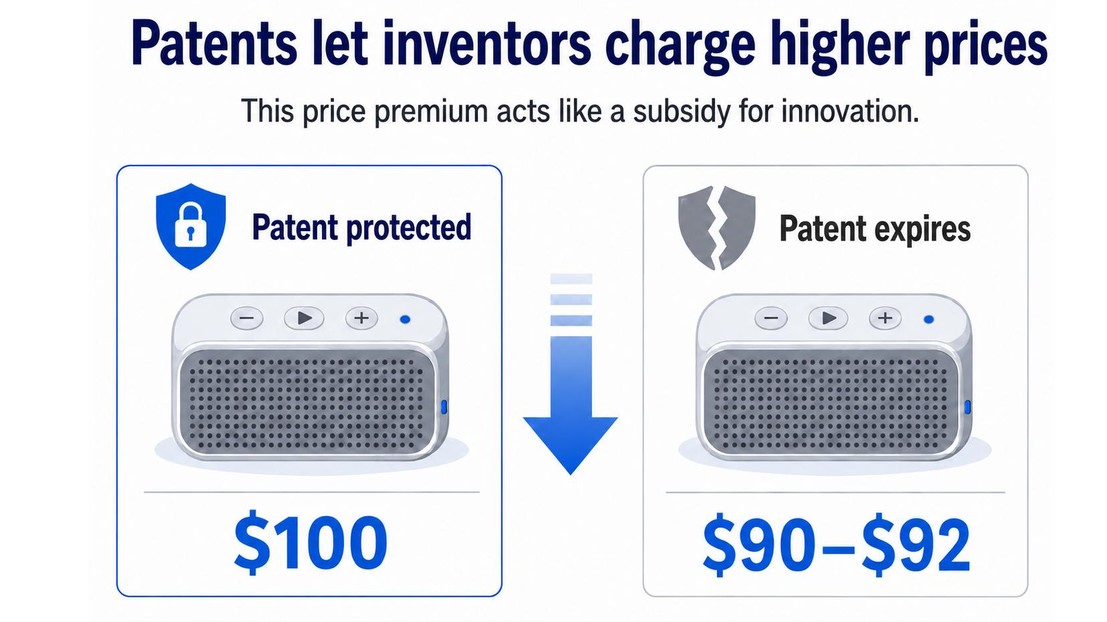
A new study co-authored by Prof. Gaétan de Rassenfosse, published in the Journal of Empirical Legal Studies, provides the first direct evidence that patent protection enables firms to charge supra-competitive prices for consumer products — and puts a concrete number on the premium: 8 to 10%.
The theoretical foundation of patent systems rests on a simple bargain: society grants inventors a temporary monopoly so they can recoup R&D investments, in exchange for eventually placing the invention in the public domain. In practice, however, whether patents actually translate into higher prices for consumers has remained an open empirical question outside of pharmaceuticals. The main obstacle has been data: linking patents to the specific products they protect is notoriously difficult.
The study overcomes this challenge by exploiting Virtual Patent Marking (VPM), a provision of the 2011 America Invents Act that requires patentees to disclose which patents cover which products on a public webpage. The authors assembled an original dataset linking thousands of patents to hundreds of consumer products sold on Amazon.com, and tracked their prices monthly over nearly a decade. By focusing on patent expiry — a legally fixed event entirely outside a firm's control — they establish a clean causal estimate of the price impact of losing patent protection.
The results are striking. Upon patent expiry, product prices fall by 8–10% on average. Prices begin declining roughly one year before the formal expiry date, consistent with firms strategically reducing prices to deter would-be competitors. The price drop is larger for patents that protect a greater number of products, and more pronounced in competitive markets. Notably, design patents — which protect a product's appearance rather than its function — show no detectable price effect, whereas utility patents drive the full result. Products with higher consumer ratings experience a smaller price drop, suggesting that quality and brand reputation help cushion the competitive shock.
“Because we measure the effect right at the end of patent life — when market power is presumably at its weakest — our 8–10% figure is a conservative estimate of the patent premium,” says de Rassenfosse. “The true markup that patents confer over a product’s entire lifetime is likely larger.”
The findings carry clear implications for innovation and competition policy. They confirm that the patent system does what theory predicts: it supports higher prices, and therefore provides an economic incentive to innovate. At the same time, the 8–10% figure is a direct measure of the welfare cost that consumers bear in exchange for more innovative products. The paper is the first to provide such an estimate for general consumer goods, complementing a long literature on pharmaceuticals and establishing a novel data infrastructure for follow-on research on patent valuation and market competition.