
Impact of Plasma Ashing on Mixed Monolayer Doping of Silicon
© 2026 EPFL
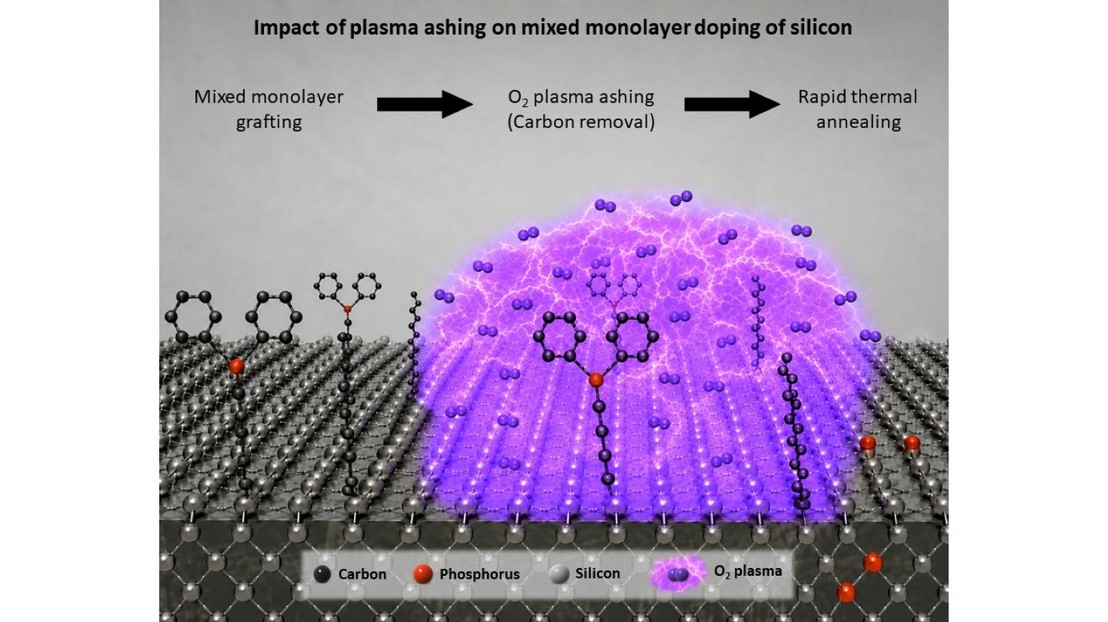
Congratulations to our colleague Pol Torres-Vila and his co-authors on their recent publication, “Impact of Plasma Ashing on Mixed Monolayer Doping of Silicon,” in Small Methods.
Controlling dopant concentration near the silicon surface is increasingly important for ultra-shallow junctions and nanoscale devices. Mixed monolayer doping (MMLD) offers a surface-chemistry-based approach in which dopant-containing molecules are mixed with non-dopant molecules, providing a route to tune the amount of dopant available at the silicon surface before thermal diffusion.
In this work, silicon was doped using mixed monolayers of the phosphorus-containing molecule allyldiphenylphosphine (ADP) and 1-undecene. The study investigated the use of O₂ plasma ashing after molecular grafting to remove residual carbon while preserving phosphorus at the surface. X-ray photoelectron spectroscopy (XPS) confirmed that the plasma treatment efficiently reduces the carbon content while largely retaining phosphorus.
Kelvin probe force microscopy (KPFM) revealed a systematic decrease in silicon work function with increasing ADP concentration. The results also showed that the SiO₂ capping method strongly influences the measured surface response: evaporated SiO₂ combined with O₂ plasma treatment produced the clearest evolution toward n-type behavior, whereas sputtered SiO₂ resulted in strong work-function pinning.
Electrical characterization using four-point probe and Hall-effect measurements confirmed increasing conductivity and carrier concentration with increasing ADP content. However, no significant difference was observed between plasma-treated and untreated samples in these bulk-integrated measurements. This highlights the importance of distinguishing between near-surface electronic properties and bulk electrical transport when evaluating monolayer-doped silicon.
Overall, the work demonstrates plasma-assisted MMLD with small molecules as a promising and tunable approach for silicon doping, while emphasizing the importance of combining surface-sensitive and electrical characterization techniques. Such control of near-surface doping is particularly relevant for nanoscale and emerging quantum-device applications.
Read the open-access article:
Impact of Plasma Ashing on Mixed Monolayer Doping of Silicon
Pol Torres-Vila, Thilo Glatzel, Mounir Mensi, Giovanni Boero, Juergen Brugger and Arnaud Bertsch
Small Methods (2026), e70970
https://doi.org/10.1002/smtd.70970