
Illusory presence alters extrastriate processing of visual humans
© 2025 EPFL
Robotically-induced feeling of an unseen person nearby leads to overestimation of humans and activation of parietal and extrastriate visual brain regions.
How does the brain estimate the number of people around us? And why do we sometimes feel that there are more than there really are?
These are questions of fundamental biological importance in biology, in particular for survival in a social world, where rapid detection and identification of others is an essential ability. Previous work from our lab discovered a proxy for this biological function, when participants systematically overestimated the number of humans (Albert et al., Nature Communications 2025). This bias was not observed for non-human objects and became even stronger when preceded by a robotically-induced presence hallucination (i.e., the false perception of another invisible person).
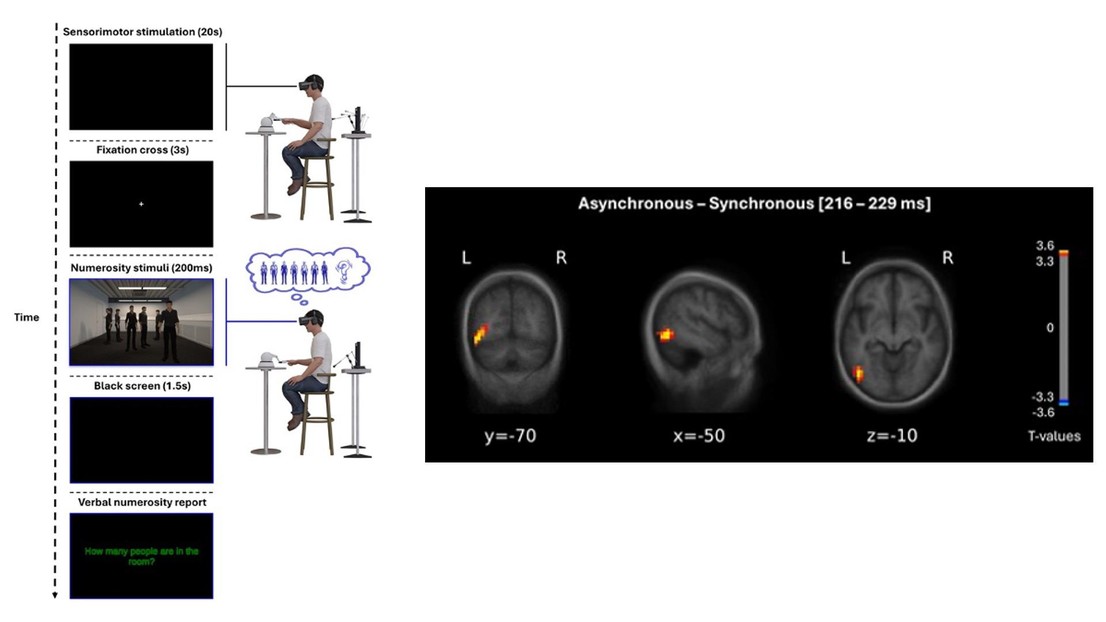
In a new study published in Cerebral Cortex and led by Louis Albert, we combined virtual reality, robotically-induced presence hallucinations, and high-density EEG recordings to map the changes in parietal and extrastriate cortex of the human overestimation bias.
We found that when participants judged the number of people in a scene, their brains showed numerosity-perception components. Critically, activity in the left extrastriate body area (at a latency of 220 ms after stimulus onset and specialized for the perception of visual humans) reflected the enhanced human overestimation bias during moments of presence hallucinations.
These findings show that robot-induced presence hallucinations and social numerosity processing, based on interactions of parietal numerosity regions and the extrastriate body area in visual cortex, mediate this important biological function of rapidly detecting other humans in space.
This research was supported by the Swiss National Science Foundation (grant number SNF 320030_188798) to Olaf Blanke; two generous donors advised by CARIGEST SA (Fondazione Teofilo Rossi di Montelera e di Premuda and a second one wishing to remain anonymous) to Olaf Blanke; Bertarelli Foundation to Olaf Blanke; Empiris Foundation to Olaf Blanke; the Human Neuroscience Platform, Fondation Campus Biotech Geneva, Geneva, Switzerland.
Albert, L., Vehar, N., Potheegadoo, J., Bernasconi, F., & Blanke, O. (2025). Visual hallucinations in Parkinson’s disease are associated with deficits in social perception. https://doi.org/10.1177/1877718X251336196