ICE lab wins Best Poster Award at ACM BuildSys 2026

Best poster award © 2026 Khovalyg
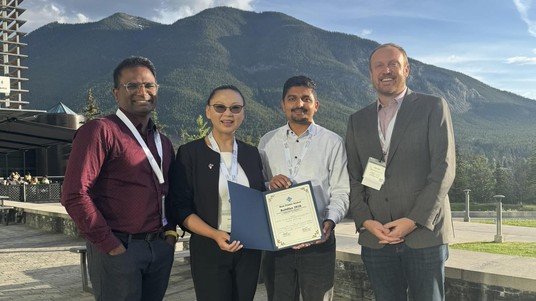
The ICE lab received the Best Poster Award at ACM BuildSys 2026 for the work on the effect of the actual human metabolic rate on the energy efficiency of buildings. Prof. Khovalyg also opened the Occupant-Centric Energy Systems (OccuSys) workshop with a keynote on closing the control loop on the human body.
The ACM International Conference on Systems for Energy-Efficient Buildings, Cities, and Transportation (BuildSys), is the leading venue at the intersection of computing and the built environment, bringing together researchers in sensing, data, control, and energy systems. The 2026 edition was held in Banff, Canada, on June 22-25 and hosted the Occupant-Centric Energy Systems (OccuSys) workshop, dedicated to modelling and control beyond static boundaries: human-building interaction, adaptive comfort, behavioural intelligence, and grid-responsive control. Prof. Khovalyg delivered the opening keynote "Closing the Loop on the Human Body: Sensing, Modeling, and Control for Occupant-Centric Buildings." Her talk argued that buildings today regulate a state they never observe: the room is carefully instrumented, but the occupant remains a black box served by one setpoint for everyone. Drawing on ICE research, from indirect calorimetry and climate-chamber experiments to studies of Tuvan nomads, she showed that metabolism is a moving target, that thermal comfort is individual and local, and that variable thermal exposure is a stimulus the body benefits from rather than a disturbance to remove. She then outlined the vision for four shifts needed to close the loop on the human body. The main message was to engineer buildings that respect what the body actually is, and energy savings will follow.
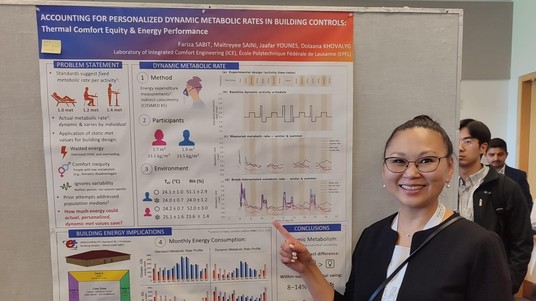
In addition, the lab's poster titled "Accounting for Personalized Dynamic Metabolic Rates in Building Controls: Thermal Comfort Equity and Energy Performance" by Fariza Sabit, Maitreyee Saini, Jaafar Younes, and Dolaana Khovalyg, received the Best Poster Award. Comfort standards assign a fixed metabolic rate to each activity, yet the poster's indirect calorimetry measurements across a full day of office activities, repeated in winter and summer, show that real metabolic rates differ by about 17% between a male and a female participant and swing by 8 to 14% between seasons for the same person. Feeding these measured, dynamic profiles into a standard small-office model control, and simulated for two climates (Cfb and Dfc), the team found that cooling energy drops by 37-70% and heating by up to 53% compared with the standard static assumption, with the largest gains for the occupant with the lower metabolic rate. Beyond energy, the work highlights a comfort-equity issue: designing to a population average systematically disadvantages people, often women, whose metabolism sits below it. The award recognises a concrete, measurable case for the keynote's central claim that personalizing the human side of the control loop pays off in both comfort and energy. Congratulations to Fariza, Maitreyee, and Jaafar on this well-deserved recognition!