
“I've always enjoyed solving other people's problems”
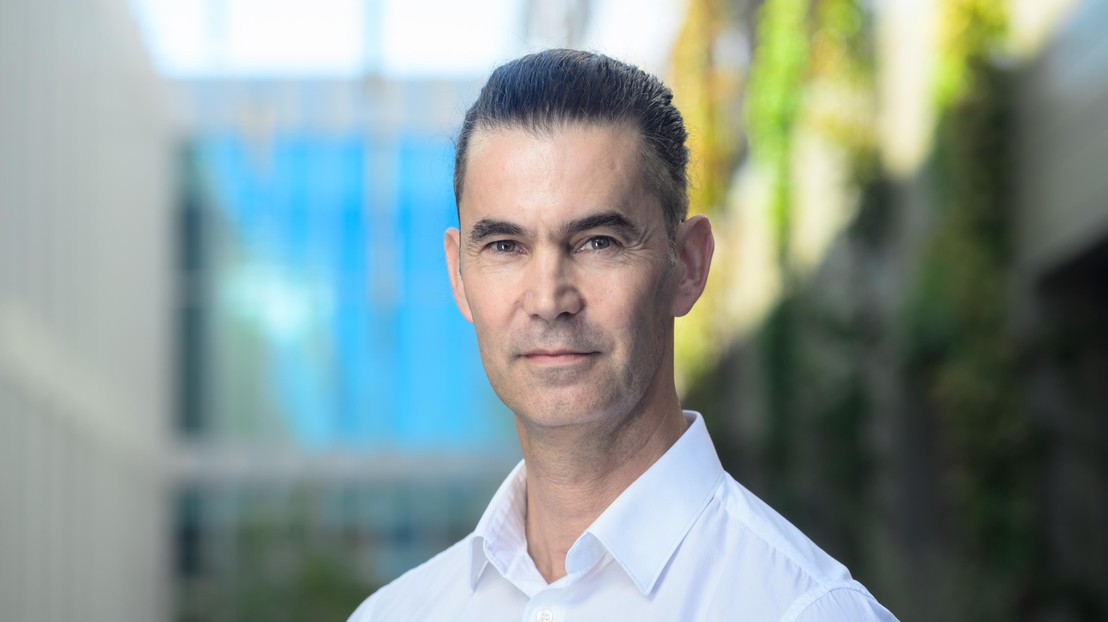
© 2026 EPFL/Lundi13 - François Wawre - CC-BY-SA 4.0
Simon F. Nørrelykke, a physicist by training, took over as head of EPFL’s Center for Imaging this spring after establishing image-analysis units at ETH Zurich and Harvard Medical School. He spoke with us about his passion for problem-solving and the opportunities and challenges that AI is bringing to the field of image analysis.
Nørrelykke’s interest in scientific imaging began during his PhD, when he used video microscopy to track the tiny movements of beads tethered to single DNA molecules. The challenge of writing code to extract quantitative information, and then using mathematics and statistics to interpret the resulting data, interested him more than the images themselves. That combination of methods development, programming and quantitative analysis – applied to other kinds of microscopy during subsequent postdoctoral research – would eventually shape his career.
Originally from Denmark, Nørrelykke studied mathematics and physics before moving into experimental single-molecule biophysics for his PhD. He worked in several countries before joining ETH Zurich in 2012, where he set up the Image and Data Analysis group at the school’s Scientific Center for Optical and Electron Microscopy (ScopeM) and led it for the following ten years. He left ETH Zurich in 2022 to establish the Image Analysis Collaboratory at Harvard Medical School, returning to Switzerland four years later to serve as the executive director of EPFL’s Center for Imaging. Here, his team provides image-analysis support to researchers across disciplines including biology, architecture, micro-and civil engineering, materials science and more.
His path to becoming an image analyst was anything but linear. During his PhD in experimental biophysics, he took up coding to develop tools for his own research needs. Then, during his postdoctoral research in Florence, Dresden, and Princeton, he wrote his own code to run numerical simulations and analyze microscopy images and time-series data in ways that the software then available couldn’t. “I didn’t feel like I was engaged in image analysis – I just had a problem to solve,” he says.
Building tools for other scientists
This approach to research never left him. Nørrelykke is more interested in exploring methods for solving problems than devoting his entire career to a single research topic. “Also, I’ve always enjoyed solving other people’s problems – even though that’s probably not the most profitable endeavor in academia!” he says. “What I find gratifying is having a positive impact. Sometimes we make a research experiment possible, and sometimes we improve experiments a little – or even a lot. And that can help a scientist get their research published or taking a decisive step forward.”
Nørrelykke’s talent in pulling together an array of skills isn’t limited to research applications. It’s also what led him to bring together other experts who, like him, work at the interface of science and image analysis. At ETH Zurich, Nørrelykke helped launch several bioimage-analysis initiatives and associations including NEUBIAS, SwissBIAS, ZIDAS and GloBIAS. “Before that, there wasn’t even a name for what we did. That was the first time we used the term ‘bioimage analyst,’” he says.
“What is the research question?”
Applied image analysis requires expertise in a number of fields – classical image analysis, machine learning and AI, statistics and programming – as well as an understanding of how the images are acquired. “You need to know enough about the imaging modality, whether it’s a microscope, an X-ray system or something else, to recognize when you might be quantifying an artifact rather than something real, and sometimes to suggest a better way of acquiring the data,” says Nørrelykke. “And you also have to know how to communicate.” Working on an image-analysis platform requires good listening skills and the ability to follow the scientific reasoning behind a research project. “Those are all things that the team at EPFL’s Center for Imaging, which was created before I arrived, does really well,” he says. “And they have an incredible amount of expertise. It’s a pleasure to work with them.”
When the team gets a new request, the first thing they do is ask a deceptively simple question: “What is the research question?” And that’s followed by a second one: “Do the images you’ve captured really enable you to answer that question?” If not, then it usually makes more sense to rework the experiment than try to fine-tune the image-analysis method. Reworking an experiment could involve changing the image resolution, using another type of instrument, taking more images or rephrasing the research question. That’s why scientists are better off contacting the Center early in the process. “Ideally, they would speak to us before they start collecting images, or at least before they’ve finished,” says Nørrelykke. “Otherwise, to paraphrase the statistician Ronald Fisher, we may end up performing a postmortem and telling them what the experiment died of.”
What comes to us are the thornier problems – and if you love problem-solving, that’s a good thing.”
- Simon F. Nørrelykke
AI is changing the problems that image analysis aims to solve
When deep learning became widely adopted in the 2010s, it transformed image analysis by solving tasks that traditional algorithms struggled with. With today’s large language models (LLMs), Nørrelykke believes we could see an even more fundamental shift. Whereas researchers once often needed a specialist even to identify the appropriate terminology and methods, today they can describe their problem to an LLM in plain language and use it to explore possible solutions. Nørrelykke views this as an “amazing” development – but it shouldn’t lull researchers into forgoing the caution required in any scientific process. A plausible answer isn’t necessarily a correct one, and LLMs can make false statements with a disconcerting degree of certainty. Crucially, they don’t reliably know when they don’t know. “Anytime you work with a black box as part of your scientific project, you need to have good controls in place,” he says. AI doesn’t change this fundamental rule of the scientific method, but it is changing the kinds of problems that reach the Center. Researchers can increasingly solve relatively straightforward image-analysis problems themselves, and the boundary of what counts as straightforward is shifting rapidly, leaving the Center’s specialists to focus on the more difficult cases. “What comes to us are the thornier problems – and if you love problem-solving, that’s a good thing.”