
“I thrive in environments where the rules aren't fixed”
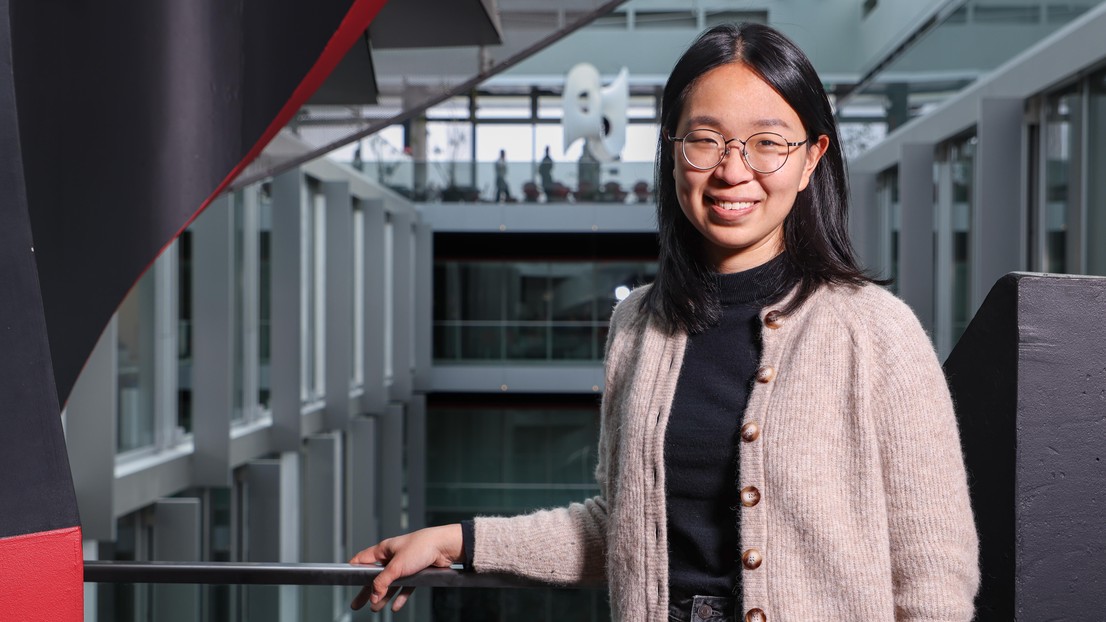
Yihui Quek © 2026 EPFL/Alain Herzog - CC-BY-SA 4.0
Quantum computing is often sold as a magic bullet that will quickly solve today’s intractable problems. Yihui Quek prefers to balance this optimism with scientific rigor, and instead ask the question: what do we want a quantum computer to be good for?
In 1993, before any quantum computer had appeared in a laboratory, Peter Shor came up with the now-famous “Shor’s algorithm” for factoring numbers, meaning that once quantum computers are built, they could run Shor’s algorithm to crack the encryption used to protect our important personal and financial data. This algorithm has become the focus of a lot of discussion and concern regarding quantum computing.
For Yihui Quek, assistant professor at EPFL’s School of Computer and Communication Sciences and School of Basic Sciences,who worked with Peter Shor during her bachelor’s and postdoc at MIT, Shor’s algorithm is less a destination than a signpost: a proof that quantum mechanics can change the rules of computation. This has led her to focus on identifying, beyond breaking cryptography, what are the important problems that should actually be run on quantum computers.
Engineering meets fundamentals
Quek, who joined EPFL last year, grew up in Singapore as the only child of a primary school teacher and an engineer. Singapore shares similarities with Switzerland, according to Quek, in that as a small country embedded in a global network, pragmatism and adaptability are crucial for survival. “Growing up, I learned to prize the engineering mindset, but I also wanted to understand the laws of nature,” she says. This led her to attending MIT, where she majored in physics. Having completed her degree requirements ahead of time, she decided to add a mathematics major on a whim, eventually culminating in a bachelor’s thesis with Shor. This was when the lofty abstractions of mathematics came calling. “I was enraptured,” she says.
Today this mix of influences is reflected in her research. Quek is tackling quantum error correction and algorithm development, which are some of the most challenging problems in quantum computing. She operates at the seam between the abstract theory of ideal, noiseless quantum processors and the experimental reality of noisy quantum devices. “To do this, I need to build bridges between the theory and experimentation of quantum computation, two research communities that don't really talk to each other when they should be talking much more!”
From hype to a playbook
Quantum computers differ from classical computers in that they operate on qubits (quantum bits) instead of bits. In principle, quantum effects can make certain, but not all, computations dramatically faster than any known classical method. Yet, the reality is far removed from this ideal: the quantum computers in existence today are in a very imperfect form and beset by errors. They are too small to run useful algorithms. But progress is moving quickly.
“Quantum computing is at an inflection point,” she explains. “In 2019, we saw for the first time experiments on a quantum processor that provably pushed beyond what could be done with classical computers. It was a huge confidence booster that maybe quantum computers, which had previously only existed in theory, could actually be realized in practice.”
Between 2019 and 2023, as early “quantum advantage” demonstrations captured headlines, noise was still the dominant obstacle, and optimism often ran ahead of what the devices could reliably support. Prior to coming to EPFL, Quek’s instinct was to slow the story down by putting mathematics between claims and conclusions. Researching the weaknesses of small and error-prone quantum computers, her findings led scientists around the world to rethink a popular workaround called “error mitigation,” which was used as a substitute for true error correction. She showed that while this method might help in very small systems, it won’t be sufficient as quantum computers grow larger and include more qubits.
Today, that tone is shifting. Experimental demonstrations of error correction have convinced Quek that there is a credible route to scaling up quantum processors. With that in mind, her attention is shifting toward the next question: if and when we can keep errors under control, what compelling problems should quantum computers tackle?
At EPFL, she is developing new quantum algorithms — and the strongest possible classical baselines to compare them against — aimed at answering that “what are they for?” question. “We’re moving from ‘can we run anything at all?’ to ‘what should we run that actually matters?’” she says. “And we should be ambitious about that question.”
That mix of ambition and rigor is also why EPFL appealed to her. “I thrive in environments where the rules aren’t fixed,” she says. “EPFL felt like a place that’s small enough to be dynamic, but serious enough to build something new.”