
Hybrid photonic chips reach 581 Gbit/s
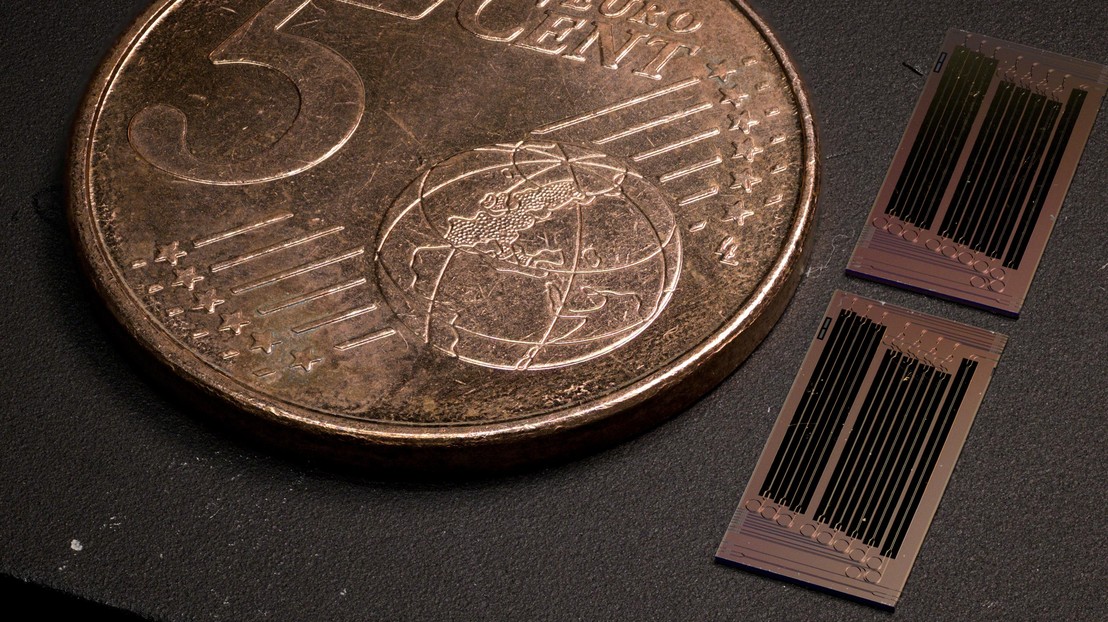
The photonic chips next to a €5 coin. Credit: Hugo Laroque ©2026 EPFL
A wafer-scale bonding method developed at EPFL enables ultrafast optical modulators by bonding lithium tantalate onto 100-millimeter semiconductor wafers of silicon nitride, supporting data rates above 500 Gbit/s.
Data centers, artificial intelligence systems, and high-speed networks depend on electro optic modulators. These devices convert electrical signals into light pulses for transmission through optical fibers. As data volumes increase, modulators must deliver higher speeds while remaining stable and manufacturable at scale.
Silicon nitride photonic integrated circuits offer low optical losses and compatibility with established semiconductor fabrication. However, silicon nitride does not provide efficient electro optic modulation. Ferroelectric materials such as lithium tantalate do, but integrating them with foundry-compatible platforms has posed major manufacturing challenges.
Now, researchers at EPFL, the Shanghai Institute of Microsystem and Information Technology and the Karlsruhe Institute of Technology (KIT), have developed a wafer-scale process to bond thin films of lithium tantalate onto silicon nitride photonic circuits. The work was led by Tobias J. Kippenberg (EPFL) and Christian Koos (KIT), and is published in Nature Communications.
The team fabricated silicon nitride circuits using a high-yield photonic Damascene process, a technique for fabricating low-loss silicon nitride waveguides—microscopic channels that confine and guide light across a chip.
They then bonded a 300-nanometer lithium tantalate thin film across 100-millimeter wafers. The approach avoids aggressive plasma etching of the ferroelectric layer, which can degrade device performance and complicate large-scale production. The result is a hybrid platform compatible with high-volume semiconductor manufacturing.
The chip guides light efficiently while allowing it to be switched on and off at extremely high speeds. Light travels through the microscopic waveguides with little loss, meaning the signal remains strong over distance.
To test what this means in practice, the researchers used the devices to send real data through optical fibers. With one transmission format, they reached 333 gigabits per second. With a more advanced format used in long‑haul and data‑center links, they reached 581 gigabits per second. These data rates fall within the performance range required for modern AI data centers.
The modulators also show stable operation under direct current bias. Over one hour of measurement, output power drift remained below 0.5 dB. Lithium tantalate offers lower birefringence and improved bias stability compared with lithium niobate, which helps preserve signal integrity in complex systems.
By combining wafer-scale bonding with a mature silicon nitride process, the platform addresses key barriers that have limited ferroelectric photonics. It reduces contamination risks associated with processing ferroelectrics inside CMOS foundries and improves fabrication repeatability by minimizing patterning of the ferroelectric film.
These capabilities open the door to applications such as electro optic transducers, on-chip microwave oscillators, and tunable LiDAR systems. Beyond high-speed connections in data centers, the platform supports radio frequency photonics and microwave to optical conversion. Its compatibility with established silicon nitride manufacturing offers a route toward scalable production of ultrafast electro optic devices.
The photonic integrated circuits were fabricated at the EPFL Center of MicroNanoTechnology. The lithium tantalate on insulator (LTOI) wafers were fabricated in Shanghai Novel Si Integration Technology and SIMIT- CAS.
Other contributors
Swiss National Science Foundation (SNSF)
European Union Horizon Europe program
German Research Foundation (DFG)
Shanghai Science and Technology program
Jiachen Cai, Alexander Kotz, Hugo Larocque, Chengli Wang, Xinru Ji, Junyin Zhang, Daniel Drayss, Jiale Sun, Shuhang Zheng, Xin Ou, Christian Koos, Tobias J. Kippenberg. Heterogeneously integrated lithium tantalate-on-silicon nitride modulators for high-speed communications. Nature Communications 28 February 2026. DOI: 10.1038/s41467-026-69769-3