
Greener labs, high-quality science: EPFL's sustainability push
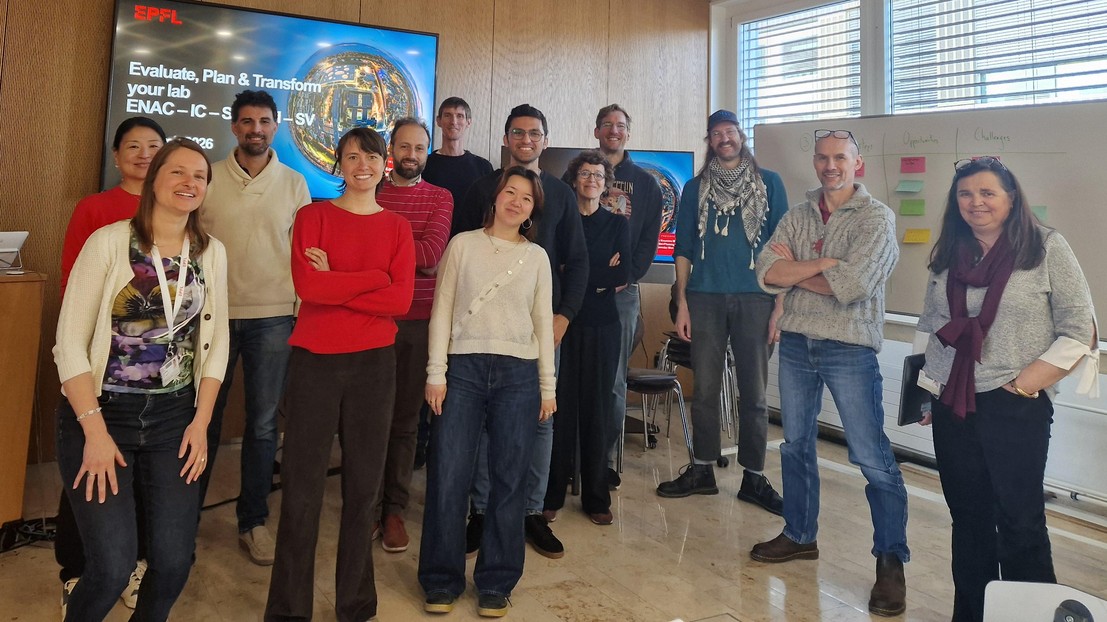
Closure Sustainability journey (17.03.2026) Credit: Anna Kounina Massé © 2026 EPFL
A six-month sustainability program developed by sustainability managers from three faculties equips researchers to identify and reduce the environmental impact of daily lab practice.
There is no doubt that scientific research plays a central role in addressing global challenges. Nonetheless, lab work itself can have a significant environmental impact.
EPFL’s own Climate and Sustainability Strategy aims at a 40% reduction in greenhouse emissions by 2030, and to achieve net-zero emissions by 2040, in line with Swiss federal targets. To meet that goal, EPFL has formed the Green Labs initiative to ensure that “all EPFL laboratories conduct environmentally and socially responsible research without compromising research quality and that all laboratory practices are aligned with planetary boundaries”.
In September 2025, thirteen labs and research platforms across all of EPFL’s schools joined the “Evaluate, Plan and Transform Your Lab” initiative, a six-month, hands-on program designed to rethink how research is conducted and aimed at embedding sustainable practices into everyday lab work.
Supported by Sustainability Managers from the schools of basic sciences, engineering and life sciences as well as from the Centre of MicroNanoTechnology (CMi) platform and Laboratory of Semiconductor Materials laboratory (LMSC), the participants adopted the roles of “Sustainability Ambassadors” and worked together towards a shared vision of reducing the environmental footprint of research activities while maintaining scientific excellence.
“Evaluate, Plan and Transform Your Lab”
The program begins with evaluation: labs assess their environmental footprint, looking at energy use, procurement, waste and digital infrastructure. The goal is to identify the main sources of emissions and define priorities for mitigation. This step makes use of the EPFL CO₂ Calculator, an open‑source, web‑based tool scheduled for deployment in autumn 2026.
The next step is to plan: using dedicated tools and institutional resources, the Sustainability Ambassadors develop action plans tailored to the research activities and profile of each lab, and selected measures that combine environmental impact, feasibility, and cost-effectiveness. Laboratories may also choose to go through a sustainable lab certification, such as LEAF (Laboratory Efficiency Assessment Framework), Green DiSC, or the upcoming SPARKHub certification scheme.
This step often involves discussions within research teams to align priorities and encourage engagement.
Finally, labs transform their practices: they implement concrete changes in day-to-day operations, from procurement choices to waste management, and fostering a culture of sustainability within the lab environment.
Building a community of practice
Beyond individual labs, the “Evaluate, Plan and Transform Your Lab” initiative is also building a network committed to sustainable research. Participants exchange experiences, share solutions, and support one another through peer learning.
Education and awareness are also key. Workshops and community events help disseminate good practices and engage the broader EPFL community in the transition towards more sustainable research. A new workshop is already planned to extend the Green Labs methodology and continue supporting labs reduce their environmental impact.
Participating labs
