Gilbert Hausmann Award - 2025 - Nick Sauerwein
Crédit : Mohammad Bereyhi
A Cavity-Microscope for Quantum Simulations with Locally-Controllable All-to-All Interactions
EPFL thesis n°10108
Thesis director: Prof. Jean-Philippe Brantut
For his contributions to the development of the cavity-microscope, which combines high-aperture optics and cavity quantum electrodynamics in a new way, and for using this tool for quantum simulation experiments using cold atoms.
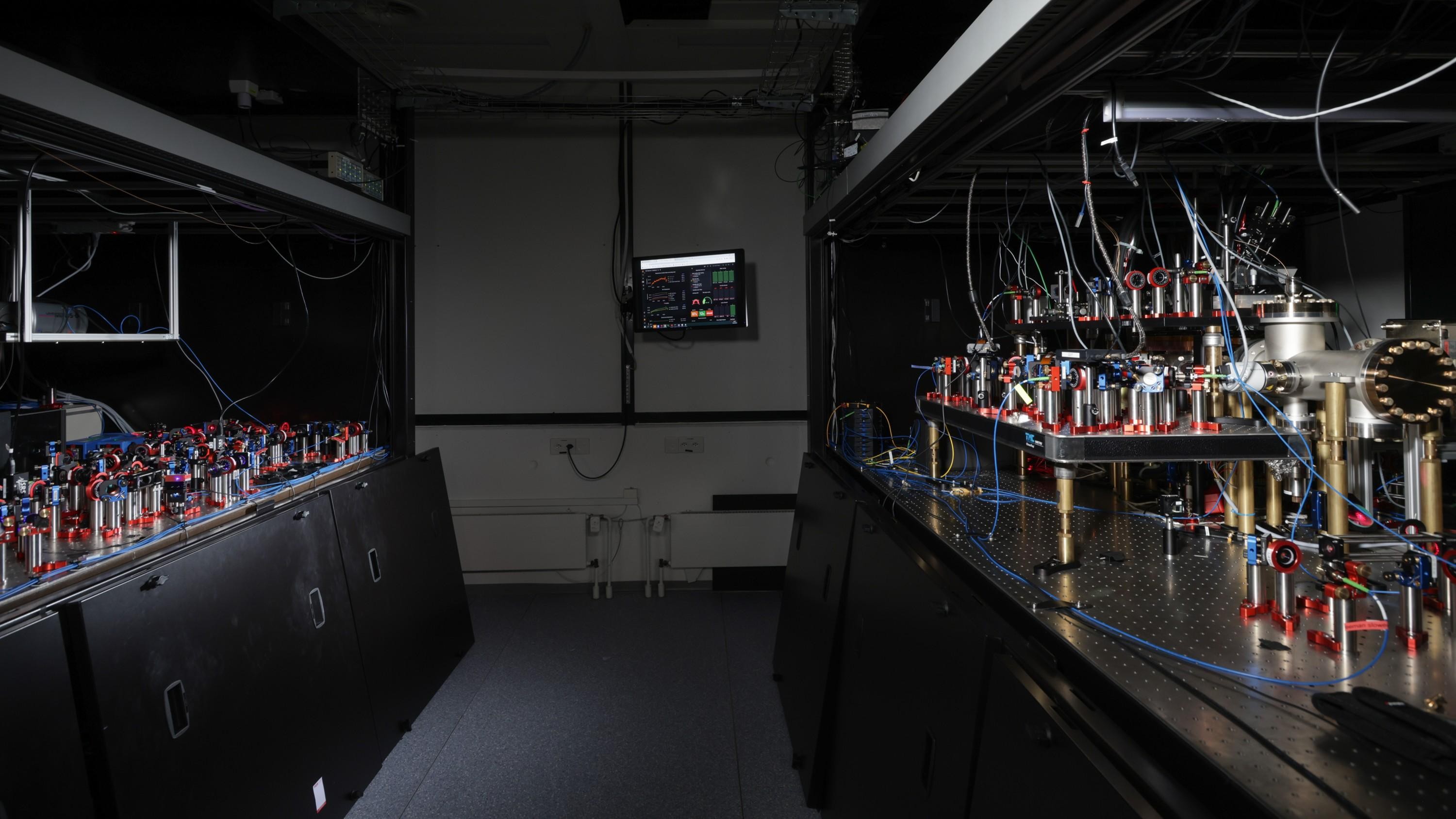
This thesis introduces an innovative experimental platform combining cold fermionic atoms with locally controllable light-matter interactions, facilitated by a novel device, the cavity-microscope. This device integrates a high-finesse cavity with a high numerical aperture microscope, enabling strong photon-atom interactions and precise spatial engineering of atomic optical properties. We detail the design and fabrication of the cavity-microscope, emphasizing its vibration-damping platform and the advancements in our next-generation model. The Hamiltonian governing our system is described, highlighting measurement techniques that allow real-time analysis of atomic cloud properties, such as atom count and temperature, via the cavity’s dispersive shift. Our cavity-microscope demonstrates the ability to manipulate light-matter interactions, inferring the 3D density profile of the atom cloud through scanning probe techniques. Control is achieved using Floquet and wavefront engineering, with optical aberrations corrected by a spatial light modulator. We realize an all-to-all interacting, disordered spin system, exploring interaction-disorder competition and disorder-induced coupling breakdown. Finally, we examine the requirements for controlling high-rank cavity-mediated interactions, essential for accurate quantum simulations of quantum gravity via the Sachdev–Ye–Kitaev model, supported by robust numerical experiments.