Gilbert Hausmann Award 2020 – Dmitrii Unuchek

© 2020 Dmitrii Unuchek
Spin-valley optoelectronics based on two-dimensional materials
EPFL thesis n°7473 (2019)
Thesis director: Prof. A. Kis
For ground-breaking work on the realization of the first room-temperature exciton transistor and exceptional contributions to the understanding of exciton transport in two-dimensional semicondcutors.
Two-dimensional (2D) materials have attracted great scientific interest over the last decade, revealing exceptional mechanical, electrical and optical properties. Subnanometer-thick single-layer forms of these crystals represents an ultimately scaled down platform for further miniaturization of electronic devices. Indeed, the large family of 2D materials contains hundreds of members, including metals, semiconductors, insulators, and others, covering the whole spectrum of potential applications. Availability of all necessary building blocks for the construction of all-2D solid-state devices makes this platform ideal for fabrication of ultrathin, transparent and flexible devices.
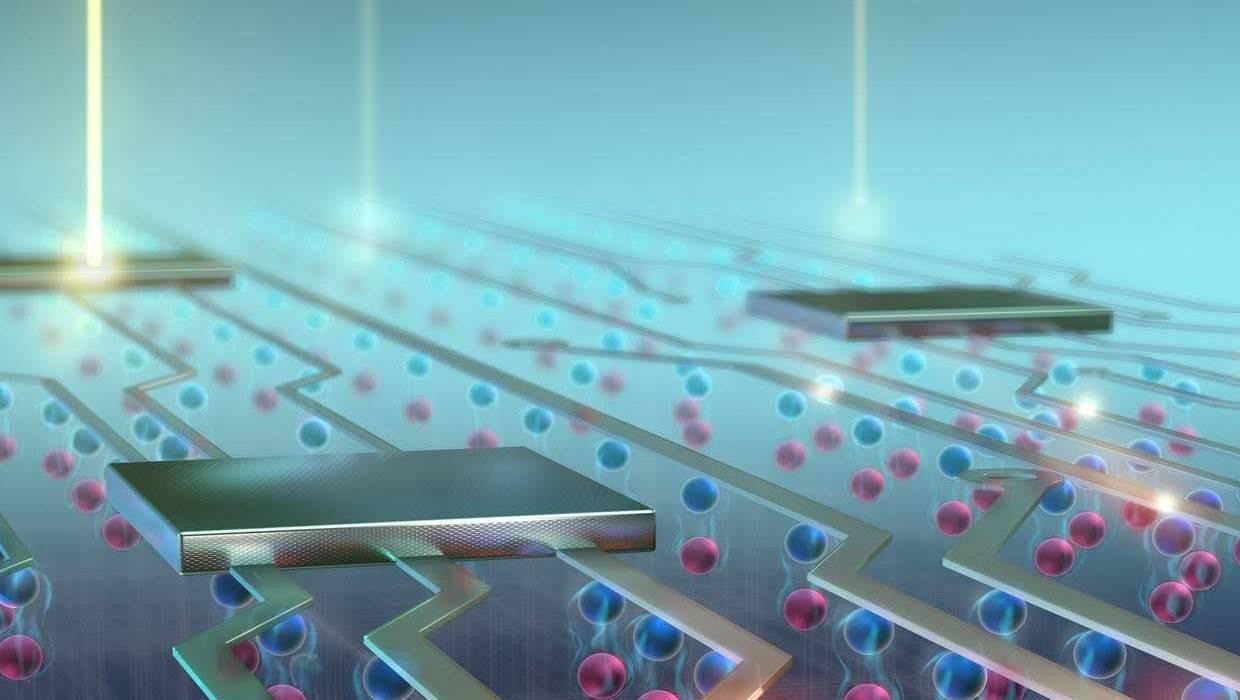
This thesis explores monolayers of semiconducting 2D materials for realization of novel optoelectronic devices. First, we demonstrate atomically thin light emitting diodes and ultrasensitive photodetectors as building blocks for use in electrical-to-optical interconnects. Next, we study spin and valley degree of freedom of charge carriers in these materials and employ these degrees of freedom for realization of complex spin-valley devices for new generation computational devices. Finally, we investigate interlayer excitons, electron-hole pairs hosted by heterostructures of 2D semiconductors. We use these quasiparticles as well as their peculiar properties for realization of exciton-based optical switches. We further develop excitonic devices to demonstrate a valley-excitonic transistor – new-generation quantum device based on valley-encoded information.