From Preservation to Openness: Building Data and Open Science

© 2025 EPFL
The “Digitalizza la cultura 2025” conference offered the ACM an opportunity to share their experience in the preservation and promotion of digital architectural archives.
Echoing the EPFL Data Week and the World Digital Preservation Day, these reflections continue to evolve at the crossroads of research, technology, and digital practices.
Created in the late 1980s within what is now the ENAC School at EPFL, the Archives de la construction moderne (ACM) are dedicated to collecting, preserving, and providing access to the archives of architects, engineers, and other key figures in the construction field. Positioned at the intersection of cultural heritage and scientific research, they fulfill a dual role: preserving a highly valuable technical and cultural record while translating preservation requirements into forms of access and reuse that align with contemporary research practices.
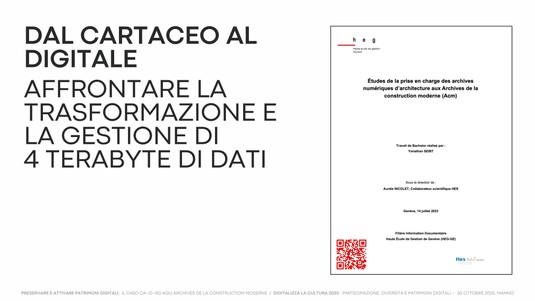
From Paper to Digital: Meeting the Challenge of Transforming and Managing 4 Terabytes of Data
This work takes place within a context of profound digital transformation affecting society as a whole—and particularly the fields of architecture and engineering. While the archives received until recently were almost exclusively on paper, the acquisition of collections from a new generation of professionals who have worked in digital environments and are now reaching the end of their careers marked a turning point. Since 2020, new accessions have often been hybrid, combining analogue documents and digital files. To support this transformation, a study conducted as part of a Bachelor’s thesis in Information Science at the Geneva School of Business Administration (HEG) led to an analysis of these new collections, revealing over 4 terabytes of data distributed across servers and 430 CD-R/DVD-R media.
This analysis provided a concrete diagnosis and the first recommendations toward a sustainable digital preservation strategy tailored to architectural archives.
Dimensions of Digital Preservation: Obsolescence, Instability, Data Integrity, and Access
One of the main challenges encountered is the obsolescence of digital formats. Unlike paper documents, which remain readable for decades if properly stored, digital files depend entirely on the hardware and software used to create them. As formats and applications evolve rapidly, older files can become unreadable. To ensure long-term accessibility, it is therefore necessary to periodically migrate data into open, sustainable formats. Added to this is the fragility of storage media: servers, CDs, and hard drives may deteriorate or become obsolete, which makes regular monitoring, backup copies, and systematic integrity checks essential.
Preserving a digital file therefore means not only saving its content but also maintaining its interpretive context—the set of metadata describing its structure, provenance, and visualization logic—to ensure its intelligibility and documentary value over time.
Architectural Digital Archives: Complexity, Formats, and Technological Dependencies
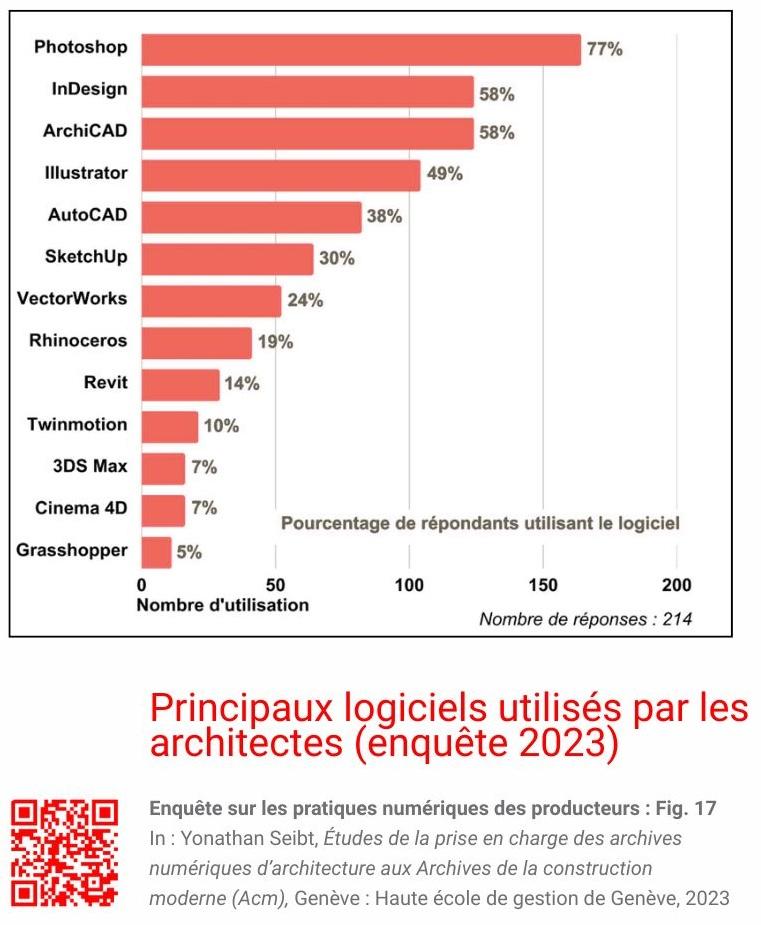
Today, architectural digital archives encompass a wide variety of formats: technical files, 3D models, images, PDFs, office documents, and more. The analysis of two recent hybrid collections—Renato Salvi (402 GB, 144,000 files) and Rodolphe Luscher (516 GB, 151,000 files)—illustrates this complexity, highlighting the need to preserve not only the files themselves but also their interpretive context and metadata. With the widespread use of computer-aided design (CAD) software and, more recently, building information modeling (BIM) systems, architectural production has undergone a profound transformation. Each CAD file, for instance, may contain multiple layers (structures, systems, finishes, furnishings), often linked to external libraries or cross-references, making it difficult to identify an original or final version. This evolution has provided new capabilities for simulation and analysis but also strong technological dependencies that pose serious challenges for file longevity.
The CA–O–RD Project: Contemporary Architecture – Open Research Data
It is within this context that the CA–O–RD project was launched in 2024, supported by the Open Research Data (ORD) program of the ETH Domain and by the ENAC-IT4Research unit, which provides the technical and IT support required to develop and implement the digital infrastructure. The project is built around two complementary tools: Morphé/AtoM, an archival description platform compliant with international standards and adopted in 2018, and Archivematica, a long-term digital preservation system based on the OAIS (Open Archival Information System, ISO 14721) reference model, which defines principles ensuring the authenticity, readability, and accessibility of digital content over time. This open-source software implements these principles through an automated processing chain: each incoming file is verified, its format identified, and, if necessary, converted into a stable and open version. The process concludes with the creation of an Archival Information Package (AIP) containing the file and its metadata, and a Dissemination Information Package (DIP) linked to the archival descriptions in Morphé/AtoM, ensuring the coherence, traceability, and intelligibility of the preserved documents.
Metadata as a Research Resource: Practices and Perspectives
 With the full integration of Archivematica and Morphé, the CA–O–RD project is entering a new phase focused on leveraging metadata as a resource for research. In line with the principles of open science, the ACM are drawing inspiration from the FAIR principles (Findable, Accessible, Interoperable, Reusable) to structure and open their digital data. The goal is to make metadata more coherent, readable, and reusable: to eliminate redundancies, harmonize descriptive language, extract key entities, and link them to controlled vocabularies—thus strengthening semantic interoperability and machine readability, both prerequisites for integration into research data ecosystems.
Through this initiative, the institution is equipping itself with a sustainable tool for managing, structuring, and enhancing the digital heritage of contemporary architecture. Beyond preservation, this framework paves the way for new forms of interdisciplinary research and knowledge production based on data quality and reusability.
Organized on the initiative of the Dipartimento dell'educazione, della cultura e dello sport (DECS) of the Canton of Ticino, Divisione della cultura e degli studi universitari (DCSU), and implemented by the Ufficio dell’analisi e del patrimonio culturale digitale (UAPCD),
in collaboration with the Bachelor’s program in Leisure Management at the University of Applied Sciences and Arts of Southern Switzerland (SUPSI).
A project by the Archives de la construction moderne (ACM) of EPFL’s ENAC School, in collaboration with the ENAC-IT4Research unit.
Team:
– Salvatore Aprea (2024–08.2025), Director – ACM; Cyril Veillon (09.2025–), Director – ACM/Archizoom
– Yonathan Seibt (2024), Kethsana Muong (2025), Barbara Galimberti (2024–), Archivists – ACM;
– Hugo Solleder (2024–), Research Software Engineer – ENAC-IT4R; Nicolas Dubois (2024–), ETS/HES Engineer – ENAC-IT