
From Glaciers to the Alps: Decades of Climate and Glaciology Research
© 2025 EPFL
Jérôme Chappellaz has spent decades drilling into some of the world's most extreme environments, from the depths of Antarctica to the heights of the Bolivian Andes. Now, as Academic Director of ALPOLE (Alpine and Polar Environmental Research Center) and EPFL professor, he's bringing that expertise to the Swiss Alps. This article is a re-transcription of the 2024 “Fil Rouge” interview of Jérôme Chappellaz.
EThe mountains and the poles have much more in common than one might think. Both environments contain the cryosphere, water in its solid state as ice, frozen soil, and snow. The physical and chemical properties we study are remarkably similar, whether at the poles or in high mountains.
A Journey from Volcanoes to Ice
Chappellaz's path to glaciology began with an unexpected inspiration. At four and a half years old, he watched Neil Armstrong take his first steps on the moon.
It triggered a desire for discovery and understanding,
A childhood fascination with volcanologist Haroun Tazieff set him on course for a career in Earth sciences. From volcanic rocks, his interest shifted to ice. Since 1988, he has led over twenty expeditions to Antarctica and the Arctic, extracting cylindrical ice cores that serve as time capsules of Earth's climate history.
Reading Earth's Climate History
Ice cores are far more than frozen water.
A glacier is like a book. When we drill through it, we retrieve a history book that tells us about past climates and Earth's environment.
The breakthrough came from French scientist Claude Lorius, who in 1965 noticed bubbles fizzing in his Antarctic ice-chilled whisky. Those tiny air bubbles, trapped in ancient ice, contain fossilized samples of past atmospheres. Today, scientists can reconstruct greenhouse gas concentrations from up to 800,000 years ago, revealing eight complete cycles of glaciations and warm periods. The most profound insight? Ice cores have definitively shown that greenhouse gases like carbon dioxide, methane, and nitrous oxide naturally contributed to past climate cycles. The difference today is the unprecedented speed and scale of human-caused emissions.
The Race Against Time: Ice Memory Foundation
In 2015, Chappellaz co-founded the Ice Memory foundation, a project born from an urgent realization: glaciers are disappearing, taking their irreplaceable climate archives with them.
We glaciologists work with this raw material and realize we've only just begun to decipher its alphabet. There are probably still countless letters left to discover.
The Ice Memory Foundation aims to collect ice cores from threatened glaciers worldwide and preserve them in an Antarctic sanctuary for future generations. The logistics are daunting. During a 2015 expedition to Bolivia's Nevado Illimani at 6,300 meters altitude, a team of forty porters carried 30 kilograms of ice each down the mountain, walking at night along fixed ropes to keep the samples frozen. Not every mission succeeds. Chappellaz recalls his first Antarctic expedition in 1988, when 700 meters of carefully collected ice core melted in a shipping container at Le Havre after dockworkers failed to plug it in over a weekend.
Two years of work, gone
Smart Sensors for Extreme Environments
At EPFL, Chappellaz leads a laboratory developing intelligent sensors for extreme environments, leveraging the institute's exceptional engineering capabilities. His current focus: measuring greenhouse gas emissions from aquatic environments, particularly in Greenland's transforming fjords. During a recent expedition aboard the Swiss research vessel Forel, his team studied how fjords are changing as glaciers retreat from floating on water to receding onto land.
This transforms matter transfer from soil to fjord, impacting biological activity, fish, algae, everything. We're trying to quantify whether these transformations will increase or decrease greenhouse gas emissions.
One surprising discovery: methane concentrations 1,000 to 10,000 times higher than atmospheric levels deep beneath Greenland's ice sheet, likely produced by microbes in the underlying soil and potentially being released as glaciers melt.
Science Meets Mountain Wisdom
Despite his scientific credentials, Chappellaz is cautious about the limits of expertise.
I don't have a scientistic approach claiming science has all the answers. We need common sense alongside science to quantify phenomena and provide good solutions.
He draws a clear line between his roles as scientist and citizen.
Scientific discourse has value and weight as long as it remains neutral. We're here to establish facts, a form of truth through observation. When we start adding partisan connotations, we lose that objectivity.
Instead, he advocates for dialogue between scientists and those who work the land daily.
Farmers have daily experience with soil. Their voice is extremely valuable. I can't conceive of scientists imposing their methods on farmers. We must enter into dialogue and find the best compromises, the best ways forward.
This philosophy echoes lessons from his polar expeditions, where boilermakers, mechanics, and cooks proved as essential as scientists, like the welder who improvised a tool to rescue equipment stuck 120 meters down a borehole.
On expeditions, there's a flattening of the social pyramid. Everyone's competence matters because life hangs by a thread, and it depends on skills distributed across the camp.
The Future of ALPOLE and Alpine Research
EPFL's decision to establish ALPOLE in Valais reflects both the canton's alpine character and strategic positioning in climate research. The center studies not only ice physics but also practical applications, such as how snow interacts with solar panels in high-altitude renewable energy installations. For Chappellaz, the Savoyard who once feared Valaisans might remember his ancestors' defeat at the Battle of La Planta in 1475, the welcome has been warm.
I love the mountains, this spirit, this attachment to the land. Valaisans know what the earth means and understand the extreme character of mountain environments.
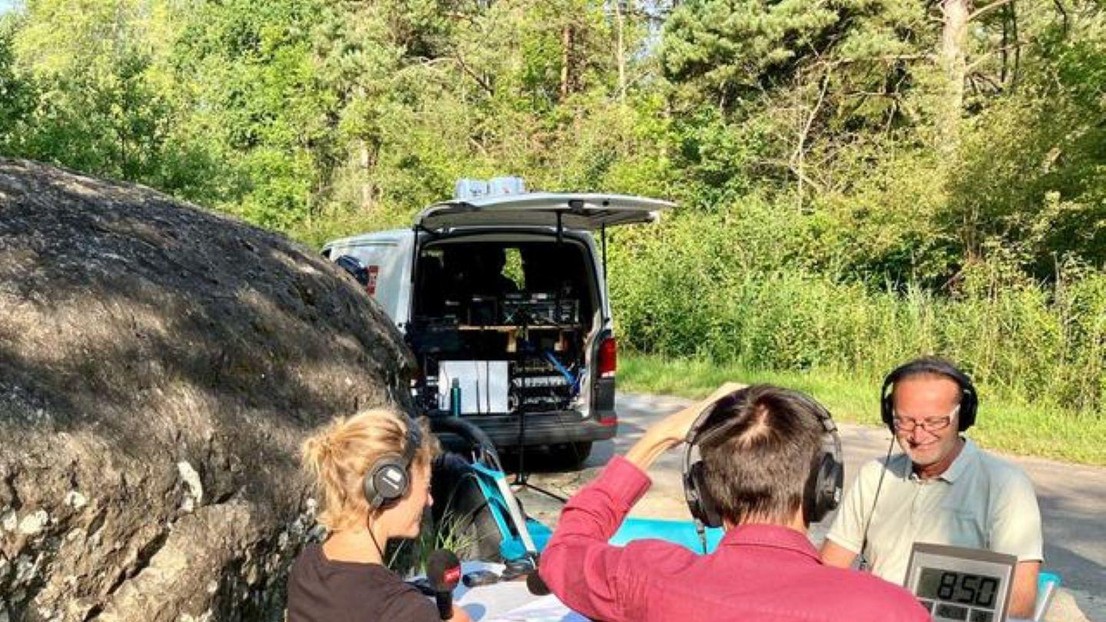
As climate change accelerates, that understanding becomes ever more critical. Standing beside an erratic boulder deposited 20,000 years ago by the Rhône glacier.
Above our heads was a kilometer of ice. No trace of life. And look, in 20,000 years, we're surrounded by forest, a magnificent lake, and life in all its forms.
The question now is what the next 20,000 years will bring, and whether we'll preserve enough of the past to help future generations understand it.