
From African Research to Global Energy Solutions
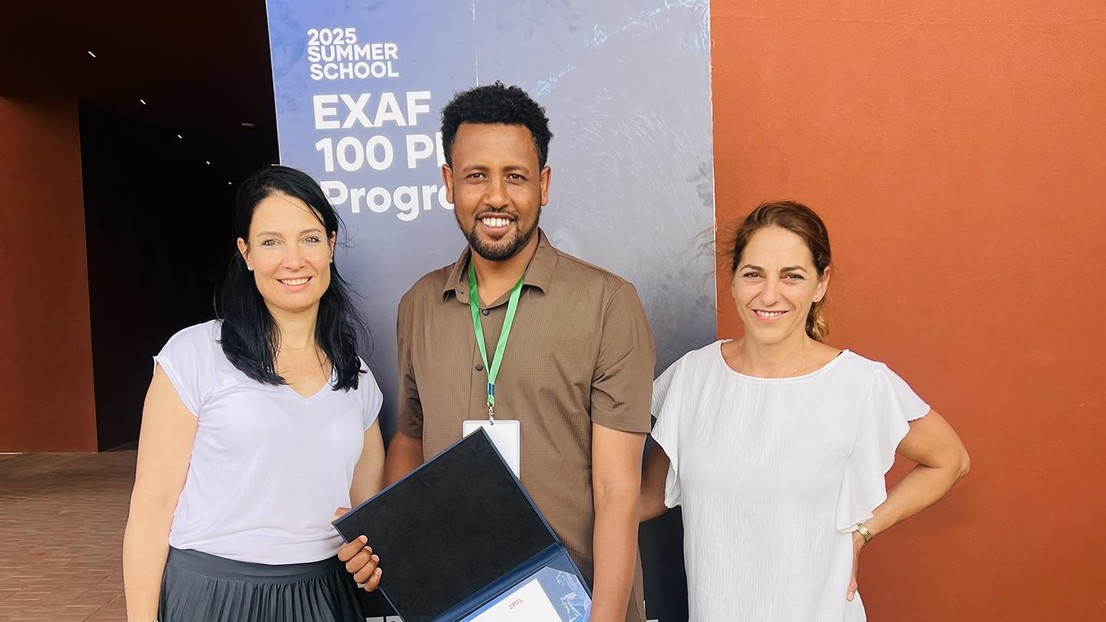
Seyoum Abebayehu (centre) during the 2025 Summer School at UM6P, Ben Guerir. © 2026 EPFL
The ExAF Centre is pleased to highlight a recent scientific publication by Seyoum Abebayehu Getaneh, a beneficiary of the second cohort of the 100 PhDs for Africa programme. This publication illustrates the programme's commitment to strengthening advanced research capacities in Africa and promoting high-impact scientific work that addresses global challenges.
This review article examines recent advances in the use of two-dimensional molybdenum disulfide (2D MoS₂) as an electrode material for supercapacitor applications. Supercapacitors are gaining increasing attention due to their high power density, rapid charge–discharge capability, and long cycling life, making them essential components of modern energy storage systems.
Key scientific contributions
The article highlights the strong relationship between the structural phases of MoS₂ and its electrochemical performance. In particular, it discusses:
The differences between bulk and monolayer MoS₂ and their influence on electronic and electrochemical properties.
The role of the 2H, 1T, and 3R phases, and how phase engineering can significantly enhance electrical conductivity and charge transport.
The impact of intrinsic strategies (phase transformation, defect engineering, and doping) and extrinsic approaches (composite and heterostructure formation) on improving charge-storage mechanisms, rate capability, and cycling stability.
Relevance for sustainable energy
By clarifying the structure–property–performance relationships of 2D MoS₂, this work provides valuable insights for the design of high-performance supercapacitor electrodes. These advances are particularly relevant for the development of efficient, durable, and affordable energy storage solutions to support renewable energy integration.
Read the full article https://pubs.rsc.org/en/content/articlelanding/2026/ra/d5ra08612d
ExAF and 100 PhDs for Africa
This publication illustrates the impact of the 100 PhDs for Africa programme, which supports African doctoral researchers in producing world-class research with local and global relevance. The ExAF Centre remains committed to fostering scientific excellence and innovation that contribute to sustainable development.