
“First-year students ask the same questions as leading scientists”
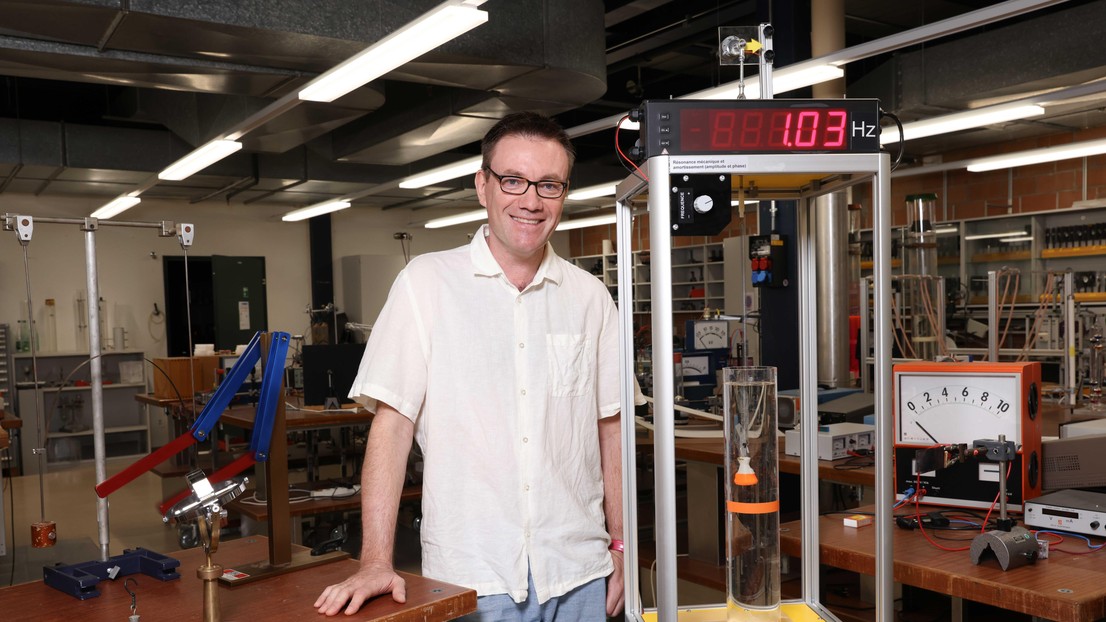
Philippe Müllhaupt, best teacher in the mechanical engineering section for 2025.2026 EPFL/Alain Herzog - CC-BY-SA 4.0
Philippe Müllhaupt, who was named the best teacher in the mechanical engineering Section for 2025, first learned to appreciate teaching thanks to his music theory professor. Although he quickly gave up music, he never lost his enjoyment of sharing knowledge with others.
The first time Philippe Müllhaupt walked into a lecture hall full of EPFL first-year students, he almost turned around and walked right back out. “It was a pretty disconcerting experience,” he says. “It felt like I was in an arena, facing a pack of 400 wild animals.”
Müllhaupt, a lecturer and researcher at EPFL’s automatic controls laboratory, now “loves teaching first-year bachelor’s students! They come to EPFL and attend classes because they want to learn more about science and engage with it. In fact, they ask the same questions as leading scientists, which is stimulating but also a real challenge.”
That’s not a challenge Müllhaupt believes should be left to new teachers, as fielding these kinds of questions requires “knowing the ropes.” He says that “the deeper you go into the basics, the harder the material is to teach. You’ve got to be psychologically adept at this.”
Giving the same lecture twice
Fortunately for Müllhaupt, he wasn’t faced with that challenge early on in his career. When he joined EPFL as a lecturer in 2000 – after having completed a master’s here in 1993 and a PhD in 1999 – he was initially asked to teach master’s level classes. “That was easier because the students had already learned how to work the EPFL way.”
However, things changed in 2013 when EPFL revamped its degree programs and Müllhaupt was assigned to teach some of the large classes for first-year students. “I decided to give each lecture twice so that there would be fewer students attending each one,” he says. That also helped those who were having trouble grasping the material, as they could sit through the discussion a second time.
I teach the old-fashioned way.
A lasting mark
Müllhaupt has always enjoyed sharing his insights with others, a skill that comes naturally to him. His sister, who struggled in math, was the first person to benefit from his predilection for teaching. And when in college, Müllhaupt gave tutoring lessons to earn some extra money. “Even back then, I liked using images to encourage more abstract thinking,” he says. “Once this kind of thinking becomes a habit, it simplifies complex topics and builds bridges between different fields of application.”
Müllhaupt’s music theory professor was also a big fan of abstract thinking. “She managed to do a lot with very little – she was extremely efficient!” he says. “I quickly gave up music but held on to her teaching method and enthusiasm. I believe that a good teacher is one who, without necessarily bringing you to a very advanced level, leaves a lasting mark.”
Other teachers who left a mark on Müllhaupt – and who served as role models – include a professor at Université Paris-Sud, where he completed a Diplôme d’études approfondies (similar to a master’s degree) in signal processing and automated control systems before starting his PhD at EPFL. “This professor was capable of summarizing the previous lecture in just five minutes. That’s something I’ve never been able to do.”
The old-fashioned way
When asked to describe his teaching style, Müllhaupt thinks for a moment before answering: “I teach the old-fashioned way.” His lectures – even those using digital technology – follow a structure based on handwritten reasoning. He generally teaches on the chalkboard, “which puts me at a pace that matches students’ own note-taking,” he says. “During the pandemic I had to write out my lectures ahead of time, but when students watched them online, the content was displayed step by step as I spoke.”
Müllhaupt also points out that “several studies have found a sharp increase in dyslexia among young people due to the excessive use of tablets.” He encourages students to read back through their notes a few hours after each class and write up a clean copy.
Kind, but firm
The atmosphere in Müllhaupt’s classroom is light-hearted: he’s an advocate of “kindness and good listening skills.” That’s reflected in the way he’s always available for his students and happy to answer their questions, guiding them to a solution “when they get stuck.” At the same time, Müllhaupt describes himself as “demanding and firm.” He’s known for being a particularly tough grader. “But being firm doesn’t mean being authoritative,” he says. “It means focusing on knowledge.”
In the era of artificial intelligence, Müllhaupt believes it’s essential for students to gain a full understanding of their field. “We’re seeing a boom in false information and knowledge gaps,” he says. He views AI as an interesting tool, but one that has its share of risks. “The human brain simply isn’t designed to assimilate so much information,” he says. Using this kind of new technology without a solid understanding of the fundamentals “is a little like building a skyscraper on a wobbly foundation.”