
Ferdinand Hofmann, builder of tokamaks
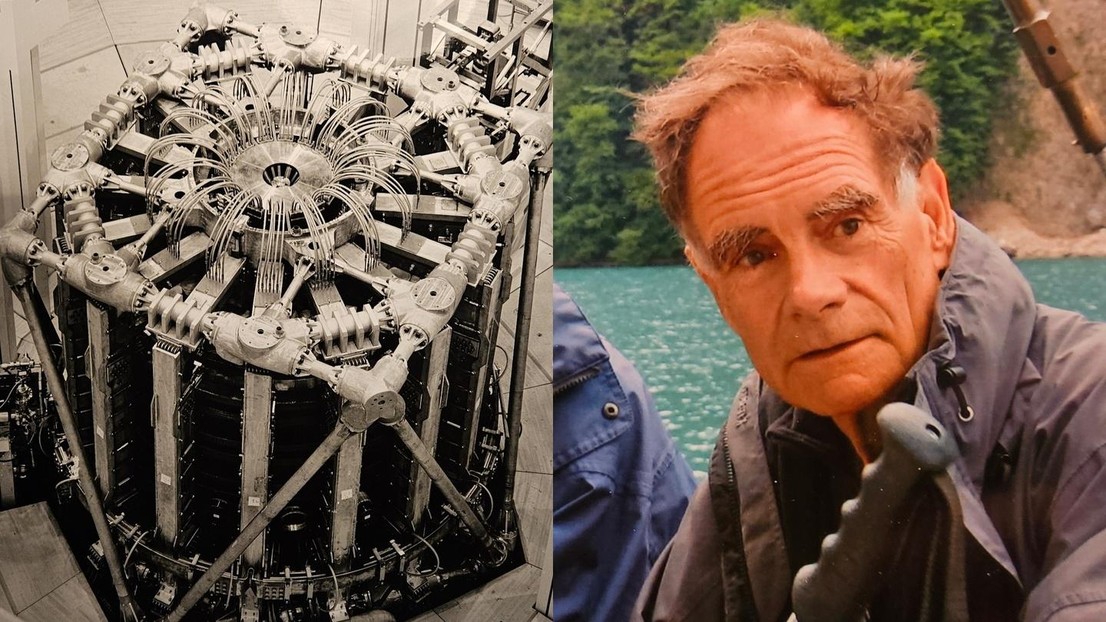
On the left, a photo of TCV, and on the right, Ferdinand Hofmann© 2026 EPFL
An exceptional physicist and engineer, and progenitor of EPFL’s flagship fusion facility - the Tokamak à Configuration Variable (TCV) - Ferdinand Hofmann passed away in December 2025 at the age of 88. A reserved man, he devoted his career to fusion physics research. For nearly 35 years, until retiring in 2002, he left a lasting legacy on the Centre de Recherches en Physique des Plasmas (CRPP), the former name of the Swiss Plasma Center. He was a transitional figure - bridging an era when cutting-edge experimental science still had a distinctly hands-on character to one that has become highly specialised and internationally distributed.
A simple mention of his name is enough to sense immediately that he was one of the figures that truly mattered at the Swiss Plasma Center (SPC). “A great scientist,” “the father of TCV,” “a born teacher, all those who worked alongside him from the late 1960s to the early 2000s, praised his exceptional qualities as a scientist, an engineer and an educator. Ferdinand Hofmann was more than a physicist, mathematician or engineer; he thought and built with all these views. “He was a complete physicist, from planning a machine, building it, overseeing its technical and scientific operation and, ultimately, in interpreting its experimental data,” notes Antoine Pochelon, a former SPC scientist.
Ferdinand was a reference to the whole group for sane commentary upon the good, the bad and the wild ideas that successive groups of young researchers generated
This versatility belonged to a time when research was approached more broadly: computers still played a limited role, and experimental devices were kept simple enough in their design compared to the hyper-specialisation that characterises fusion physics research today. Ferdinand Hofmann’s projects first took shape on paper, where hand-drawn sketches were annotated with formulas and equations. His comprehensive and precise command of the subjects he tackled - reminiscent of a master craftsman working without templates or safety nets - made him an intellectual anchor within the laboratory. According to Basil Duval, a physicist at the SPC, “Ferdinand was a reference to the whole group for sane commentary upon the good, the bad and the wild ideas that successive groups of young researchers generated.” Despite this vast accumulated knowledge, he never showed off.
A quiet guru
That discretion was an integral part of who he was. Basil Duval recalls that Hofmann was “Reserved, to the point of achieving an almost guru-like reputation, spending every lunchtime taking a solitary constitutional walk around the EPFL, he appeared unreachable, and quite possibly invisible, to those that did not know him.” Yet beneath this apparent reserve lay a deep intellectual generosity.
Ferdinand Hofmann experienced all the “major sociological phases of fusion research
“When you asked him a question, he wouldn’t just give a quick answer,” explains Pierre-André Duperrex, a physicist at the Paul Scherrer Institute. “Often only a week or more later would new elements emerge to enrich the discussion. Behind his restraint, there was genuine generosity of mind.” This inherent modesty followed him everywhere. Even those closest to him were often not fully aware of the true scale of his achievements - achievements that were, in fact, considerable.
A career closely intertwined with the history of the CRPP
Ferdinand Hofmann joined the CRPP in 1968 and went on to experience all “the major sociological phases of fusion research.” At that time, and through the late 1970s, research groups remained small: one or two researchers, a thesis supervisor and a doctoral student, Antoine Pochelon recalls. Designing a machine rested on the shoulders of a handful of people that has to master all its scientific and technical needs. Nowadays, the SPC has a staff of close to two hundred.
In that context, three fusion devices emerged from his hands. The first, the Belt Pinch in the 1970s, was a machine that produced short, belt-shaped plasma discharges. It was followed by the Tokamak Chauffé par Ondes d’Alfvén (TCA), commissioned in 1980, and finally the Tokamak à Configuration Variable (TCV), inaugurated in 1992 that is still producing leading-edge results over thirty years later.
From TCA to TCV: a gradual vision
The TCA tokamak, a precursor to TCV but conceived with TCV in mind, was dedicated to the study of plasma heating by Alfvén waves using low-frequency radio waves. Although modest in size and with a circular cross-section vacuum vessel, it provided considerable operational flexibility. “TCA was operated for ten years and is currently enjoying a second life at the University of São Paulo in Brazil,” explains Claude Raggi, a former CRPP mechanic.
He developed an ambitious scientific program, achieving records in both plasma elongation and plasma current density
Ferdinand Hofmann’s involvement in this project was total. “He made major contributions to the design and construction of the TCA tokamak,” says Yves Martin, adjoint to the SPC director. “It was always planned as an intermediate step, to TCV, requested by Europe (EURATOM). As an example of the level of his involvement, he designed the complete magnetic coil array and modelled the forces acting upon it in quiescent and disruptive operation”
Soon after TCA began operation, Ferdinand Hofmann turned his attention to refining the TCV design, a facility capable of operating with a variety of magnetic shapes such as high-elongation. It offered remarkable operational flexibility - unique in the world. “He then developed an ambitious scientific program, achieving records in both plasma elongation and plasma current density” Yves Martin emphasises. Still in operation today, TCV celebrated its thirtieth anniversary a few years ago and continues to generate a large volume of results of the highest scientific value, placing it among the five leading fusion research tokamaks in the European program.
Today, the Tokamak à Configuration Variable does more than deliver top-tier scientific results. With its unique shaping flexibility, it retains the ability to mimic other experimental devices and explore key questions for future fusion devices, that were often not even envisioned thirty or forty years ago. In this sense, this machine, conceived by Ferdinand Hofmann, not only to advances Fusion research, but continues to open new experimental perspectives to the future, to help answer the scientific challenges of the decades to come.