
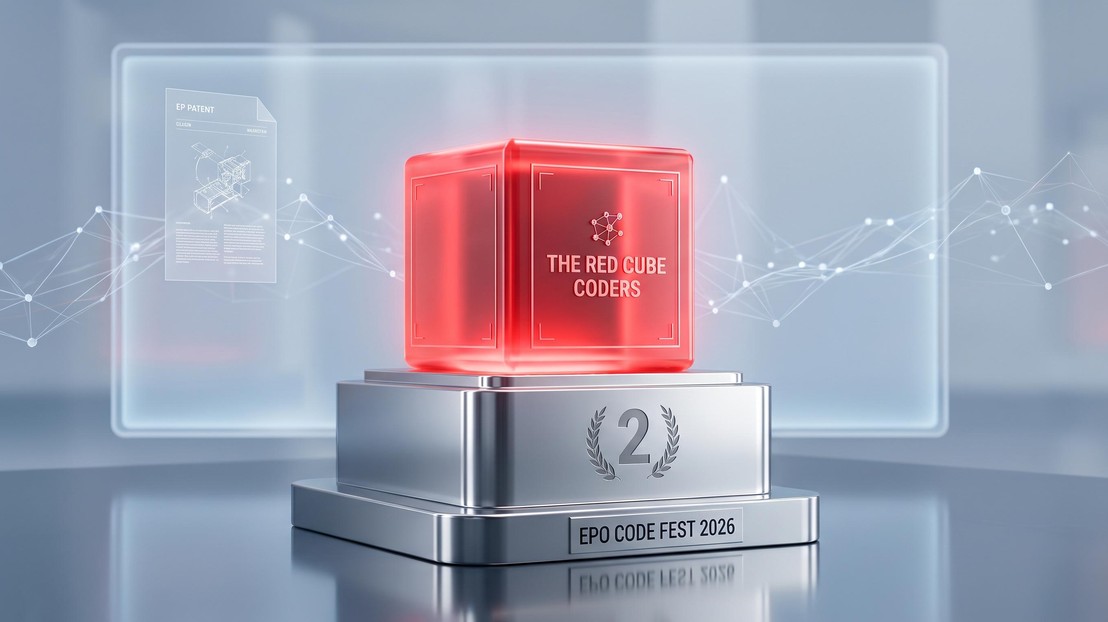
EPFL team takes second place at EPO CodeFest 2026
© 2026 EPFL
Congratulations to the “Red Cube Coders” on winning second place at the European Patent Office’s CodeFest 2026! The team brought together Prof. Gaétan de Rassenfosse (EPFL’s STIP Lab), Reza Hosseini (Marsys.ai, former MTE student), Dr George Abi Younes (Artefact, former EDMT student), Mehdi El Bouari (EPFL, current DS student), and Dr Elena Mas Tur (EPO examiner).
Now in its fourth edition, the EPO CodeFest challenged participants to develop automated solutions for evaluating patent portfolios. The objective was to make patent evaluation more accessible and scalable, helping innovators assess their assets and make informed business decisions. This year, the EPO CodeFest received 23 proposals by teams and individuals from 12 countries.
The EPFL team’s solution introduces two complementary indicators that capture important dimensions of patent value. The indicators provide new information that researchers and practitioners can incorporate into existing patent valuation frameworks.
The blocking score, inspired by the Google IP team, measures how strongly a patent constrains the scope of subsequent patent applications. Using language models, the team estimates how much applicants narrow the protection they seek during examination, then attributes these reductions to earlier patents cited by examiners. The scope reduction measure is inspired by the recent work of Dr. Sébastien Ragot. The blocking score provides a new way to identify patents that occupy technological territory others are seeking to protect.
The commercialization score estimates the probability that a patent protects a product or process that has reached the market. It draws on IPRoduct, a database developed at EPFL that links patents to commercial products. The machine learning approach learns from these documented links while accounting for the fact that commercialization is not always publicly observable.
“Good patent analytics starts with asking meaningful economic questions,” says Professor Gaétan de Rassenfosse. “AI gives us new ways to answer those questions at scale. Our ambition was to develop transparent, reproducible measures that help researchers and practitioners understand how patented inventions translate into economic value.”
This recognition highlights the Science, Technology and Innovation Policy (STIP) Lab’s strength in advancing the frontier of patent analytics. Building on the lab’s research into patent measurement and commercialization, the project demonstrates how economic insight and advances in AI can produce practical tools for evaluating innovation. It also reflects the value of collaboration between EPFL researchers, alumni, and patent practitioners.
