
EPFL Startups 2025: a record cohort
EPFL figures for 2025 © 2026 EPFL
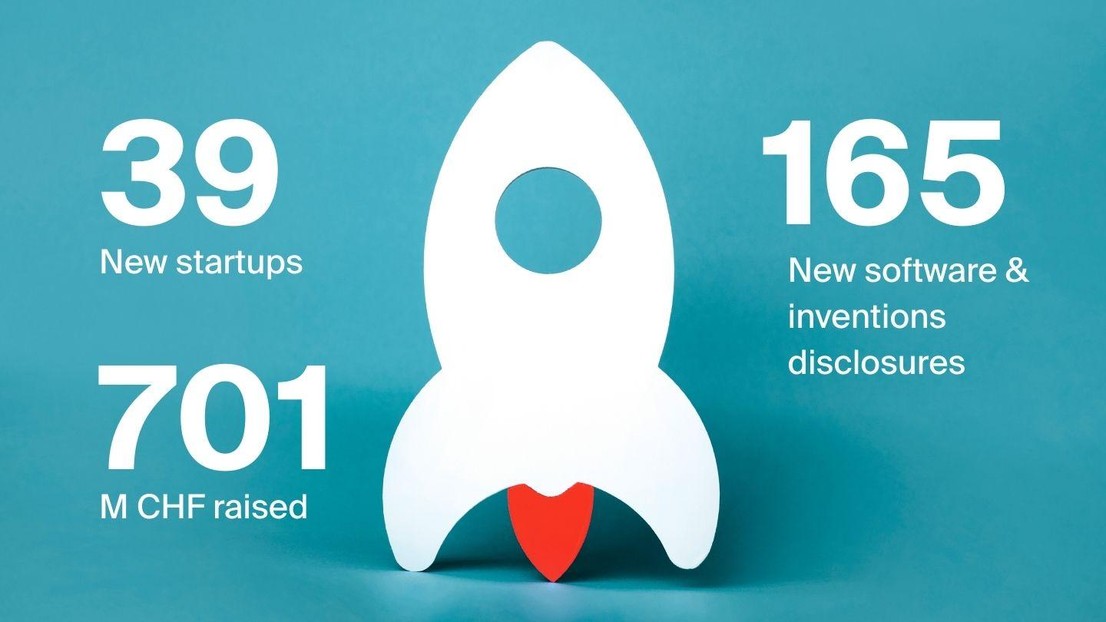
In 2025, as EPFL celebrates the 20th anniversary of the Innogrant program, the School is reaching a historic milestone: 39 startups have been launched, almost double the annual average observed over the past two decades. The entrepreneurial momentum on campus has reached an extraordinary level, confirming the rise of the Swiss deep tech ecosystem.
Launched in 2005, the Innogrant was Switzerland's first program dedicated specifically to deep tech. In the past twenty years, it has awarded more than 200 grants, contributed to the creation of 150 startups, and supported projects that have raised more than CHF 1.8 billion.
This pioneering initiative in Switzerland and Europe has enabled the emergence of disruptive technologies, high-impact companies, and a community of visionary founders. In twenty years, this long-term commitment has become one of the pillars of EPFL's entrepreneurial model. And the impressive growth observed in 2025 is part of that trajectory: it reflects the maturity achieved by a solid ecosystem, marked by record numbers of startups and fundraising.
2025: A record year
With 39 new startups, 2025 stands as the most productive year in EPFL's history. This figure confirms the central role played by research in continuously feeding the deep tech pipeline: year after year, the School's researchers provide the scientific and technological basis that enables the emergence of future startups and scale-ups.
Beyond the creation of new companies, 2025 also stands out for its strong activity in intellectual property and technology transfer, with 165 new software programs and inventions, a rise of around 25% compared with the five‑year average.
Finally, the fields represented in this cohort confirm EPFL's technological diversity. While clear trends emerge in ICT and AI, the cleantech, engineering, and medtech sectors remain equally robust and well-represented.

Significant fundraising and the emergence of global leaders
EPFL startups raised a particularly significant amount of funding in 2025, reaching CHF 701 million. In ten years, these amounts have increased more than tenfold, confirming the attractiveness of EPFL startups to international investors.
Major fundraising rounds in 2025 included:
- Distalmotion (USD 150 million)
- Cyberhaven (USD 100 million)
- Orbis Medicines (EUR 90 million)
- Ecorobotix (USD 105 million)
- Neural Concept SA (USD 100 million)
- Corintis (two rounds for a total of EUR 50.8 million)
- RAAAM Memory Technologies (USD 49 million)
- Bloom Biorenewables (USD 17.5 million)
Some of these companies also illustrate the long timelines, resilience, and determination required in deep tech. Nexthink, founded in 2004 and a unicorn since 2021, reached a new milestone more than twenty years after its creation, with Vista Equity Partners taking a majority stake in 2025, valuing the company at nearly USD 3 billion.
Cyberhaven, now based in the United States, which emerged from Prof. Candea's laboratory, was supported by an Innogrant in 2013 and founded in 2014. It also reached unicorn status in 2025 thanks to a major Series D round.
A comprehensive ecosystem built over time
These results reflect the maturity of an entrepreneurial ecosystem built over time. At the heart of this dynamic, the EPFL Startup Launchpad plays a central role. By supporting projects according to their scientific, technological or entrepreneurial maturity, it enables even the most complex projects to progress toward incorporation and enter the market with the best possible chance of success.
This approach reflects the strength of an ecosystem capable of guiding deep tech ventures from the laboratory all the way to company creation.
EPFL thus confirms its role as a driving force of Swiss and European deep tech, and demonstrates that patience and consistent investment in innovation can produce global leaders.