
EPFL researchers help observe new subatomic particle at CERN
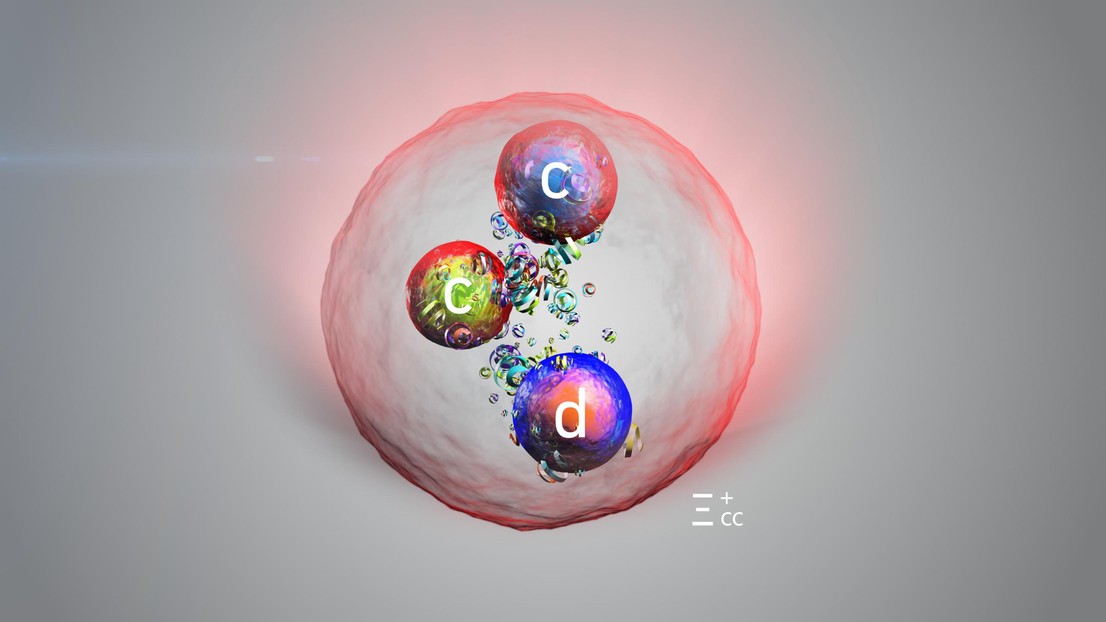
Artist’s impression of the new particle, which contains two charm quarks and one down quark. (Image: CERN)
EPFL researchers have helped observe a new doubly charmed baryon at CERN’s LHCb experiment, a heavier relative of the proton.
CERN and the LHCb experiment have announced the discovery of a new, proton-like particle.
Protons, the positively charged particles in the nucleus of the atom, are only one member of a wider family called baryons. Baryons are made of three quarks. Protons and neutrons contain only light quarks, the up and down quarks. These are the lightest types and make them stable and common.
Other baryons include heavier quarks. These increase their mass and make them short lived, so scientists detect them indirectly through their decay products.
Among the rarest baryons are those with two charm quarks, which offer a clear way to test the strong force, one of the four fundamental forces that binds quarks into hadrons like protons and neutrons, holding atomic nuclei together. However, these “doubly charmed baryons” are harder to detect.
The LHCb collaboration has now observed a new doubly charmed baryon, known as Ξcc+, one of a small number of such particles ever identified. It contains two charm quarks and one lighter quark, making it a heavier cousin of the proton.
EPFL's contributions
Researchers at EPFL’s High Energy Physic Laboratory, led by Professor Laurent Dufour, contributed directly to the result at two critical levels.
First, they helped develop the calibration of particle momentum measurements for the upgraded Run 3 detector. This calibration acts as the fine tuning of the experiment’s measurement system. Any precise measurement of the mass of particles, such as these new baryons, depends on it. This LHCb result is the first to use that calibration of the new detector.
Second, they developed analysis tools that ensure that the quality data of the data can still be improved any time in the future. In this analysis, they enabled the inclusion of about 25 percent more data, strengthening the result.
The LHCb experiment studies particles produced in high energy proton collisions at CERN’s Large Hadron Collider. The new baryon was identified by reconstructing its decay products and looking for consistent signals in large datasets. Careful calibration and data selection were essential to isolate the signal and measure its properties.
Doubly charmed baryons offer a unique way to study how quarks interact inside matter. Their structure differs from that of ordinary baryons, which makes them a strong test of quantum chromodynamics, the quantum field theory describing the strong interaction, one of the four fundamental forces.
The LHCb experiment has recently been largely replaced by a newer version, with substantial contributions from EPFL to essential detectors. “These measurements are a testament to the performance of this new detector in uncovering rare phenomena, which would not have been possible without technological advances,” says Dufour.
Further information:
LHCb presentation at Moriond is available here.
LHCb news article.