
EPFL managers test and adopt meetings in motion
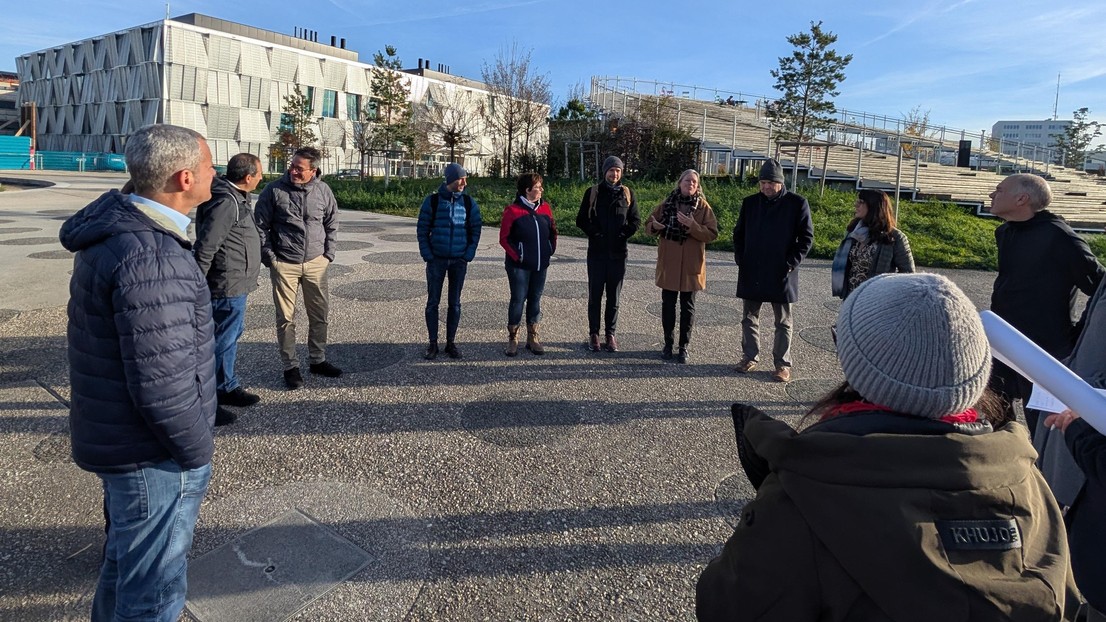
The test group © 2025 EPFL Gaëlle Gander
A dozen unit heads agreed to promote outdoor meetings after trying the practice themselves and listening to two testimonials about its – sometimes unexpected – benefits.
Crises can sometimes spark beneficial solutions. This was evident when listening to Volker Gass, Director of Strategic Initiatives at the Vice Presidency for Innovation (VPI), and Marie-Claude Cialente, Head of Student Affairs at the Vice Presidency for Academic Affairs (VPA). On a bright November morning in 2025, they were invited to share their experiences of Meeting in Motion with a group of other managers, gathered for the occasion by Albertine Kolendowska, Project Manager for Mental Health at the Vice Presidency for Human Development (VPH), Wellbeing and Inclusion department (WINC).
For Volker Gass, it all started during the Covid period in 2021, when a new vice president had just arrived and needed to settle in. “Everyone was fed up with Zoom, and we needed to take a step back. So I suggested to Ursula Oesterle that we go for a walk, since we couldn’t hold in-person meetings. That way, we discovered the many advantages of this method: it allows you to step outside the usual framework, take time without interruptions, dedicate the moment entirely to the other person, and open space for a more emotional perspective. The important things discussed are remembered, and you can always jot down notes afterwards. Walking side by side also creates the physical distance you want, without the intensity of eye contact, which can help with sensitive discussions. Another advantage is that no one else overhears. You can’t slam the door either. It’s a neutral space, infinite because it’s outdoors, yet still protected.”
Neutrality and confidentiality
Marie-Claude Cialente, for her part, has long practiced meetings in motion. “I started back when I was still a smoker: when someone on my team wasn’t doing well, I’d suggest going outside with me. It helps to see things from another angle and be less focused on the problem. Being outdoors also multiplies sensory channels and improves memory. Leaving the office creates a certain neutrality. I’ve continued this practice at EPFL, partly because I don’t have a private office. This way, confidentiality is preserved.”
Being outdoors also multiplies sensory channels and improves memory. Leaving the office creates a certain neutrality.
Invited to a one-hour meeting to test the formula on a specially designed route, the other managers from different vice presidencies listened with interest to these two testimonials. Before setting off, they also received advice from Gaëlle Gander, coach at the UNIL+EPFL Sport Health Service: first to wake up their bodies with morning stretches, then later along the route to practice breathing exercises that promote cardiac coherence.
During the walk, participants were asked to reflect in pairs on the potential benefits of mobile meetings, the obstacles and enablers, and ways to implement the practice within their teams. From the outset, it was made clear that this type of meeting is best suited to small groups of two or three people, and not recommended for larger audiences.
Benefits, obstacles, and enablers
The six manager pairs engaged in lively discussions, stopping three times to share their reflections with the group.
Regarding benefits, participants noted that walking meetings are well suited to brainstorming and decision-making, as they stimulate listening and creativity. Walking side by side encourages deeper thinking and allows silences that would feel less natural indoors. Several agreed that such meetings foster more authentic conversations and make it easier to address delicate issues. But Volker Gass cautioned: “Don’t wait for problems to arise before adopting this system. It’s better to start when things are going well, to build trust.”
Don’t wait for problems to arise before adopting this system. It’s better to start when things are going well, to build trust.
As for obstacles, some mentioned that seeing two people strolling together on campus during work hours could be misinterpreted by onlookers, sparking curiosity or criticism. Hence the importance of legitimizing the practice officially within the institution. For those seeking discretion, routes outside campus were suggested, both to avoid being seen and to minimize distractions.
Three proposed circuits
Managers were introduced to three walking circuits lasting 45 to 60 minutes, designed by Alexandre Saint-Amour, Project Manager for Mobility and Outdoor Spaces at the Vice Presidency for Operations (VPO): the Lakeside Escape, along the lake at Saint-Sulpice; the Countryside Escape, around the fields and football pitches near the Vortex north of campus; and the Belvedere Escape, heading up into the hills of Ecublens to the west.

Participants emphasized the importance of arriving prepared for outdoor meetings, with a clear agenda to stay focused, and the option of recording voice notes to avoid forgetting key points. They also highlighted the need to anticipate weather conditions and adapt equipment accordingly: good shoes for comfort, and one umbrella per person in case of rain, to avoid crowding together.
Starting from Avenue Piccard in the heart of campus, the six pairs stopped at Place Cosandey, detoured via the Estudiantines student housing south of campus, then continued along Route Colladon and the Diagonale, finally arriving near the Coupole. Recognizing that this practice promotes well-being and can improve interpersonal communication, participants stressed the importance of leadership in spreading the habit across the School. When asked, “Who commits to practicing this type of meeting in the future?”, twelve enthusiastic hands were raised.