
“EPFL lets me pursue people and nature.”
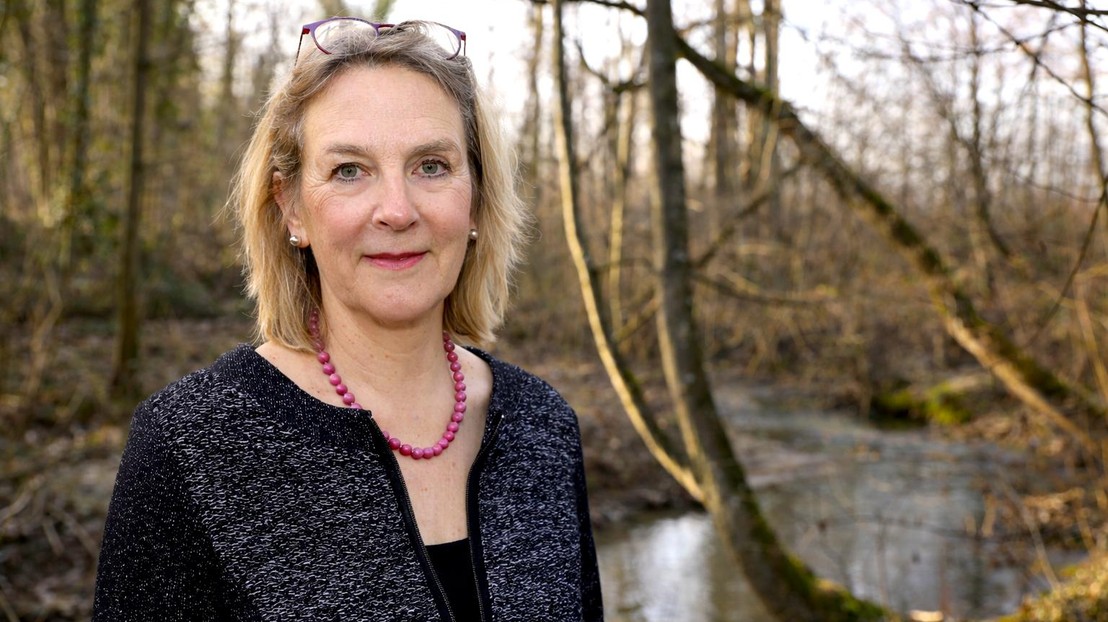
Kristin Becker van Slooten specializes in environmental sciences. She completed her PhD in environmental chemistry and ecotoxicology at EPFL. - 2026 EPFL/Alain Herzog - CC-BY-SA 4.0
Throughout Kristin Becker van Slooten’s ever-rising career – she did her postgraduate studies in environmental sciences and engineering at EPFL when that field was in its infancy, and will step down this year from the ETH Board after a decade of service – she’s hewed to a simple conviction: science must serve the living world.
Kristin Becker van Slooten specializes in environmental sciences. After completing her PhD in environmental chemistry and ecotoxicology at EPFL, she worked first as a scientist and then as a senior scientist, picking up the lead role in a research group along the way. From there she shifted to EPFL’s top echelon, serving as an advisor to Patrick Aebischer and the general secretary. In 2017, she began representing both EPFL and ETH Zurich on the ETH Board and took up the position of project manager for gender equality at EPFL.
“I was born in Hanover, in northern Germany. My mother got out of eastern Prussia as the Red Army pushed in, and my father was from East Germany” – the Soviet zone established in 1945 that became the German Democratic Republic in 1949. When she was 14 years old, she and her family moved to Geneva. She went to the International School of Geneva, where her classes were taught in English. After finishing high school, she decided to study biology at the University of Geneva. “That wasn’t an easy decision. A career with a focus on social issues would have suited me well too. But I’ve always had a strong connection with nature and animals.” That interest finally gained the upper hand.
For her master’s thesis, Kristin went to the Federal Research Station in Liebefeld, an old agricultural and dairy station near Bern. “I was lucky to be supervised by Jürg Fuhrer, who had just gotten back from the US. He oversaw my research into the effect of tropospheric ozone on plants. Once I graduated, I wanted to delve deeper into environmental subjects. That was back in the 1980s, and my only option was EPFL’s postgraduate program in environmental sciences and engineering.”

Kristin then joined Joseph Tarradellas’s Laboratory of Environmental Chemistry and Ecotoxicology at EPFL. “I did my PhD thesis there on the origin, contamination and behavior of organotins in lake ecosystems. And I stayed on as a researcher, overseeing a total of 37 research projects. I just loved it! Prof. Tarradellas is a very humane person, and he has a humanitarian perspective, letting us work with what were called underdeveloped countries like Honduras and Vietnam. He believed in me enough to send me to my first conference before I’d produced any results so I could meet other experts in my field.” Later, she teamed up with Environment Canada to work on soil ecotoxicology, drawing on her expertise in a specific invertebrate found in soil. Because she was the only German speaker in his lab, Prof. Tarradellas would also send her to commission meetings in Bern, giving her a taste of future developments in her career.

A varied career at EPFL
Surprising as it sounds, Kristin spent her entire career at EPFL. But she never grew bored, she says, because of the variety: she was never in any given role, with any particular group or even in any specific building for too long. “During my time as a researcher, I visited many countries both in Europe and beyond – including Honduras, Vietnam, Chile, Uruguay, South Africa, Thailand, Canada and the US – to attend conferences and meet with other researchers. Through all this, my love of meeting people and learning more about nature only grew stronger.” During these heady years, she felt that she was carrying out useful missions, surrounded by people who, like her, were committed to their work.“At EPFL, I’ve been able to pursue my interest in people as well as nature.”
When she was a PhD student, she represented the School’s scientific staff on the EPFL Assembly. That’s how she first came into contact with the ETH Board. In 2004, the role of delegate of the EPFL and ETH Zurich assemblies on the ETH Board became vacant. She applied and was selected. In this position, she defended the interests of four groups – students, administrative and technical staff, scientific staff and teaching staff – each of which she had been a member of in her own career.

That momentum grew when, in 2006, she was selected to advise the president and the general secretary. “Before I got that offer, I had occasionally spoken with Patrick Aebischer, then the EPFL president, on the train to Bern. I remember telling him I was thinking about getting out of research. He told me to call him the day I made that decision.” Kristin duly stepped down from her seat on the ETH Board and ended up working “on the third floor” for 10 years. “Patrick was very adept at generating support for his ideas. Whenever I left his office, I was always really pumped up.” At the time, EPFL helped to found the International Sustainable Campus Network (ISCN), a global network of universities focused on sustainability. “We put together a big conference in Lausanne, bringing together people in charge of campus sustainability, and some university presidents and rectors. They came from ISCN member universities or the Global University Leaders Forum, a community established by the World Economic Forum. This event led to the development of the ISCN-GULF Sustainable Campus Charter, which was driven by Aebischer and Ralph Eichler, the president of ETH Zurich at the time. The charter was signed by 29 universities in 2010. That was really amazing, at a time when our two schools weren’t nearly as close as they are today.”

In 2010, Kristin’s life changed radically: her husband died, leaving her alone to raise their young son. “That had a huge impact on my life and my career decisions, especially since I didn’t have any family in the area.” In 2016, she was encouraged to again put her name forward to represent the EPFL and ETH Zurich assemblies on the ETH Board. Her weak point: her close ties to the EPFL president. Her strong point: her close ties with the EPFL Assembly and the ETH Board, as she had remained abreast of the issues handled by the ETH Board over the prior ten years. She was reelected in 2017, the same year she threw herself into her work at EPFL’s Equal Opportunity Office – a decision she has never regretted.
“When my time is up on the ETH Board at the end of July 2026, I’ll remain at the Equal Opportunity Office. And after I retire in the summer of 2027, I plan to stay busy, including as a volunteer. I haven’t yet decided if that’ll be in the humanitarian or environmental sphere. I’d also like to travel, taking my time – and the train – to enjoy nature.”