
EPFL hosts XXVI Swiss NMR Symposium
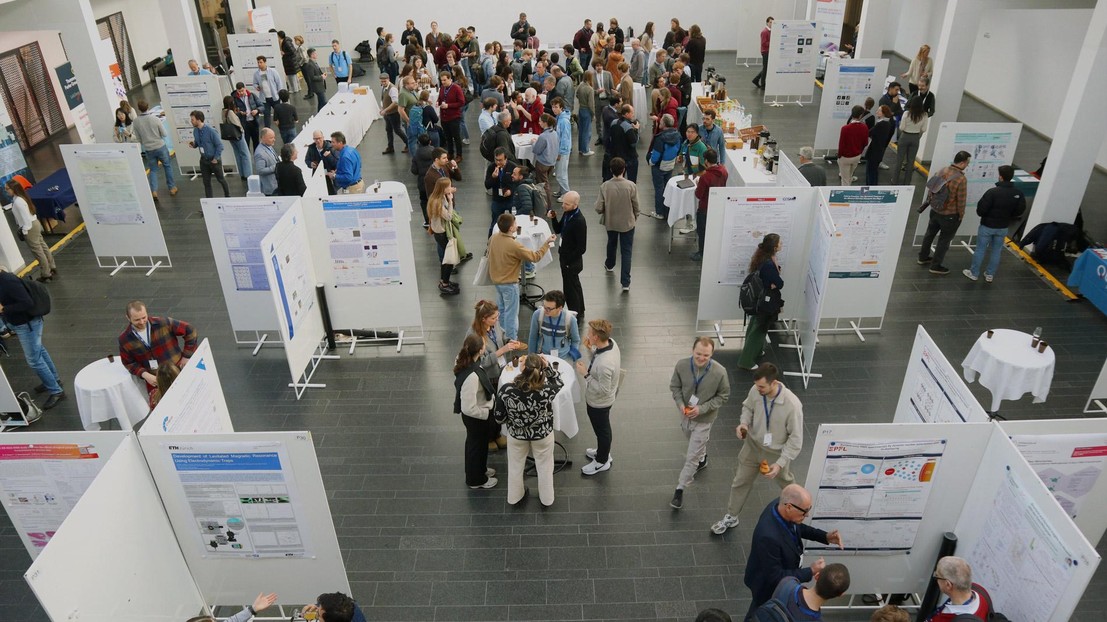
Active discussions around more than 50 posters presented at the meeting. Credit: EPFL/CIBM 2026.
Around 200 researchers from across Switzerland gathered at EPFL for the XXVI Swiss NMR Symposium, a one-day meeting highlighting advances in nuclear magnetic resonance (NMR) across chemistry, materials science, biology, medicine and physics.
On 5 February 2026, EPFL hosted the XXVI Swiss NMR Symposium, the biennial national meeting of the Swiss nuclear magnetic resonance (NMR) community. The event brought together scientists from universities, research institutes and industry for a full day of talks and discussions, reflecting Switzerland’s long-standing strength in magnetic resonance research.
The symposium serves as a platform for exchange across disciplines that rely on NMR, from fundamental chemistry and materials science to biomedical research and physics. Switzerland has played a central role in the development of NMR spectroscopy, with a tradition that spans methodological breakthroughs, high-field instrumentation and advanced data analysis.
This year’s Symposium highlighted both technical innovation and real-world applications. Talks ranged from new hardware concepts and methodological advances to studies of complex materials and biological systems. The breadth of topics underscored how NMR continues to evolve as a core analytical technique across many areas of science and engineering.
EPFL researchers were strongly represented, with contributions from the Institute of Chemical Sciences and Engineering, the Laboratory of Magnetic Resonance, the Institute of Materials, the CIBM Center for Biomedical Imaging, the CIBM MRI EPFL MR Imaging Technology Section the CIBM Pre-Clinical Imaging EPFL Metabolic Imaging Section, and the Laboratory of Magnetic Resonance Imaging Systems and Methods. Their presentations reflected the central role magnetic resonance plays across campus, from fundamental method development to industrial and clinical collaborations.
Several presentations stood out as highlights. Maria Adobes Vidal from Novartis discussed the use of NMR spectroscopy to de-risk co-amorphous drug formulations, helping to assess the stability and performance of pharmaceutical compounds.
Alexander Barnes from ETH Zurich presented work on miniature high-field superconducting magnets, pointing toward more compact NMR systems.
Marco Grisi from Annaida Technologies showed how NMR spectra can be obtained from single embryos, an approach aimed at supporting improved in vitro fertilization methods.
From EPFL’s Laboratory of Magnetic Resonance, Ran Wei presented new polarizing agents designed to increase the sensitivity of solid-state NMR experiments.
EPFL Professor Lyndon Emsley, who chaired the local organization of the meeting, emphasized the significance of the event for the national community: “Switzerland is the international leader in NMR spectroscopy, with a tradition going back to the Nobel prizes awarded to Richard Ernst and Kurt Wüthrich in the ETH domain. At the meeting we saw an extremely vibrant set of talks and posters from world-class groups across all the main academic and industrial sites in the country, covering subjects from medicine to nuclear physics, and with many exciting new emerging ideas especially relating to new uses for machine learning or to the study systems containing disorder of dynamics.”
Organized at EPFL, the Symposium attracted close to 200 participants. Beyond the formal presentations, the meeting reinforced the importance of a national forum where researchers from academia and industry can meet, exchange ideas and prepare future collaborations.