
EPFL helps pin down Universe's expansion rate
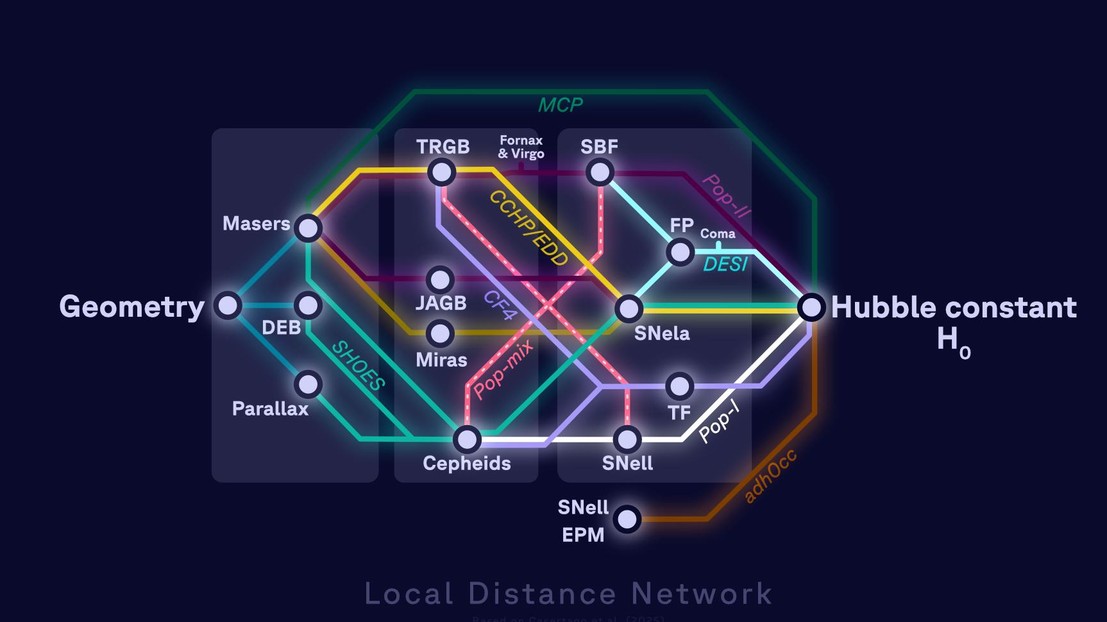
The “metro map” analogy of the Local Distance Network. Based on Casertano et al, 2025. Graphic by Fabio Crqmeri, ISSI.
An international collaboration, including researchers at EPFL, reports the most precise direct measurement of the Hubble constant, using a community-built distance network designed to reduce bias and test consistency across methods.
How fast is the Universe expanding today? Astronomers call this number the Hubble constant (H0). For years, different ways of measuring it have disagreed, creating the so-called Hubble tension. A large international team has now delivered the most precise direct measurement to date, while showing that the disagreement is unlikely to arise from a single error in local measurements.
The H0 sets the scale of the Universe. It tells us how quickly galaxies move away from each other. Astronomers measure it using a chain of distance indicators, often called the distance ladder. Each step builds on the previous one, from nearby stars to distant supernovae.
This approach has improved steadily, but it has a weakness. Errors can propagate along the chain. If one step is biased, the final result can shift. At the same time, measurements based on the early Universe give a lower value than local measurements. This mismatch has grown more significant with better data.
From a ladder to a network
The H0 Distance Network Collaboration has now taken a different approach. Instead of relying on a single chain, they built a network that combines many independent distance indicators into one coherent analysis. The study will appear in Astronomy & Astrophysics.
The work began at a 2025 workshop at the International Space Science Institute (ISSI) in Bern. Researchers met to agree, in advance, on methods and data. They then analyzed the data collaboratively over several months.
EPFL helps shape the approach
At EPFL, Professor Richard Anderson played a central role in launching and shaping the project. He co-organized the 2025 ISSI workshop that initiated the study, alongside lead author Stefano Casertano, and helped design the consensus process used by the collaboration.
The workshop brought together researchers to agree, in advance, on how to build the analysis, based on detailed discussions of the strengths and limits of different methods and datasets.
The team of international researchers defined hypotheses and methods before any results were seen. Participants discussed options and then voted anonymously and in a binding way on which approaches to include. This step reduced the risk of confirmation bias, since all data were publicly available.
Anderson’s expertise on the calibration and systematics of stellar standard candles provided a crucial element for this work. These objects set the absolute scale for distance measurements. Several results developed by his group at EPFL were incorporated directly into the analysis.
The Local Distance Network, illustrated by a “metro map” analogy developed by Anderson, links multiple methods of measuring astronomical distances in a statistically rigorous fashion. These include Cepheid variables, the tip of the red giant branch, supernovae, and many other more or less correlated methods.
A key novelty of the Network approach is that it considers correlations explicitly. The network combines them using a statistical framework that accounts for shared uncertainties. This allows researchers to test consistency across methods and avoid relying on any single path.
The analysis shows that independent distance indicators agree within their stated uncertainties. No single method dominates the final result. Removing key components leads to only small changes in the outcome.
A sharper value for cosmic expansion
The H0 collaboration reports a value of H0 = 73.50 ± 0.81 km s−1 Mpc−1, with a precision of just over 1%. This is the most precise direct measurement of the local expansion rate to date and draws on a broader base of evidence than previous approaches.
The new result remains in strong tension with values inferred from the early Universe under the standard cosmological model. The difference is about five to seven standard deviations.
Because the network combines many methods, the result suggests that overlooked error in local measurements cannot explain the Hubble tension. This strengthens the case that the tension points toward missing ingredients in the fundamental physics included in the most commonly adopted cosmological model.
The framework also sets a path forward. New data from upcoming observatories can be added to the network, improving precision and testing the consistency of future measurements.
H0DN Collaboration, Stefano Casertano, Gagandeep Anand, Richard I. Anderson, Rachael Beaton, Anupam Bhardwaj, John P. Blakeslee, Paula Boubel, Louise Breuval, Dillon Brout, Michele Cantiello, Mauricio Cruz Reyes, Geza Csörnyei, Thomas de Jaeger, Suhail Dhawan, Eleonora Di Valentino, Lluís Galbany, Héctor Gil-Marín, Dariusz Graczyk, Caroline Huang, Joseph B. Jensen, Pierre Kervella, Bruno Leibundgut, Bastian Lengen, Siyang Li, Lucas Macri, Emre Özülker, Dominic W. Pesce, Adam Riess, Martino Romaniello, Khaled Said, Nils Schöneberg, Dan Scolnic, Teresa Sicignano, Dorota M. Skowron, Syed A. Uddin, Licia Verde, Antonella Nota. The Local Distance Network: A community consensus report on the measurement of the Hubble constant at ∼1% precision. Astronomy and Astrophysics. DOI: 10.1051/0004-6361/202557993