
EPFL helps create sharpest map of dark matter
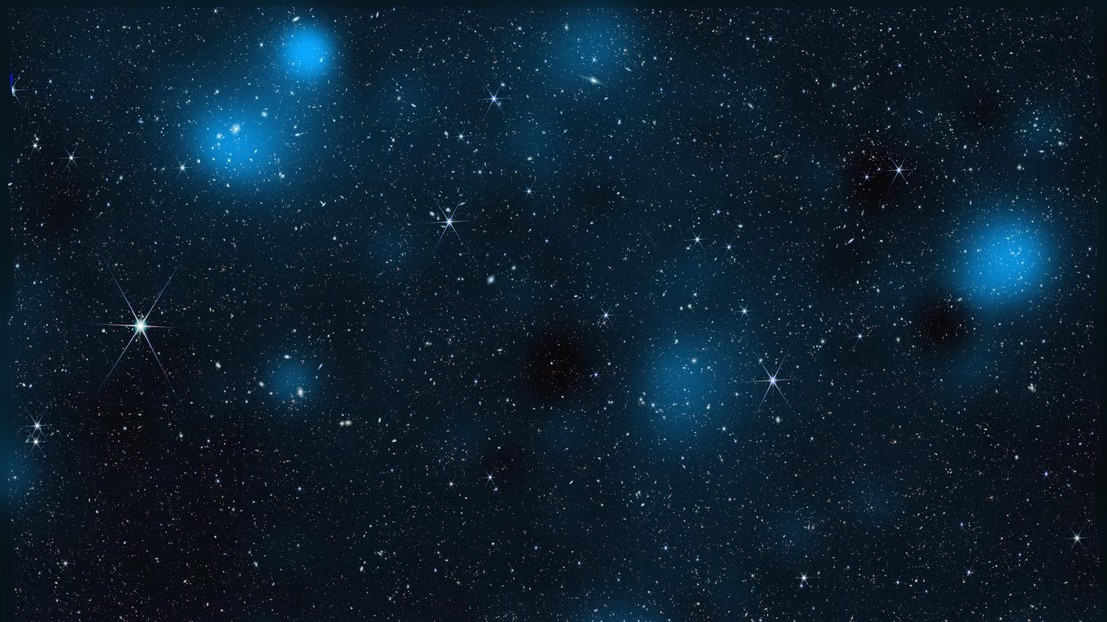
Credit: NASA/STScI/J. DePasquale/A. Pagan
Scientists from NASA’s Jet Propulsion Laboratory, Durham University, and EPFL have created one of the highest‑resolution maps of dark matter to date, using observations from the James Webb Space Telescope. The study reveals how invisible dark matter is woven together with the galaxies and galaxy clusters we can see, offering an unprecedented look at the cosmic structure that shaped the Universe
"This is the largest dark matter map we’ve made with Webb, and it’s twice as sharp as any dark matter map made by other observatories,” says Diana Scognamiglio, lead author of the paper and an astrophysicist at NASA’s Jet Propulsion Laboratory in Southern California. “Previously, we were looking at a blurry picture of dark matter. Now we’re seeing the invisible scaffolding of the universe in stunning detail, thanks to Webb’s incredible resolution.”
Dr David Harvey, from EPFL’s Laboratory of Astrophysics, carried out the shape measurement of all 250,000 galaxies, testing the shapes for systematics and thus providing the catalogue from which the mass map could be generated.
“At the heart of these incredible mass maps is gravitational lensing—the weak distortion of galaxies’ images as dark matter bends their light as it traverses the Universe to us on Earth,” he explains. “To measure this effect, we need to carefully model the shapes of very small and very distant galaxies, which means understanding the telescope in detail and how imperfections in James Webb may imprint themselves on the galaxy images.”
The new map shows dark matter and regular matter tightly aligned across galaxy clusters and the filaments connecting them, including structures that were previously too faint or too distant to detect. These features are visible thanks to Webb’s ability to resolve extremely faint, high‑redshift galaxies, giving scientists a window into the cosmic web as it appeared when the Universe was only a few billion years old.

“Mass maps like this are great way to visualise the distribution of all the matter in the Universe—in effect how we would see the sky if we had access to dark matter goggles," says Harvey. "What is truly amazing is how far we can see. James Webb is enabling access to a time in the Universe that many thought inaccessible with these kinds of techniques. It really showcases the power of the James Webb Telescope to carry out incredible science. What’s more, this work is just the tip of the iceberg, with many more exciting studies to come with this amazing dataset.”
The EPFL team now plans to extend this work with future surveys, including ESA’s Euclid mission and NASA’s Nancy Grace Roman Space Telescope.
Swiss State Secretariat for Education, Research and Innovation (SERI)
Marie Skłodowska‑Curie fellowship
Diana Scognamiglio, Gavin Leroy, David Harvey, Richard Massey, Jason Rhodes, Hollis B. Akins, Malte Brinch, Edward Berman, Caitlin M. Casey, Nicole E. Drakos, Andreas L. Faisst, Maximilien Franco, Leo W. H. Fung, Ghassem Gozaliasl, Qiuhan He, Hossein Hatamnia, Eric Huff, Natalie B. Hogg, Olivier Ilbert, Jeyhan S. Kartaltepe, Anton M. Koekemoer, Shouwen Jin, Erini Lambrides, Alexie Leauthaud, Zane D. Lentz, Daizhong Liu, Guillaume Mahler, Claudia Maraston, Crystal L. Martin, Jacqueline McCleary, James Nightingale, Bahram Mobasher, Louise Paquereau, Sandrine Pires, Brant E. Robertson, David B. Sanders, Claudia Scarlata, Marko Shuntov, Greta Toni, Maximilian von Wietersheim-Kramsta & John R. Weaver. An ultra-high-resolution map of (dark) matter. Nature Astronomy 26 January 2026. DOI: 10.1038/s41550-025-02763-9