
Engineering students drawn to the ancient Mediterranean
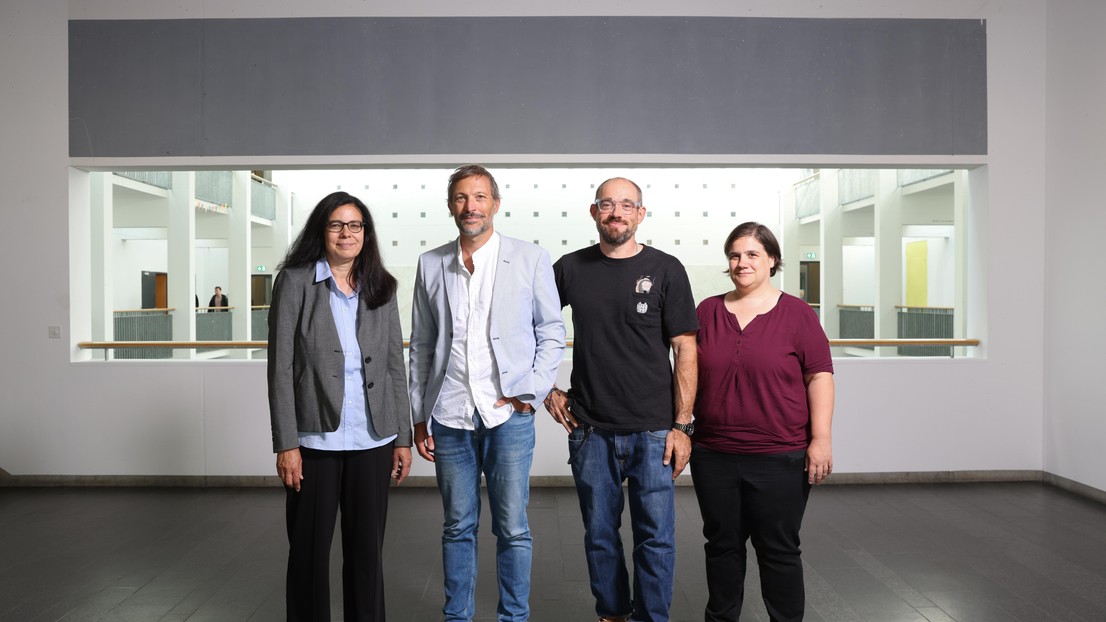
Giuseppina Lenzo, Matteo Capponi, Matthieu Pellet and Ruth Ebach - 2026 EPFL/Alain Herzog - CC-BY-SA 4.0
The SHS Best Teaching Award for 2025 went to a team of lecturers who take students on a journey through the ancient Mediterranean.
Matteo Capponi, Ruth Ebach, Giuseppina Lenzo and Matthieu Pellet make up the winning team that teaches a class called Mediterranean Antiquity: Mythology and Pop Culture. It’s proven to be a hit among engineering students at a time when ancient Egypt, Greece and Rome are a source of inspiration for many video games and novels. We spoke with the four teachers about the secret to their success.
Can you tell us more about the Mediterranean track within the SHS program?
Matthieu Pellet (MP): There are six separate classes in the track, but they’re linked thematically – they all cover topics related to the ancient Mediterranean. I’m pretty sure it’s one of the very first tracks ever offered in the SHS program.
Matteo Capponi (MC): There are four of us, each with different cultural expertise. In this course, we encourage students to draw comparisons between various aspects of the ancient cultures. The classes are designed to get the students to think in comparative terms themselves, without being able to rely on artificial intelligence. Perhaps that’s the real added value of our teaching approach.
How do you prompt students to think in comparative terms?
Giuseppina Lenzo (GL): Let’s take love, funerary rites and wars, for example. These are all things that were present in antiquity and are still an important part of modern life. Every week, we explore these topics from a different angle based on the region (Middle East, Greece or Egypt). So the students end up studying the same topic several times, but from the perspective of a different ancient civilization.
MP: One of our goals is to look at otherness. These engineers will probably end up working in other countries with people from a range of cultures, and an ethnocentric attitude is never helpful. In our classes, students learn how to step back from their own culture, think about differences and question the facts. We use the ancient civilizations as a mirror: it’s easier to study an “other” who lived 3,000 years ago. These civilizations are far removed from modern times, but the people who lived in them went to war, fell in love and buried their dead, just like we do.
Ruth Ebach (RE): What I find really interesting is that the groups we teach are extremely diverse. There are European students at EPFL, of course, but also students from Israel, Iraq, Egypt, Lebanon and more. They represent a rich patchwork of cultural heritage.
The four of you usually teach at the University of Lausanne. How is it different teaching engineering students?
RE: We’re all philologists and we’re accustomed to working with ancient texts in the original language. But at EPFL we have to use translations, which is quite different.
GL: I’m amazed at the extent to which our classes attract EPFL students. But it’s an interesting experience for us too, giving lectures to two very different audiences.
MP: I agree that it’s very stimulating. I’d also say that having engineers and architects “on board” is a real plus, especially for project work. We can tell they have specific skills.
Can you give us an example?
MP: One project in particular that comes to mind is an escape game that students developed based on Plato’s Atlantis, a myth that combines philosophy and political science. For their project, the students wrote code, generated 3D models and more. It was crazy! But before that, they spent six months reading the text – getting their head around it and making it comprehensible.
GL: I have the feeling that the students really get into it. They put a lot of effort into coming up with original ideas, building on other skills they’ve learned at EPFL.
MC: Here, it might be worth pointing out that our track includes classes of different levels. The ones for students early in their bachelor’s programs are more academic – essentially lectures. But the ones later in the bachelor’s and those at the master’s level delve more into the works. For instance, students might be asked to examine a play, a passage from the Bible or a papyrus, and then reinterpret it – tell the story to their classmates in today’s language. The master’s level classes in particular involve building bridges between past and present. That’s where students can express their creativity. They’ve written Minecraft-style epics, not to mention plays and musicals!
MP: This is precisely what makes our classes at EPFL so instructive. They’re based on pulling together knowledge from very different fields, which gives rise to new constructs that can be more contemporary than the somewhat outdated approaches used elsewhere.
In your opinion, why was your team selected for the 2025 SHS Best Teaching Award?
MP: In the class evaluations we receive, students often say that the teachers “get along well with each other.” So I guess the fact that we enjoy what we do and have fun is viewed positively.
MC: That said, it’s not only about having fun. There’s a lot of work behind this course. We constantly tweak and update our lectures. I’ve been teaching this for ten years, and I think I’ve changed how I do it every year. For instance, our Mediterranean antiquity in pop culture class is entirely new – students seek out the past in the present, looking at antiquity through popular culture. We like to try new things, and if they don’t work, we move on to something else. The regular class evaluations help us a lot. We take students’ feedback very seriously.
Your classes are optional, but they’re always full!
MC: That’s true. I’ve heard they fill up in just a few minutes. To be honest, at first we wondered whether students saw our classes as an easy way to earn credits. But after looking more closely, we realized that wasn’t true. It’s just that our students have fun while earning those credits.
MP: But that doesn’t mean they turn in shoddy work! Sometimes we have to speak with master’s students and explain that they have other courses to take besides ours.
GL: I think another reason why our classes are so popular is that many people at EPFL are interested in ancient civilizations. That interest is sometimes underestimated.


