
Engineering New Materials for Radio Astronomy
© 2026 EPFL
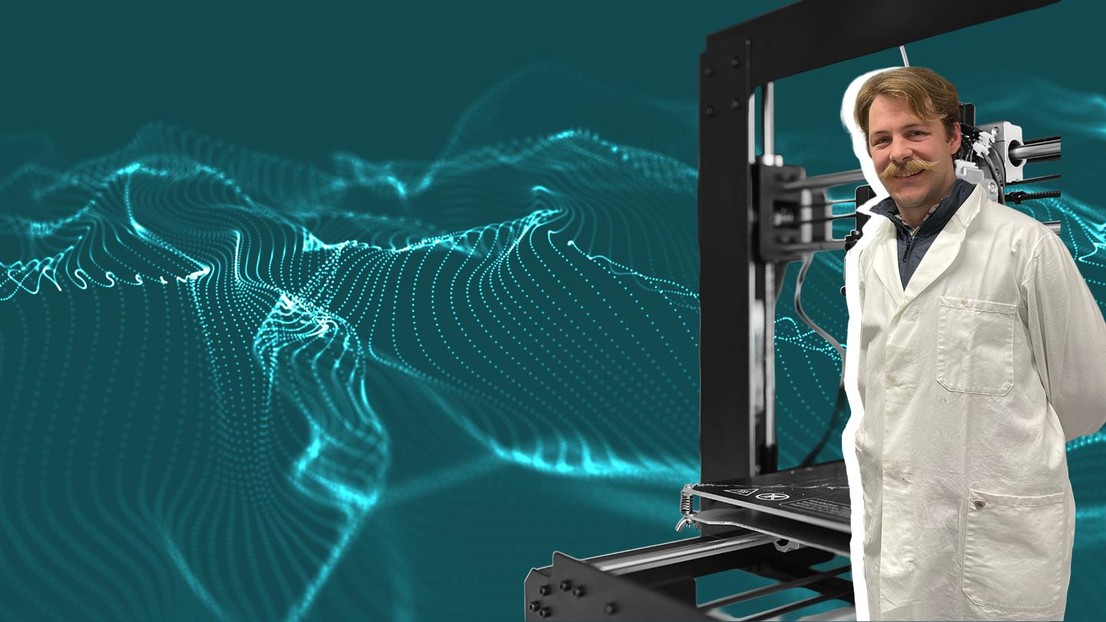
South African researcher and lecturer Archibald Rohde is pursuing his PhD at the University of Pretoria through the 100 PhDs for Africa programme, developing 3D-printable materials for radio astronomy and advanced communications.
Could you briefly introduce yourself and tell us about your academic and professional journey since joining the 100 PhDs for Africa programme?
I am a South African researcher, lecturer and PhD candidate at the University of Pretoria. I completed a BEng in Electronic Engineering, BEng (Hons) in Microelectronics Engineering, and MEng in Microelectronics Engineering at the University of Pretoria before starting my PhD. I spent some time during my studies as a research intern at the Karlsruhe Institute of Technology in Germany. I also held an assistant lecturing position at the University of Pretoria for the latter half of the last decade.
What motivated you to apply to the 100 PhDs for Africa programme, and what were you hoping to gain from the experience?
Knowledge, besides time, is probably the ultimate currency a human can have. During a research stay in Germany I had realised that a European PhD would be equivalent to harvesting the knowledge I had grown in Africa and spending this currency at a European university. It was at this time that I saw the advertisement for the EXAF 100 PhDs for Africa programme and it immediately stood out as an opportunity to spend my knowledge in Africa, while not detaching the research from the international community. In fact, this programme offered the opportunity for exchange and international collaboration to an extent where any intellectual property developed would either be joint owned, or even better, published openly so that the world could have access to the knowledge we create together. The programme stood out instantly as a truly collaborative project between South Africa and Switzerland.
Research and PhD
Could you tell us about your PhD research in a way that a non-specialist could easily understand? What question were you trying to answer, and why does it matter?
South Africa is a world leader in radio astronomy and there is a massive need for home-grown technologies to match this demand, as well as similar technologies in 5G and 6G communications. The curious will remember how cabled television cables used to have a metal wire coated in a thick teflon layer and then another metal layer. The electromagnetic wave in the wire moved through this teflon filling to bring television to your home. This extends to most electromagnetic waves and their applications in communications or radio astronomy: we can propagate a wave through a material depending on the properties of the material. Similar to how lenses in eye glasses can bend light, we can do similar things with electromagnetic waves in dielectric materials and achieve fascinating results. The collaboration with EPFL is centred around the development of new and exciting materials for these interesting use cases. This PhD is focussed on the investigation of exotic 3D printable materials so that one can fabricate complex microwave devices used in radio astronomy and communications. 3D printing allows the fabrication of previously unthinkable design geometries, while also allowing rapid prototyping and testing. This work not only focuses on 3D printable dielectric materials, but also ferrimagnetic materials which can be used in the design of isolators for sensitive measurement equipment. In short: think accessible, cheap, and easily prototypeable materials for advanced microwave design.
What were the main challenges you encountered during your PhD, and how did you overcome them?
In South Africa, a PhD is not a paid position, but a degree you pay for. Funding was the main challenge (as with most South African PhD students), but this was overcome largely by the awarding of the EXAF 100 PhDs for Africa grant.
You worked under joint supervision between an African university and EPFL. What did this collaboration bring to your research and to your development as a researcher?
The nature of the project means that both groups are experts in completely divergent fields (microwave engineering at the University of Pretoria, and materials at EPFL). The collaboration has been a very interesting exploration of the intersection of these fields. It is very exciting to be working in an interdisciplinary project between vastly different fields.
Experience at EPFL & in Switzerland
You also spent time at EPFL and in Switzerland during your PhD. What did these stays bring to you, both academically and personally?
EPFL is a top rated university with access to technologies and infrastructure which has allowed expedited research and a very interesting view on well funded research in an international environment.
Do you have a memorable, amusing or unexpected moment from your time in Switzerland that you would like to share?
I attended a “Desalpe” in the villages and was very happily amused by the flower-crowned Swiss cows! Heidi did not lie, this place is great.
What are your plans for the next chapter of your career, and what are you hoping to contribute to research in Africa?
I have been employed as a lecturer at the University of Pretoria in South Africa and intend to stay in this position and pursue a professorial position, so that I may continue to do research and train the next generation of African engineers.
If you could give one piece of advice to a young African researcher considering applying to the 100 PhDs for Africa programme, what would you tell them?
The programme had many challenges in its inception, but now runs with a very capable and caring team. The funding is good and well managed. The team are willing to go the extra mile for you even through Swiss bureaucracy (which is something to get used to).
100 PhDs for Africa is a programme stemming from the “Excellence in Africa” initiative developed by UM6P and the EXAF Centre (EPFL).