
Engineered Strain in 2D Materials
© 2026 EPFL
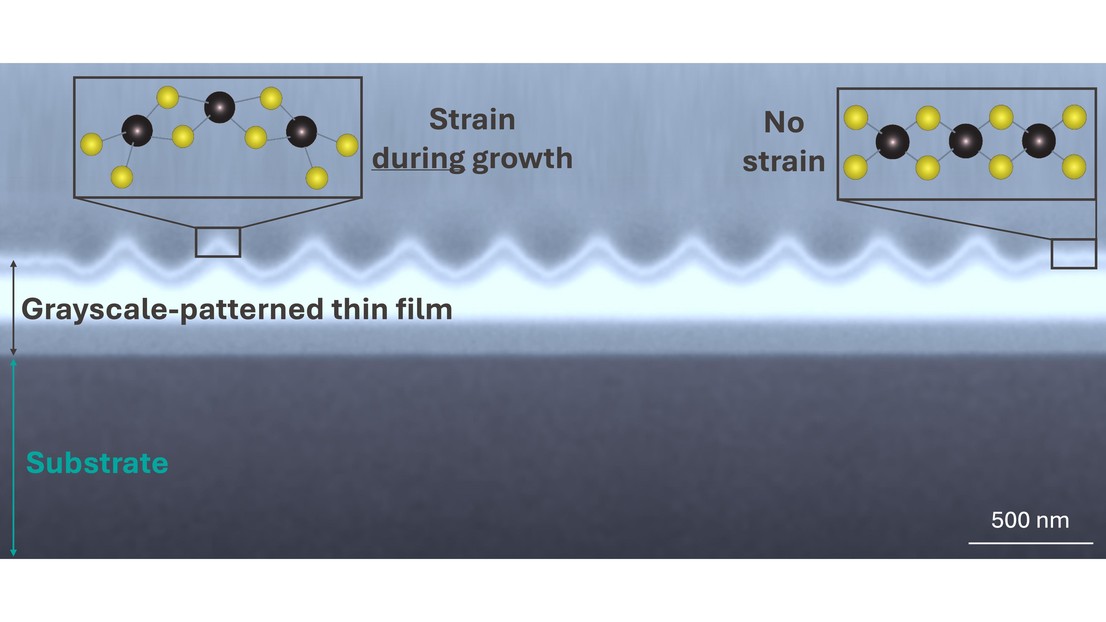
Congratulations to our colleague Dr. Berke Erbas, for his recent publication entitled "Engineered Strain in 2D Materials by Direct Growth on Deterministically Patterned Grayscale Topographies" in the journal "Advanced Science".
Strain is a proven technique for modifying the bandgap and enhancing carrier mobility in 2D materials. Most current strain engineering techniques rely on the post-growth transfer of these atomically thin materials from growth substrates to target surfaces, limiting their integration into nanoelectronics. Here, we present a new approach where strain in 2D materials is already introduced directly during their growth on grayscale-patterned topographies instead of flat surfaces. Both strain levels and orientations are deterministically engineered by controlling grayscale surface contour lengths through thermal expansion mismatches in nanostructured stacks, where the conformally grown and firmly attached 2D material is forced to match the underlying morphology change during cooling. With this method, we experimentally demonstrate precise control of localized tensile strain from 0 to 0.5% in grown MoS2 monolayer along both uni- and multiaxial directions, while higher strain levels are shown to be theoretically possible. This strain-engineered growth of 2D material films directly on the target substrates is a generic and adaptable approach to various combinations of grayscale-thin-film/substrates and eliminates all the transfer-related limitations of previous approaches, thus paving the way for integrating strained 2D materialsinto next-generation nanoelectronics.
For more details, please visit: https://doi.org/10.1002/advs.202522850
B.E., G.B., and J.B. acknowledge funding from the European Research Council (ERC) under the European Union’s Horizon 2020 research and innovation program (Project “MEMS 4.0”, ERC-2016-ADG, grant agreement No. 742685), the NFFA-Europe Pilot Project (the EU’s H2020 framework program for research and innovation, grant agreement No. 101007417) and the Swiss National Science Foundation (SNSF) (grant No. 10002312). H.F. acknowledges the SNSF, under the AMBIZIONE program (grant agreement No. PZ00P2_193361). A.B. and A.K. acknowledge that this work was financially supported by ERC grant SKIN2DTRONICS (grant no. 101167218).