
Enerdrape's Underground Innovation Featured in Bloomberg
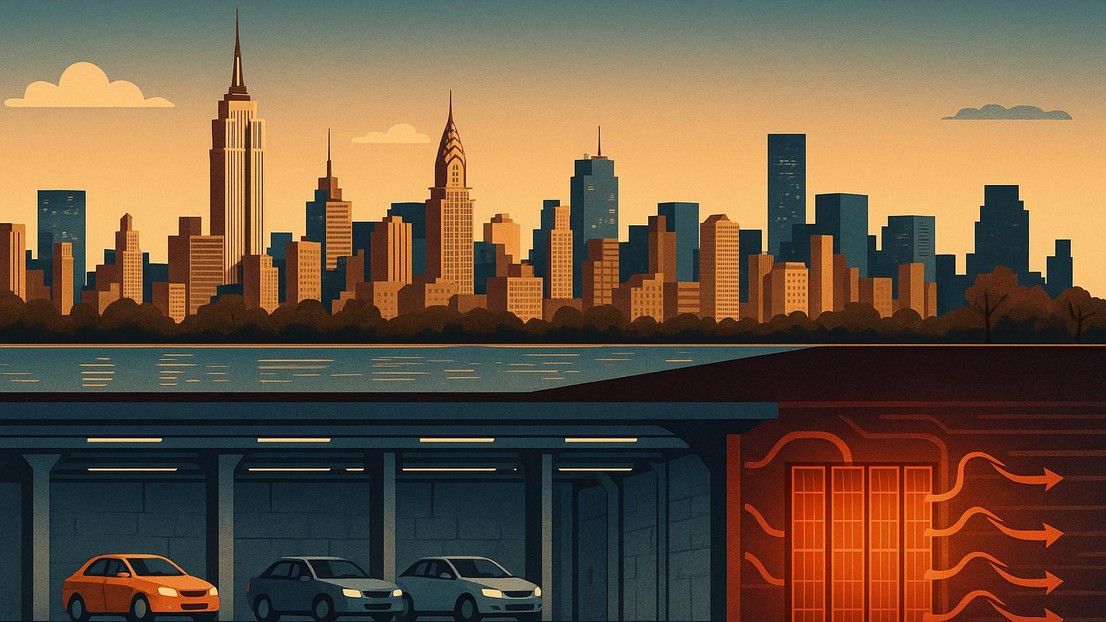
Enerdrape panels in underground carpark I © 2025 EPFL
LMS spin-off brings no-drill geothermal energy from Lausanne to New York, showing how underground spaces can power the cities of tomorrow.
The world is starting to take notice of what began as a bold idea at EPFL’s Laboratory of Soil Mechanics. This week, Bloomberg, one of the world’s most influential business and financial outlets, featured Enerdrape in a story about how underground parking garages could become a new source of clean energy.
The article shows how Enerdrape’s no-drill geothermal panels can tap into something cities usually ignore: the heat stored in underground spaces. Anyone who has walked into a subway station in summer knows how much heat is hidden underground. Enerdrape turns that waste into a resource.
“Enerdrape moves heat from where it is not needed to where it is,” explained co-founder Alessandro Rotta Loria, who developed the technology during his PhD with Prof. Lyesse Laloui.
From Lab to City
The idea grew out of decades of research at LMS on energy geostructures, a field that Prof. Laloui has helped shape from the start. At first, the team focused on new buildings, but they soon realised the bigger challenge was with existing housing stock. Cities like New York are full of older multifamily buildings that are difficult to retrofit.
In 2015 the team built the first prototype of a heat-exchanging panel. Four years later, Enerdrape was launched as a spin-off, carrying EPFL’s spirit of innovation into practice.
Making an Impact
Today, Enerdrape has projects running in Switzerland, Spain and France. In Paris, for example, 145 panels supply renewable heat to 72 affordable housing units. They cover a quarter of hot water demand and cut CO₂ emissions by 15 tons each year. Collaborations with Engie, Coop Immobilier and other partners show how adaptable the technology is across different contexts.
For cities like New York, where older buildings dominate and where climate laws are becoming stricter, Enerdrape offers a practical, low-intrusion option to cut emissions from heating and cooling. Bloomberg’s coverage highlights both the opportunity and the challenges ahead: upfront cost, supportive policy, and adapting the system to a wide variety of buildings.
A Vision for Sustainable Cities
For LMS, Enerdrape’s recognition is more than a commercial success. It shows how research at the lab can make its way into real solutions for the energy transition.
“This milestone reflects what drives us at LMS,” said Prof. Laloui. “Advancing geotechnical innovation from the laboratory to real-world solutions that accelerate the clean energy transition.”
From underground data centres to carbon storage, and now to urban geothermal retrofits, LMS keeps showing how engineering research can turn into real solutions for more sustainable cities.
Read the full Bloomberg feature here: https://go.epfl.ch/bloomberg