
“Embracing difference is the foundation of a shared world”
© 2026 EPFL/A.Herzog
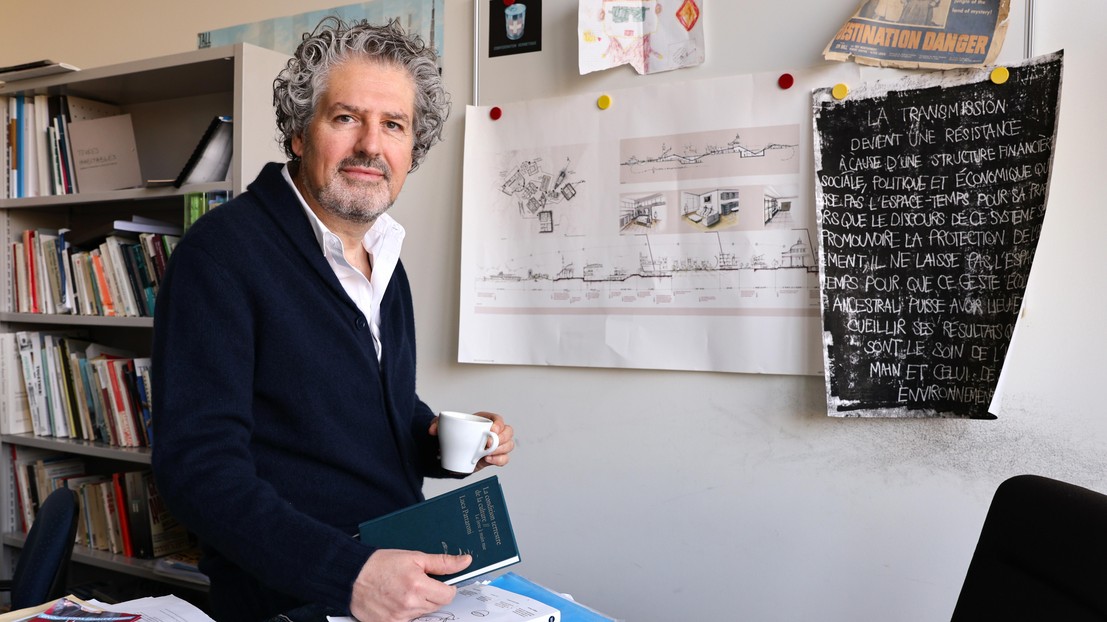
For almost two decades, Luca Pattaroni has been studying alternative and countercultural communities at EPFL’s Urban Sociology Laboratory (LASUR). His research asks what these models of coexistence and collective living might teach the rest of society.
When asked what question drives his work, Luca Pattaroni, who co-heads LASUR at EPFL, is unequivocal: “How do people and communities, with all their diversity and differences, learn to live side by side in a city?” Pattaroni specializes in what are often labeled the “margins” of society. Yet he sees alternative communities, countercultural movements, activist and artistic circles, squats, the homeless, migrants and many others not as outsiders, but as people whose ways of living deserve recognition. For him, their experiences offer different ways of living together – fresh perspectives from which society as a whole could learn.
Born and raised in Geneva to a family with Italian and Ticinese roots, Pattaroni initially studied international relations before pursuing postgraduate studies at École Normale Supérieure in Paris. It was there that he first encountered the social sciences, coming to realize that sociology was the field for him.
Bridging theory and practice
“I’ve always been fascinated by the great French intellectual tradition and by philosophy,” says Pattaroni. “But I also wanted to be politically engaged, which led me to study international relations after several years of student activism. Sociology seemed to offer the best of both worlds.” After completing his postgraduate studies, he went on to undertake a PhD in sociology, exploring the notion of responsibility. “The same idea was at work there, too: philosophy, ethics and politics aren’t concepts that merely exist in the abstract,” he explains. “They influence everyday life and the way our societies are built and organized. I wanted to test those ideas in the real world and understand what they actually mean in practice.”
Beyond theory and practice, Pattaroni’s work is guided by a third thread: the pursuit of social justice. It’s a concern that underpins both his research and his wider engagement. “Designing housing, a transport system or a public space is always a political act,” he explains. “You’re influencing the way society functions and how people live together. I’ve always been absorbed by one question: how do we build a shared world that’s fair, free from oppression and respectful of both human diversity and the natural environment?”
Why “re-neighboring” matters
For Pattaroni, building a more balanced society starts by looking at vulnerability, resistance and exception – those places where different forces intersect and interact.
Over close to two decades at EPFL, this perspective has led him to develop a number of ideas, including one he calls “re-neighboring.” As Pattaroni explains, the concept brings together three notions. The first is “dwelling,” which encompasses the different ways people live their lives. The second is “hospitality:” creating the conditions for people to live alongside one another with respect, ensuring everyone has a voice and a place. “Think of a building designed around a tree: instead of cutting it down, you choose to live with it and adapt to its presence,” he explains. The third is “the commons,” which has to do with how we share the world while embracing our differences. Pattaroni expands on this notion: “The commons can be more or less expansive as a concept. Liberalism, for instance, offers a highly individualized form in which relatively little is shared. Other models, rooted in anarchist or libertarian traditions, involve much greater sharing.”
Relearning how to live side by side
“At our lab, we’ve looked at fear and perceptions of insecurity, which tend to produce a society of enclaves, with groups retreating further and further into themselves,” says Pattaroni, who goes on to explain that the problem is not simply that communities no longer meet or mix. More fundamentally, he argues, they are losing the ability to live side by side in a spirit of tolerance and mutual respect.
“Enclaves become especially problematic when relationships between groups are marked by unequal power and privilege, with some benefiting at the expense of others,” he says. “The challenge today is therefore twofold: making our shared spaces more permeable, while also making them fairer and more respectful.”
Pattaroni is equally unequivocal when asked how he’d respond to accusations that his work as “too activist:” “No matter what field we work in – the humanities, engineering or a technical discipline – the research we do and the projects we carry out always have political implications. Research on cleaner cars, for example, doesn’t pose a threat to the existing transport system. That’s a very different political proposition from trying to redesign our cities and reduce our reliance on cars. Our decisions are never really neutral.” For Pattaroni, recognizing such assumptions is preferable to pretending they don’t exist and allowing them to influence our research unnoticed. But he’s equally emphatic about the importance of scientific rigor: “Research demands discipline, critical distance and intellectual honesty from start to finish. That’s especially important today, with fake news on the rise and scientific expertise increasingly being called into question.”