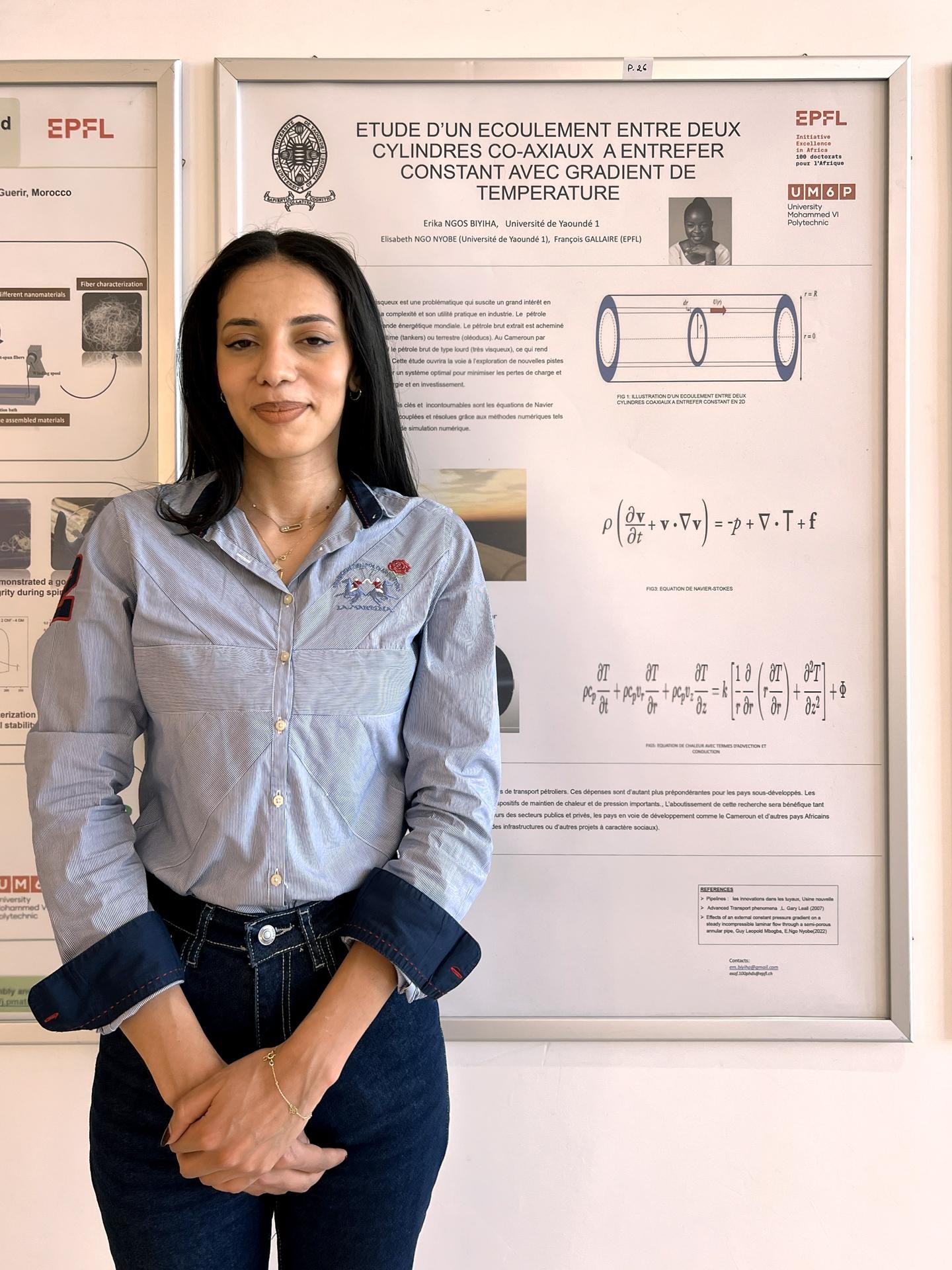
Drawing Inspiration from Nature to Create the Materials of Tomorrow
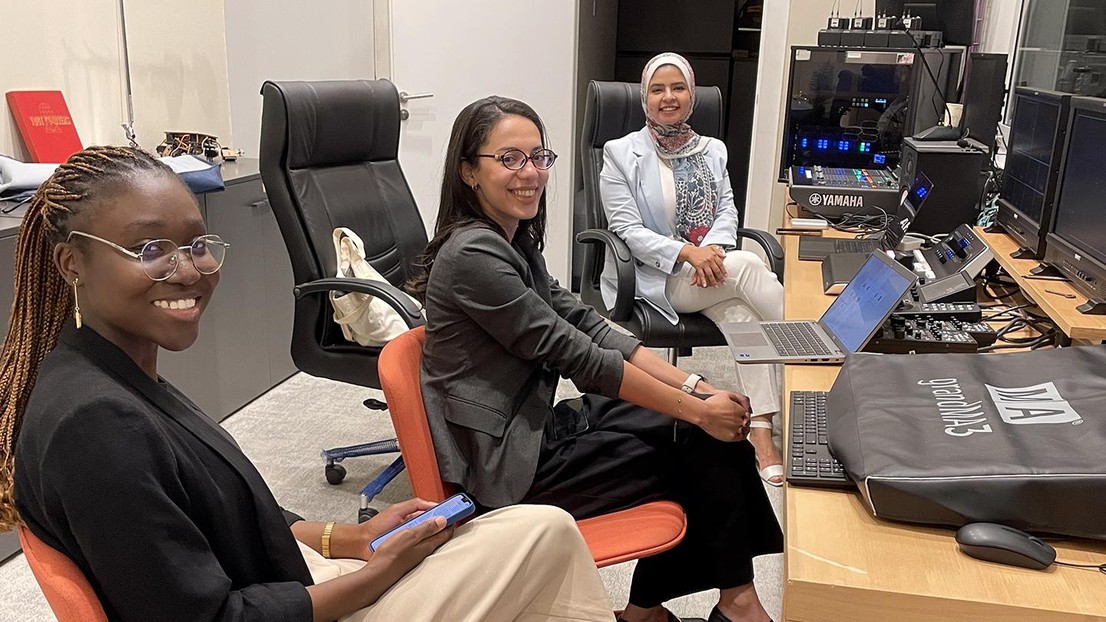
Meryem alongside Shimaa Heikal (right) and Abla Grace Leaticia Kouassi (left) © 2026 EPFL
Meet Meryem Jamal, a PhD student at Mohammed VI Polytechnic University and member of the 100 PhDs for Africa programme. Her research focuses on developing bio-based and bio-inspired fibres from biomass recovery to design sustainable, high-performance materials.
Can you introduce yourself?
My name is Meryem Jamal and I am a PhD student at the Sustainable Materials Research Centre (SUSMAT-RC) at Mohammed VI Polytechnic University (UM6P). I obtained a master's degree in analytical and environmental chemistry at Sidi Mohamed Ben Abdellah University. My academic background gradually led me towards sustainable materials science and bio-inspired approaches to the development of functional materials.
How did you hear about the Excellence in Africa initiative's 100 PhDs programme?
The 100 PhDs programme was highly recommended to me by my supervisor at UM6P. I then took the time to find out more by consulting the various communication platforms and resources made available by UM6P.
What prompted you to apply?
This programme perfectly matched my scientific ambitions, particularly in terms of structuring my doctoral project, exposure to an international research environment, and developing scientific and interpersonal skills that are essential for my future career as a researcher.
Was the application process easy for you?
The process was demanding but well structured. It allowed me to clarify my research objectives and refine my scientific vision, which was a very enriching experience.
Can you describe your project? What is/are your research question(s)?
My thesis project focuses on the development of bio-inspired materials from natural resources, with a particular focus on the development of fibres and films. It aims to understand how shaping conditions influence the structural organisation of materials and, consequently, their final properties.
Could you give some practical applications of your research?
The materials developed as part of my research are intended for applications in several fields, including biomedicine (such as sutures and dressings for wound healing), textiles, and other applications requiring durable and high-performance materials.
What is the scientific challenge of your research topic?
The main scientific challenge is to better understand how nature works and its hierarchical architectures, in order to draw inspiration from them and transpose them into the design of materials that are both high-performance and sustainable, because there is no model more successful than that offered by natural systems.
Could you briefly introduce your supervisor and co-supervisor?
My supervisor at UM6P is Professor Youssef Habibi, whose expertise in bio-based materials and polymer science is a central pillar of my thesis project. His scientific guidance plays a key role in directing and structuring my work.
My co-supervisor at EPFL is Prof. Jeremy Luterbacher, a professor at EPFL who is renowned for his research in materials engineering and biomass recovery, and whose interdisciplinary approach greatly enriches my project.
What are the advantages of co-supervision between your supervisor in Africa and your co-supervisor at EPFL?
Co-supervision offers highly enriching scientific complementarity, while giving me the opportunity to explore other research topics beyond my main subject, which is essential for our development as future researchers.
How will the collaboration with EPFL help you meet the scientific challenge described in the previous question?
The collaboration with EPFL allows me to benefit from a stimulating research environment, high-level scientific exchanges and access to complementary tools and approaches, promoting a deeper understanding of the issues being studied.
Can we talk about your stay in Switzerland? Was it easy to prepare your site for Switzerland?
Preparing for the stay required some organisation, particularly in terms of administration and logistics, but it went smoothly thanks to the support I received.
What did you do?
In addition to my experimental work in the laboratory, I also took advantage of my stay to discover the magical nature of Switzerland. These moments were among the most beautiful experiences I have ever had and greatly enriched my stay, both personally and professionally.
Do you have any amusing or unexpected anecdotes to share about your stay?
When I arrived, I heard people talking about ninety and seventy, without knowing that Switzerland also used this way of counting. I probably should have done a quick Google search before paying for anything... but this little linguistic surprise is now one of my most amusing memories of my stay.
What does excellence mean to you?
For me, excellence is based on scientific rigour, intellectual curiosity and the ability to have a real impact, while remaining open to learning, interdisciplinarity and collaboration.
Images to download