
Developing Sustainable solution for Alpine Glacier melt-down
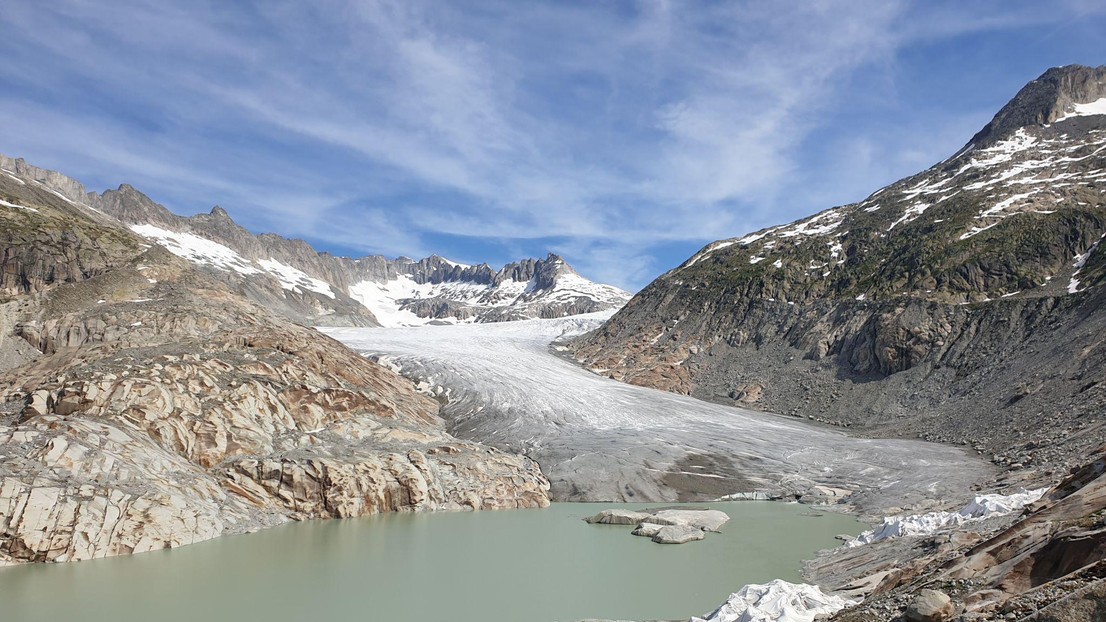
© Dominique Choffat, RTS
EPFL professor Jérôme Chappellaz recently appeared on Swiss Radio and Television (RTS) to discuss new research on protecting Alpine glaciers. Speaking from the Rhône Glacier near the Furka Pass, he explained how current methods work, and why they need improvement.
The Problem with Current Protection
For nearly 20 years, white geotextile covers have been placed on parts of the Rhône Glacier to slow melting around the popular ice cave. While these covers work well locally by reflecting solar energy back to space—a phenomenon known as the albedo effect—they create an environmental problem: they release microplastics into the meltwater that flows into streams and eventually the Rhône River.
The science behind glacier protection is straightforward. When a glacier surface is dark, it absorbs solar energy like a black surface, accelerating melting. When the surface is white, solar energy is reflected back to space, reducing melting.
It's like when you put an extra sweater on; your body heat can't escape and your body temperature rises. It's the same with Earth: we're adding greenhouse gases that trap heat.
The most direct approach involves restoring the glacier's reflective properties through white protective covers. However, this method isn’t environmentally sustainable.
We needed to find a better way. These covers are effective but they're not environmentally friendly
A New Approach: The Glacier Stewardship Program
Professor Tom Battin and Professor Jérôme Chappellaz from EPFL have launched the "Glacier Stewardship Program" with partners from ETH Zurich and the University of Innsbruck. The program explores materials and approaches that could protect glacier ice without harming the environment.
The most promising research focuses on developing biomaterials that would be transformed at the molecular scale so that when present on the surface, they have this extremely white color, and when they degrade, they don't impact the environment.
This innovative approach could provide the reflective properties needed for glacier protection while being completely biodegradable, solving the microplastic pollution problem of current covers.
The Reality Check: Cost and Scale
A paper by Mathias Huss et al. revealed what it would cost to protect glaciers on a large scale. The numbers are staggering: covering Switzerland's major glaciers would require about 1.4 billion Swiss francs every year—and still couldn't stop glacier retreat.
Currently, ski resorts and tourist sites invest up to 200,000 francs annually to protect small glacier areas that are crucial for their operations. The economic motivation is clear, but the environmental cost has been overlooked until now.
The Bigger Picture
While developing better protection methods, Chappellaz emphasizes that technology alone isn't the answer.
Nothing will replace reducing CO2 emissions if we want to slow the loss of our glaciers. No technology can protect all 230,000 mountain glaciers worldwide,
Research shows that targeted, local glacier protection makes sense for specific needs—like keeping ski slopes operational or preserving tourist attractions. But saving glaciers overall requires global action on climate change.
What's Next
The Glacier Stewardship Program aims at developing sustainable alternatives to current glacier covers. The team will explore various options through material science to provide solutions for places where glacier protection is already practiced or needed for safety reasons.
Another crucial requirement for these new materials is cost-effectiveness.
Obviously, the cost of these materials shouldn't be so high that it would be better to put that money into decarbonizing our societies,
The research represents a practical approach to buying time for individual glaciers while the world works on the larger challenge of climate change.
The RTS feature on this research has aired in July, bringing these findings to a broader Swiss audience.

Matthias Huss, Ursina Schwyn, Andreas Bauder, Daniel Farinotti,
Quantifying the overall effect of artificial glacier melt reduction in Switzerland, 2005–2019,
Cold Regions Science and Technology, Volume 184, n2021, 103237, ISSN 0165-232X,