
Copper damascene process brings electronics and photonics together
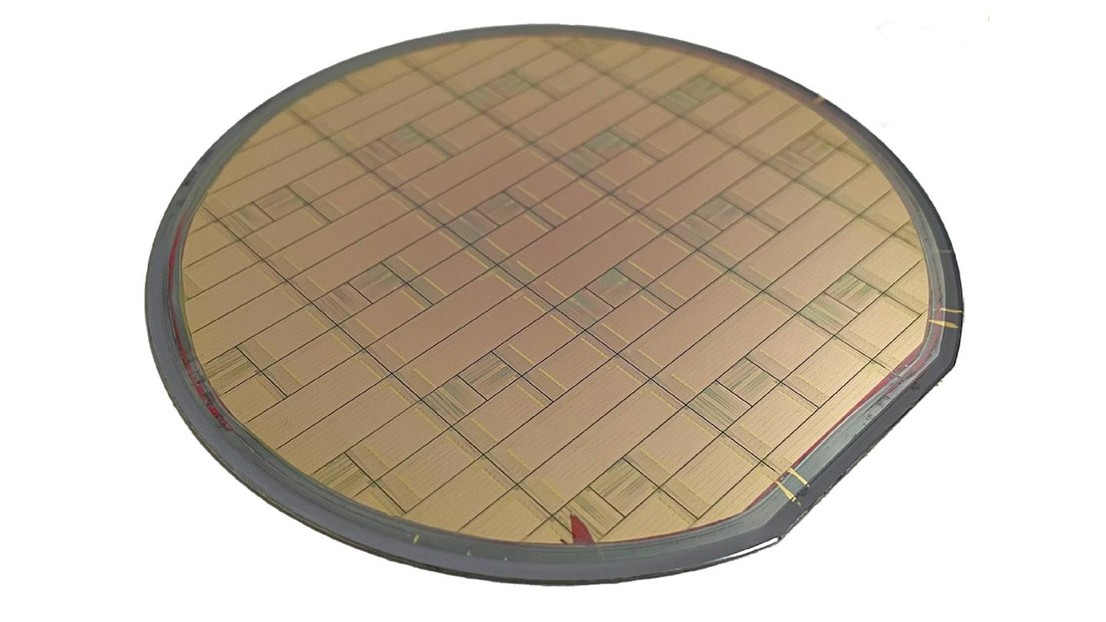
Photograph of a manufactured 100-mm wafer hosting hundreds of copper Damascene lithium tantalate modulators. Credit: Lin et al 2026.
EPFL researchers have, for the first time, applied the semiconductor industry’s standard copper wiring process to ferroelectric thin film photonics. By building lithium tantalate modulators with copper instead of gold, they remove a major barrier to 3D integration with advanced CMOS electronics and move optical interconnects closer to large scale deployment in data centers and AI clusters.
For two decades, silicon photonics has powered data centers by converting electrical signals into pulses of light. As AI and cloud computing drive ever higher bandwidth demands, researchers are moving beyond silicon. Ferroelectric materials such as lithium niobate and lithium tantalate offer the Pockels effect, an ultra-fast and linear response that enables efficient optical modulation at CMOS compatible voltages.
A key bottleneck has persisted. Although lithium tantalate on insulator wafers are already produced in high volume for 5G acoustic filters, most modulators built on them still use gold electrodes. Gold does not support the planarization needed to bond photonic chiplets directly to silicon driver electronics. This creates a gap between next generation photonics and the electronics required to drive them.
A team led by Tobias J. Kippenberg at EPFL and Christian Koos at KIT has now addressed this issue. In Nature Communications, the researchers report the first thin film lithium tantalate modulators fabricated with the copper Damascene process, the same metallization technique used in advanced CMOS logic and memory chips for more than twenty years.
“For years, the performance of ferroelectric modulators has been defined by their voltage and speed. But the question of how to connect thousands of these devices to silicon electronics at scale remained open,” says Kippenberg. “By adopting the copper Damascene process, we are aligning with established semiconductor manufacturing.”
A planar surface and improved performance
The Damascene process involves etching trenches into a dielectric, filling them with electroplated copper, and polishing the surface flat using chemical mechanical planarization. The result is electrodes that are flush with the surrounding material.
Such a planar surface is essential for modern 3D integration, especially copper:copper hybrid bonding. This technique allows chiplets to be stacked with very high interconnect density. The EPFL KIT devices are the first electro optic modulators on a ferroelectric platform with a surface compatible with this approach.
Switching to copper also improves electrical performance. Electroplated copper self-anneals and stabilizes at a resistivity about 20 percent lower than gold. In the reported devices, microwave loss decreased by 10 percent. The modulators reached line rates of 416 Gbit per second with PAM4 and 540 Gbit per second with PAM8 below the 25 percent soft decision FEC threshold. Performance matches leading gold-based devices while offering watt level on chip power handling and bias drift stability below 0.4 dB over 15 hours
From laboratory demonstration to fabrication compatibility
Unlike silver, which has slightly lower resistivity but suffers from diffusion, sulfidation, and limited process maturity, copper is already widely used in semiconductor manufacturing. The devices were fabricated on 4-inch wafers using DUV stepper lithography and showed device to device variation below 3 percent at 60 GHz. These results highlight the reproducibility of the process.
The study shows that lithium tantalate photonic integrated circuits can be produced with backend of line processes similar to those used in the most advanced CMOS nodes. This supports chip on wafer integration, where high speed CMOS driver electronics are bonded directly to the photonic die.
Implications for AI and neuromorphic computing
The implications extend beyond conventional transceivers. Photonic matrix vector multipliers, which are central to neuromorphic computing, rely on large arrays of modulators driven simultaneously by electronics. High density, low parasitic copper bonding between electronic and photonic layers could enable new photonic computing architectures.
“This work aligns photonic integration with the industrial semiconductor roadmap,” says Christian Koos. “It allows future photonic engines to follow the same integration trends that have shaped modern electronics.”
The lithium tantalate samples were fabricated at the EPFL Center of MicroNanoTechnology.
Horizon Europe EIC transition program
Swiss State Secretariat for Education, Research and Innovation (SERI)
European Research Council (ERC) (Horizon Europe research and innovation programme)
Air Force Office of Scientific Research
Mengxin Lin, Zihan Li, Alexander Kotz, Hugo Larocque, Nikolai Kuznetsov, Jiale Sun, Yichi Zhang, Shuhang Zheng, Johann Riemensberger, Christian Koos & Tobias J. Kippenberg. Copper damascene process-based high-performance thin-film lithium tantalate modulators. Nature Communications 26 February 2026. DOI: 10.1038/s41467-026-69588-6