
Congratulations to Dr. Roland Schwan for obtaining his PhD!
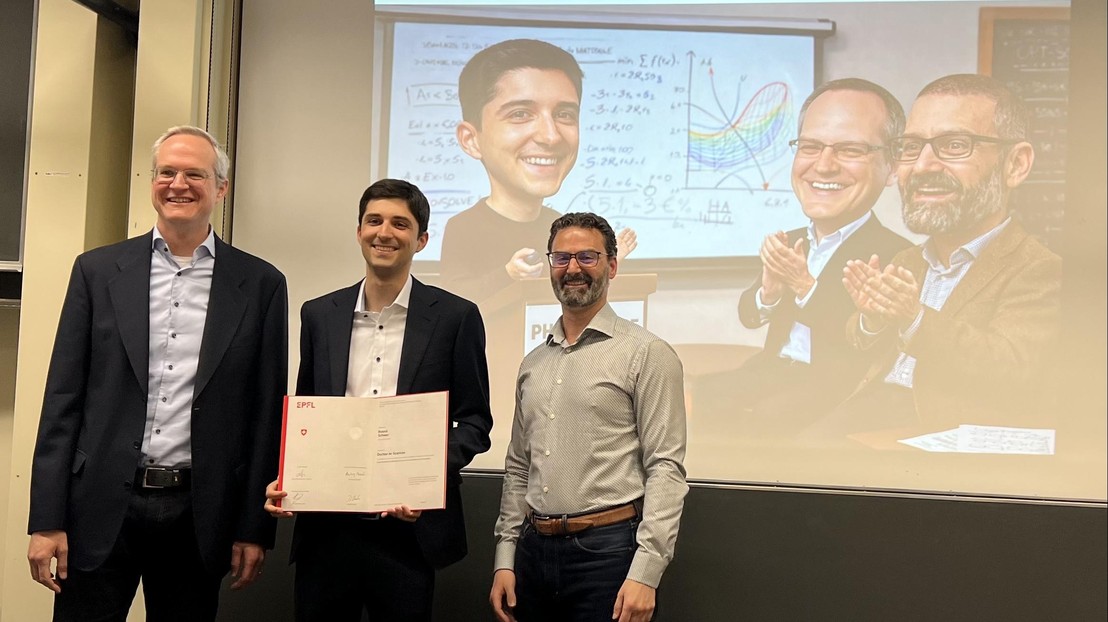
© 2026 EPFL
Dr. Roland Schwan obtained his PhD in March 2026. His dissertation, supervised by Prof. Colin Jones and Prof. Daniel Kuhn, is entitled "Numerical Methods for Optimization and Control: From Verification to GPU-Acceleration".
Abstract:
Mathematical programming establishes a rigorous foundation for solving complex problems in fields such as engineering, operations research, and finance. However, deploying these methods in real-time control applications, particularly Model Predictive Control (MPC), presents significant challenges regarding computational resources, solve times, and scalability. This thesis addresses these hurdles by progressing from theoretical verification methods to numerical algorithm design and experimental deployment.
To enable a reliable deployment of MPC on resource-constrained embedded systems, the first part of this work investigates the approximation of optimization-based controllers using neural networks. Although computationally efficient, these approximations typically lack inherent safety guarantees. We propose a framework based on mixed-integer programming to verify these neural network policies. This enables the deployment of control policies on resource-constrained embedded systems while providing formal guarantees on stability and worst-case approximation error.
The second part focuses on accelerating numerical methods for online optimization. We introduce our solver PIQP (Proximal Interior-point Quadratic Programming), a generic sparse quadratic programming solver based on a proximal interior-point algorithm that achieves state-of-the-art performance for both ill-conditioned and high dimensional problems. We extend this solver to exploit the specific structure of multistage problems, supporting general coupling and global decision variables. To maximize performance on modern parallel hardware, we develop a GPU-accelerated Cholesky factorization scheme for block tridiagonal matrices. By employing nested dissection permutation strategies, this technique reduces the computational complexity for long prediction horizon problems from linear to logarithmic time.
Finally, we validate these methods on a custom-developed multi-agent hovercraft platform. We employ physics-informed deep learning to identify nonlinear system dynamics directly from trajectory data and demonstrate the practical scalability of the proposed tools by implementing a cooperative distributed MPC framework. The experiments showcase fully decentralized nonlinear MPC for formation control and collision avoidance, featuring true neighbor-to-neighbor communication and sampling rates in the millisecond range running entirely onboard embedded systems.
The methods and tools developed throughout this thesis advance the practical deployment of optimization-based control systems, from theoretical guarantees through efficient numerical implementation to real-world hardware validation.