
Cognetics detect risk for cognitive decline in Parkinson's disease
© 2026 EPFL
Cognetics links neuropsychology with robotics technology in Parkinson's disease. Sensitivity to robotically-induced hallucinations uncovers subtle frontal subcortical deficits in patients with so-called minor hallucinations that standard cognitive tests fail to detect.
When does a fleeting sensation of a presence become a warning sign?
Up to 60% of people with Parkinson's disease experience minor hallucinations — fleeting sensations of a presence (presence hallucination) when no one is there, or glimpsing of an undefined and moving figure at the edge of vision. Although these experiences are known to precede more complex visual hallucinations and are considered early markers of cognitive risk, standard neuropsychological assessments have repeatedly failed to detect any objective cognitive difference between patients who have minor hallucinations and those who do not.
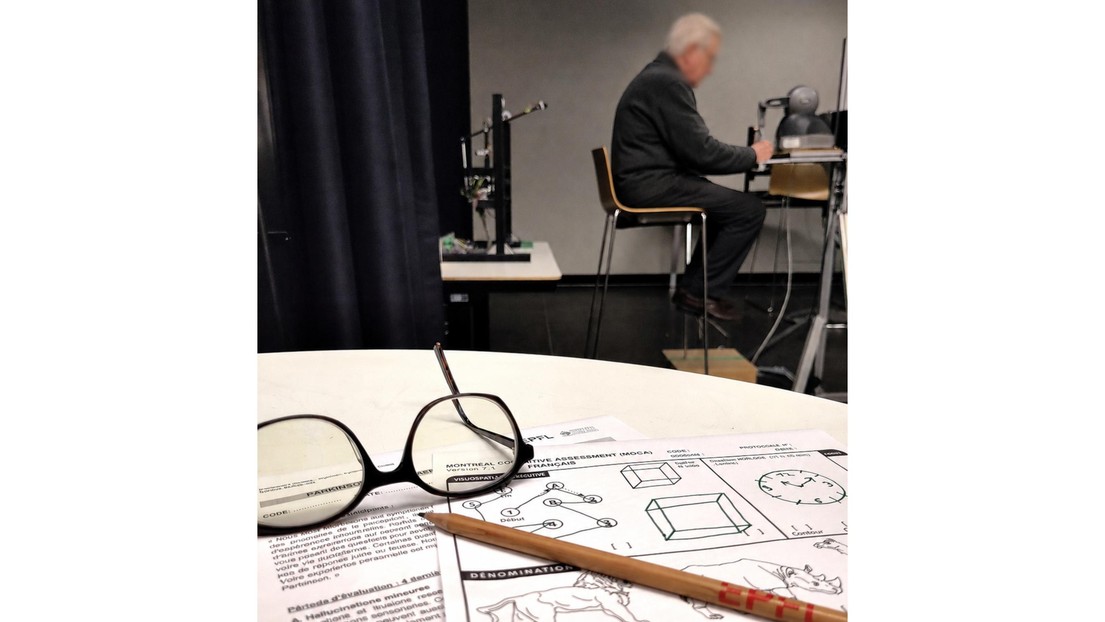
In a new study published in the Journal of Parkinson’s Disease led by Dr. Jevita Potheegadoo, we combined clinical neuropsychological testing with a robotic procedure that determines patients’ hallucination susceptibility (by experimentally inducing presence hallucinations — the sensation of an unseen person standing nearby (Bernasconi et al., 2021; Potheegadoo et al., 2022).
First, we found that patients with minor hallucinations had significantly higher hallucination susceptibility than patients without any hallucinations. Critically, this heightened susceptibility was linked to lower performance on frontal subcortical cognitive functions such as executive control, attention, and working memory, although this relationship that was entirely absent when relying on standard testing alone. Patients with minor hallucinations also reported greater subjective cognitive difficulties in daily life.
These findings demonstrate that the robotic hallucination-induction procedure should be combined with clinical neuropsychological assessments, thereby revealing a subtle but meaningful cognitive vulnerability in early Parkinson's disease that would be missed by standard clinical tools. The present approach that links techniques from cognitive science and robotics is called cognetics (Rognini & Blanke, 2016) and offers a more sensitive method of identifying patients at risk of cognitive decline. Our current work determines the potential of cognetics for earlier cognitive decline detection and extends the approach to other neurodegenerative diseases.
This work was also presented and discussed with patients and care-givers in a dedicated webinar organised by France Parkinson on March 9th 2026 (available here).
This project was supported by two generous donors advised by CARIGEST SA, the first one wishing to remain anonymous and second one being Fondazione Teofilo Rossi di Montelera e di Premuda; the Bertarelli Foundation; Parkinson Schweiz, Leenaards foundation, Empiris foundation, Swiss National Science foundation (n° 320030_188798), Synapsis Foundation.
Potheegadoo, J., Duong Phan Thanh, L. F., Bernasconi, F., Meyer, N. H., Jenni, L., Maradan-Gachet, M. E., Stucker, C., Dhanis, H., Catalano Chiuvé, S., Bally, J. F., Castro Jimenez, M., Fleury, V., Horvath, J., Wicki, B., Pagonabarraga Mora, J., Krack, P., & Blanke, O. (2026). Frontal subcortical executive dysfunction and minor hallucinations in Parkinson’s disease are linked to sensitivity to somatomotor conflicts. Journal of Parkinson’s Disease, 1877718X261440703. DOI link
Bernasconi, F., Blondiaux, E., Potheegadoo, J., Stripeikyte, G., Pagonabarraga, J., Bejr-Kasem, H., Bassolino, M., Akselrod, M., Martinez-Horta, S., Sampedro, F., Hara, M., Horvath, J., Franza, M., Konik, S., Bereau, M., Ghika, J.-A., Burkhard, P. R., Van De Ville, D., Faivre, N., … Blanke, O. (2021). Robot-induced hallucinations in Parkinson’s disease depend on altered sensorimotor processing in fronto-temporal network. Science Translational Medicine, 13(591), eabc8362. DOI link
Potheegadoo, J., Dhanis, H., Horvath, J., Burkhard, P. R., & Blanke, O. (2022). Presence Hallucinations during Locomotion in Patients with Parkinson’s Disease. Movement Disorders Clinical Practice, 9(1), Article 1. DOI link
Rognini, G., & Blanke, O. (2016). Cognetics : Robotic Interfaces for the Conscious Mind. Trends in Cognitive Sciences, 20(3), 162‑164. DOI link