
Climate Crisis, Democracy and the Digital
© 2021 EPFL
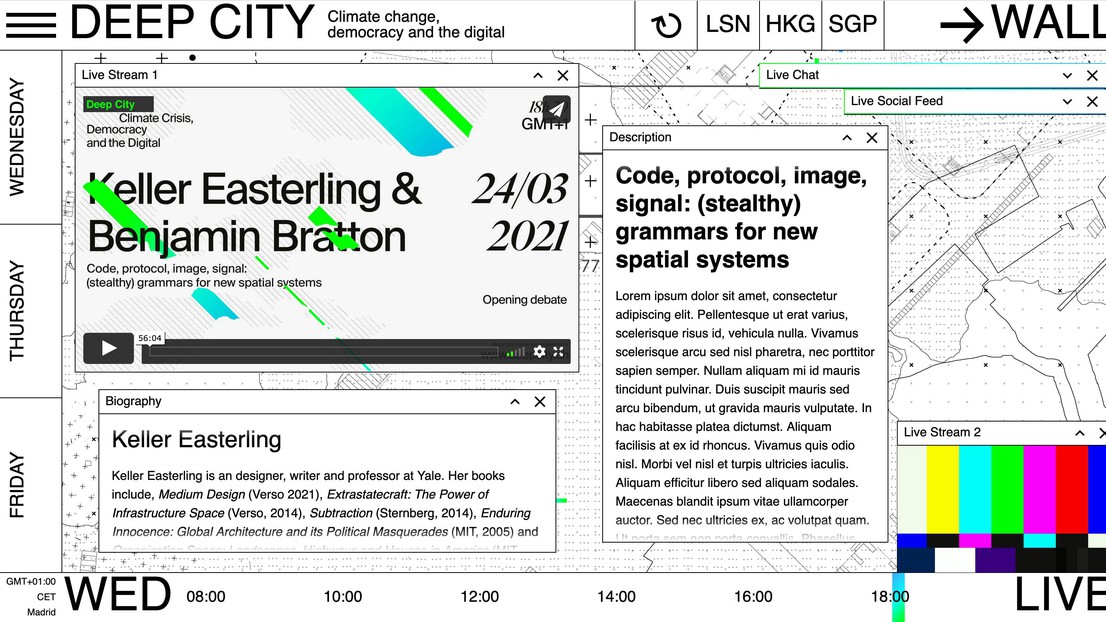
An ENAC team developed a global dialogical platform for hybrid conferencing: first launch at the Deep City International Latsis Symposium.
The new normal caused by COVID-19, challenges us to think, work and interact differently. Academic life is one of the fields directly affected. Within this new context, and with an upcoming international conference fast approaching, we felt the need to invent a new medium for the dissemination, questioning and debating of ideas, adequate for multiple events taking place in synchronous and asynchronous formats.
The new digital platform conceived by researchers and designers from ALICE and LDM as a plug-and-play tool for hybrid conferencing, and developed in collaboration with EPFL Mediacom and ComputedBy, will be first tested during the Deep City digital-physical symposium, that will take place at the end of March at EPFL (see information below). The platform was designed with the aim of augmenting the physical experience of the symposium through the digital while expanding the possibilities of the digital through a unique use of the spatial and embodied realm.
Beyond Covid-19, climate change demands us to invent tools to stage conferences and create global meaningful encounters with an ecological conscience and with the lowest carbon footprint possible. Tools where the digital becomes much more than a substitute for an unavailable presence, and the physical becomes a site of touch, synesthetic encounter and performativity. For all these reasons, this digital platform for hybrid conferencing will connect an amplified audience in different time zones and geographical areas while enhancing the spontaneity and informal interaction that physical presence offers.
The digital platform is organized around two key components: the MAP and the WALL. A spatial-temporal “MAP” will depict the different events in relation to time (when they happen), to physical space (where they happen) and to their physical proximities and thematic affinities. By making graspable all the geographical and conceptual sites involved throughout the event, the MAP will enable a situated reading of all its contents. From the MAP, the user will be able to follow each event with video streaming plus a series of supporting information (references, comments, biographies, etc). By integrating online white board technology within the platform, the WALL will enable conference participants to present material beyond traditional static displays and generate instead a processual setting, capable of transforming itself in relation to discussions and dialogues throughout events.
As the event evolves, the platform will become its own archive, with all events, activities, interactions, and the actual papers being saved for future search and research.
Deep City International Latsis Symposium.
Deep City: Climate Crisis, Democracy and the Digital will take place online, streaming from the Rolex Learning Center at the EPFL Campus in Lausanne, from March 24th to 26th 2021, with parallel and common activities in partner sites Singapore (in collaboration with SUTD Singapore University of Technology and Design) and Hong Kong (in collaboration with Hong Kong University).
Through its international Call for Contributions, Deep City – International Latsis Symposium has gathered people from around the world to discuss and present written, built, coded, drawn, filmed, or modelled work around the current links between data, machine intelligence, democracy and sovereignty, how their interrelations are producing urban and political imaginaries of a new kind as well as the need for alternative forms of negotiation and collaboration between the technological, the ecological and the social.
To consider these and other questions, we will host a series of virtual keynotes and paper presentations, as well as a physical-virtual exhibition, workshops and roundtables, to collectively grasp the Deep City. These activities will revolve around the themes of:
- Data, democracy, and sovereignty;
- New digital tools for urban governance;
- New material agencies;
- New negotiations between the technological, the ecological and the social;
- Resilient cities and territories in the post-Anthropocene;
- Artificial intelligence as new forms of design.
Co-chaired by Dieter Dietz and Jeffrey Huang from ENAC, the keynote speakers will include Keller Easterling from Yale School of Architecture, Benjamin H. Bratton from UCSD and Strelka Institute, Yves Citton fromUniversité Paris 8 Vincennes-Saint Denis, and Shannon Mattern, from the New School at New York. The Deep City International Latsis Symposium is held thanks to a grant from the International Latsis Foundation. For more information on the symposium, please visit our site https://deepcity.ch/.
Latsis Team