
“Classes must open windows into an almost infinite body of knowledge”
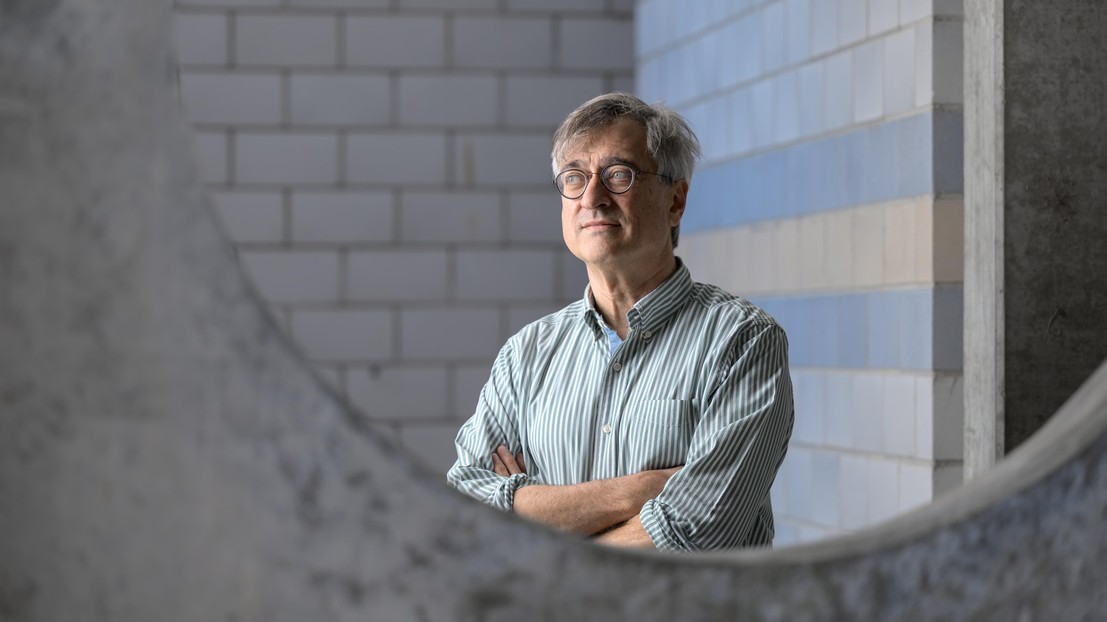
© 2026 EPFL/Lundi13 - François Wawre - CC-BY-SA 4.0
Andreas Mortensen has been an EPFL professor of materials science for the past 30 years and has held various management positions at the School, including vice president for research. He’s the winner of this year’s best teacher award for his section, handed out at the 2026 master’s graduation ceremony. .
When asked where he gets the energy to keep standing up in front of the classroom after four decades of teaching, Mortensen replies without hesitation: “from the students.” And then he adds, without missing a beat: “that is, provided that they’re there.” In his experience, classroom attendance has dropped significantly since the pandemic owing to the use of recorded lectures. Yet Mortensen is still a firm believer in the benefits of in-class learning. “If we manage to keep students’ attention during a lecture, then we’ve succeeded,” he says. “And if we also make them want to learn more about the subject, that’s even better.”
Mortensen remembers the days when teaching was done on a chalkboard, and then on overhead transparencies. He was always careful to leave his transparencies a little rough around the edges. “If your lecture is too polished, that will turn your students into mere spectators staring at the screen,” he says. He now uses PowerPoint slides, yet the most important teaching tools in his view are discussion and storytelling – that is, walking students through a concept rather than simply talking about the images on the screen.
Becoming a professor wasn’t in the cards
For Mortensen, a career in teaching and research was anything but foreordained. He went through the French educational system, completing intense university preparatory classes and then earning an engineering degree in 1980 from École des Mines de Paris. After that, he studied materials science – a major that was “a great way to not make a decision.” The field is so broad that it let him avoid having to specialize too soon. “Unlike fields that are built around a method, materials science is built around the very objects that are being studied,” he says. “That means you can draw on a number of scientific approaches.” Mortensen decided to attend MIT for his master’s degree. “I planned to stay there for just those two years” – but he ended up staying for 16. While a master’s student in Boston, he realized that he still had a huge amount to learn in his field, and that remaining at MIT to complete a PhD would be intellectually worthwhile. After that, he worked as a postdoc at a company in Japan and then returned to MIT as a professor, a role he held for ten years.
Today, Mortensen is the head of EPFL’s Mechanical Metallurgy Laboratory. His research includes developing new materials and exploring the relationship between a material’s microstructure and its properties. “I’m someone who likes to learn through experimentation,” he says. “But lab experiments make sense only if they help you better understand the mechanisms behind what you observe.” He also enjoys “alternating between theory and application, between science and technology. They both feed into each other.” One of his most memorable achievements was a material he developed around 20 years ago that contained 50% ceramic – which is inherently fragile – and 50% metal. Yet the material was almost as tough as metal alone. Today he views that accomplishment as “pretty interesting – even amusing.”
Teaching students to be curious
Mortensen has held a number of management positions during his time at EPFL, including dean of PhD programs, head of the materials science institute, dean of research, vice provost and vice president for research. “All that showed me the extent of the obstacles that a large organization faces when trying to change, but it also gave me the opportunity to witness firsthand the rapid transformation of a relatively young university and to contribute to it, even if only in a small way. ”
Mortensen isn’t entirely convinced by some of the shifts taking place in university-level teaching, such as the trend towards establishing increasingly specific learning outcomes – things that students must know or know how to do after taking a class. He agrees that there’s a place for learning outcomes, but they can also be overly limiting in terms of the knowledge that students acquire. Students might wonder why they should bother learning something if it isn’t listed as a learning outcome or mentioned on a slide. Rather than this kind of highly structured approach, Mortensen takes another view. For him, classes should serve as “windows into an almost infinite body of knowledge.” And teachers can reveal only part of this knowledge. He therefore believes university professors should be able to encourage students to go beyond the information that is served up to them – in other words, to teach them to be curious and to reward intellectual ambition.
Mortensen has received several scientific awards over the course of his career, but he insists that he does not seek recognition. But he stresses that he’s not chasing awards. That said, he’s happy to have been given the one for best teacher – especially because the decision was made mostly by students. “It’s really cool and I’m very pleased, but there’s no need to make a big deal about it,” he says.