
CHANGE Lab at CMWR 2026: from ecohydrology to landscape evolution
© 2026 EPFL
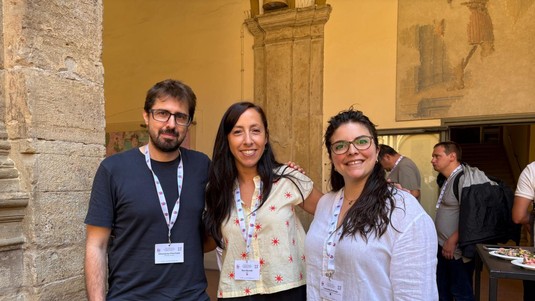
CHANGE members presented their latest research and contributed to the scientific programme of the 26th conference on Computational Methods in Water Resources (CMWR 2026) in Bologna, Italy.
CHANGE Lab members participated in the 26th Conference on Computational Methods in Water Resources (CMWR 2026) in Bologna, Italy, sharing their latest research on distributed ecohydrological modeling, coupled ecohydrological-geomorphological processes, and landscape evolution.
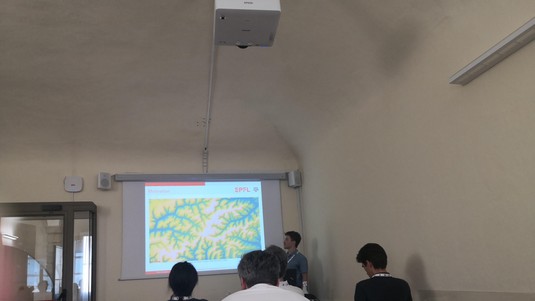
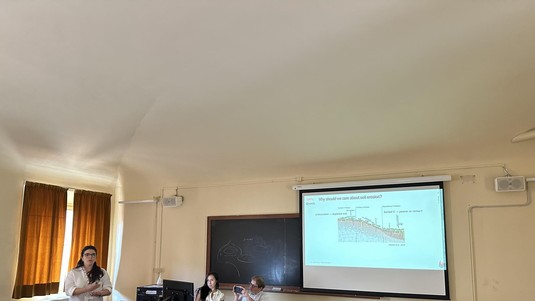
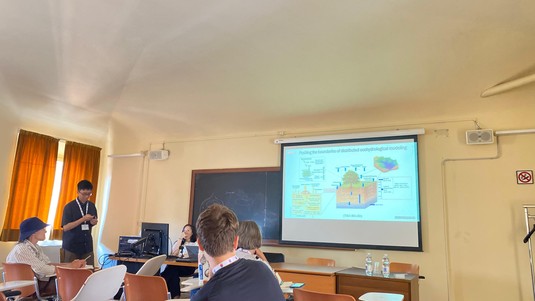
Sara Bonetti convened the Computational Ecohydrology session, bringing together researchers working on computational approaches to understand the interactions between hydrological and ecological processes across scales. Ben Kargère presented ongoing research exploring how variational principles and nonequilibrium thermodynamics can provide a unified physical framework for understanding the coupled evolution of hillslopes and river networks (Excess Entropy Production as a Driving Potential for Geomorphic Landscape Evolution). Taiqi Lian presented recent work published in Water Resources Research and Geoscientific Model Development, highlighting advances in distributed ecohydrological modeling that improve the representation of water, carbon, and nutrient dynamics across topographically complex landscapes (Advancing Distributed Ecohydrological Modeling of Catchment Water and Carbon Fluxes in Topographically Complex Landscapes). Concetta D'Amato presented ongoing work on the development of a coupled ecohydrological-geomorphological modeling framework to investigate how soil erosion and deposition influence soil organic carbon, vegetation productivity, and water fluxes over long timescales (Leveraging Coupled Ecohydrological–Geomorphological Simulations to Assess Soil Erosion Effects on Carbon Cycling and Vegetation Dynamics).
CMWR 2026 provided a valuable opportunity to present our latest research, exchange ideas with researchers advancing computational methods in hydrological sciences, and strengthen collaborations across the community! Looking forward to the next edition!

Swiss National Science Foundation (Grant 10002612)