
“Cartography is a continuously changing visual dialect”
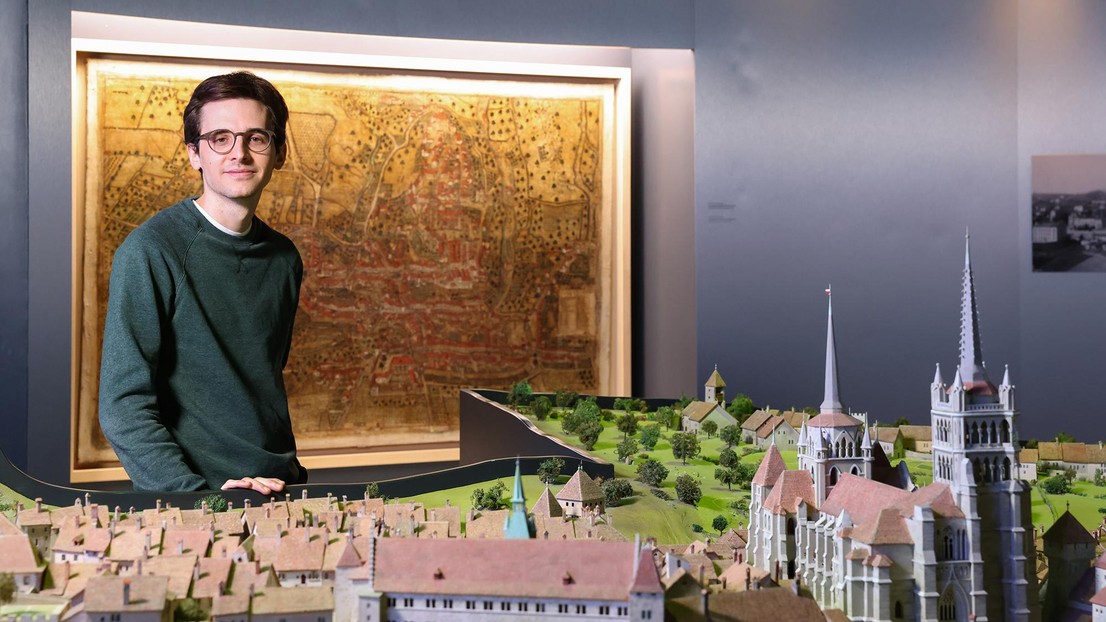
© 2026 EPFL/Alain Herzog
What can hundreds of thousands of historical maps tell us about power, culture, and how ideas spread? Through his PhD research, Rémi Petitpierre of the Time Machine Unit research group (TMU) at EPFL explores how maps, and the visual languages behind them, transform across centuries.
Please explain your research “Studying Maps at Scale”.
My PhD focuses on the historical and cultural dynamics of the evolution of cartography. It implements large-scale, digital approaches to investigate cartographic heritage through modeling and visualization. The aim is to complement the work of historians who examine maps with a qualitative and individual approach, by engaging instead with the history of cartography using computational methods and considering several hundred thousand maps.
This quantitative approach makes it possible to verify certain hypotheses formulated by humanities scholars. For example, it has long been suspected that those who control map production define how the world is represented, but also how it is understood. However, how can such a hypothesis be demonstrated empirically? By analyzing a global corpus spanning six centuries, my dissertation highlights the structural dependency between the production of maps by European powers and the economic development of the colonies.
The second part of my dissertation focuses on how cartographic knowledge and practices have historically spread. For example, tracing how visual conventions evolve and are transmitted from one city to another, or from one cartographer to another. What causes people to suddenly start using one particular symbol instead of another? My research shows that this evolution is neither linear nor based on determinate progress. Maps evolve under the pressure of multiple factors—technical developments, of course, but also economic pressures, cultural conventions, aesthetic considerations, function, and material constraints, such as the availability of certain pigments. Thus, cartography is shaped slowly, like a continuously changing visual dialect.
What do you find interesting about your field of research? What purpose does it serve?
Beyond the specific implications for the history of cartography, my research argues that socio-cultural theory—which tends to read maps as discourse, and events as expressions of power-knowledge relations—can also be demonstrated through empirical approaches such as those employed in the natural sciences. In the current context, where science and even more so social sciences face increasing skepticism, it is essential to strengthen the connections between disciplines. There are no “hard” sciences on one side and “soft” sciences on the other. The two domains are bound, and undermining one weakens the foundation of all knowledge creation.
In this sense, cartography is merely a prism through which we can study cultural dynamics, and understand how and why practices and conventions change and spread across different places and periods. Studying these processes is necessary to face the challenges of the 21st century.
How did you undertake your research?
When I first started working on maps in 2019, the field was a terra incognita. Not only were the efforts to digitize map collections still quite limited, but we did not know how to operationalize them or recognize cartographic information at a large scale. We were among the very first to publish a paper on map recognition using modern technologies.
From there, my work mainly consisted of finding methods to explore this vast discipline. It required perseverance, trial and error, but above all, a great deal of creativity. My approach was primarily exploratory. And even today, we have only begun to scratch the surface of the potential contained in this fascinating data. There is still much knowledge left to uncover.
Why did you decide to do a PhD in the digital humanities?
I believe that the great asset of digital humanities is to allow us to think and move beyond traditional disciplinary boundaries. We have this community, but it is not defined by a convergence of research topics. Even within the same lab, there is only a slight overlap between our research projects.
The academic world tends to valorize the physical mobility of researchers, but I see disciplinary mobility as perhaps even more important. Being continually confronted with vastly different issues, topics, and perspectives can be uncomfortable and destabilizing, but it compels digital humanities students and researchers to stay adaptable, curious, and versatile.
What are your plans now that you have your PhD?
I will pursue a postdoc at EPFL for two more years, partly funded by a Horizon Europe project. My time will be divided between teaching and the development of open-access tools for map analysis and historical geography. I am excited by the prospect of pushing the boundaries of knowledge further, elucidating the mechanisms of cultural evolution, and investigating, through the lens of historical maps, the way territories themselves change over time.
When you are not working, what do you enjoy doing in your free time?
While I like exploring conceptual spaces, I also enjoy traveling in the actual world. I spend most of my holidays traveling through Europe by train, visiting historical cities, and hiking to discover new landscapes. I also enjoy cooking, reading books, and playing video games.