
Bulky organic spacer enables lead-free perovskites to work in water
© 2026 EPFL
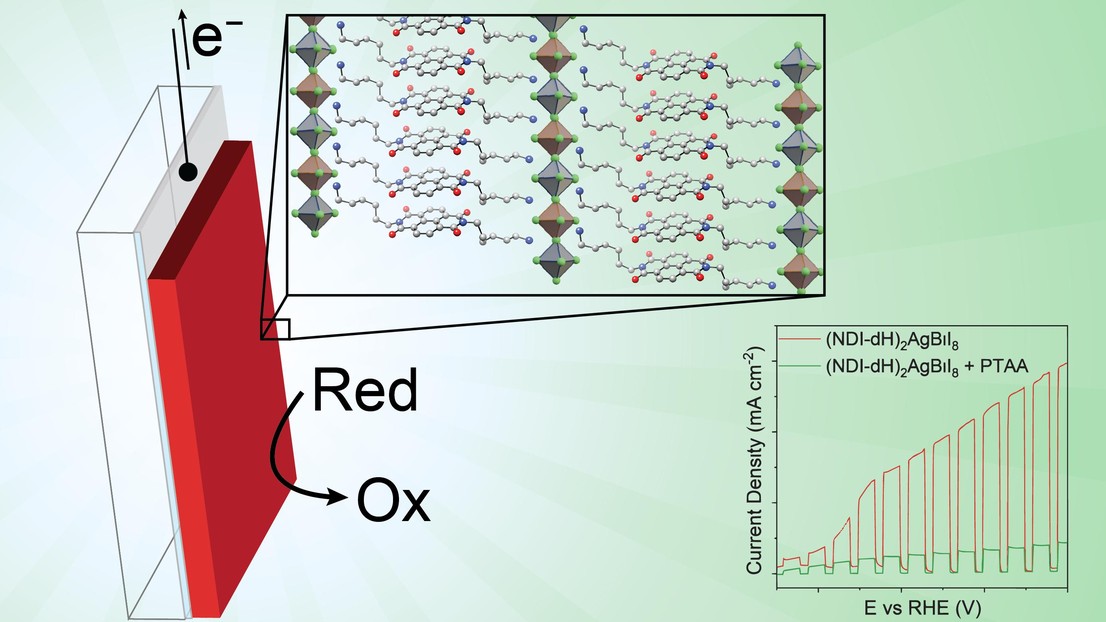
By integrating a large, bulky organic cation into a lead-free layered double perovskite, LIMNO researchers have enabled the first photoelectrochemical operation of this class of materials in an aqueous solution.
Layered hybrid double perovskites (LHDPs) are promising materials for optoelectronic and solar-energy applications, but their sensitivity to water has so far limited their use at semiconductor–water interfaces.
In a study recently published in Angewandte Chemie International Edition, researchers at EPFL's LIMNO lab introduced a hydrophobic naphthalene diimide dication (NDI-dH²⁺) into the perovskite structure, producing (NDI-dH)₂AgBiI₈. The new material combines improved electronic properties with exceptional stability in humid conditions and liquid water. These properties allowed the material to operate as a photoanode in an aqueous electrolyte, generating a photocurrent of 0.25 mA cm⁻² at +1.0 V versus RHE under one-sun illumination. With a hole-transporting overlayer, the device remained operational for more than one hour.
The researchers findings also highlight the active role that the organic spacer can play in the optical and electronic properties of the perovskite. The results demonstrate how molecular engineering of the organic spacer can improve both the performance and water stability of lead-free layered double perovskites, opening new possibilities for their use in photoelectrochemical applications.
The authors graciously acknowledge the technical support of the ISIC mechanical and electronic workshops, and Dr. Mounir Mensi for UPS measurements.