
Biodegradable drug implants for multi-drug release into the cochlea
© 2025 EPFL
Congratulations to our colleague Dr. Jongeon Park, for his recent publication entitled "Additive manufacturing of flexible, biodegradable drug implants for sustained multi-drug release into the cochlea" in the journal "Sensors and Actuators B: Chemical".
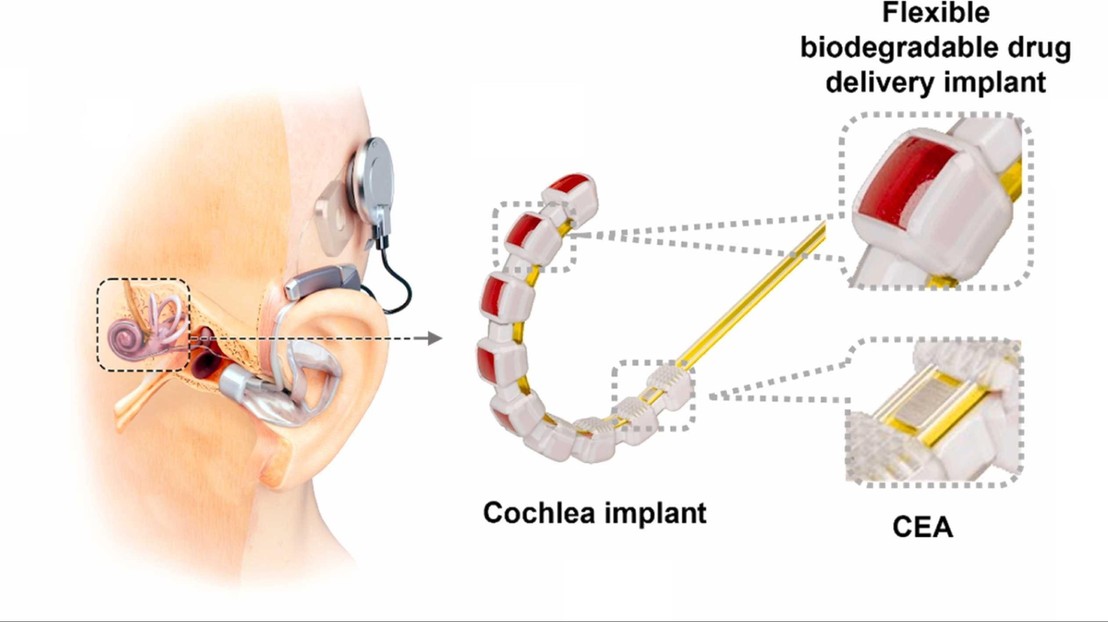
Sensorineural hearing loss is a profound form of deafness, arising from damage to cochlear hair cells, which can be treated by limited clinical options such as cochlear implants. However, the implantation procedure carries the inherent risk of electrode insertion trauma, which can potentially damage residual hearing. To date, several drug therapeutics have been proposed; however, most drug delivery systems administer single drugs over short durations with limited release, or they require additional surgery for removal. Here, we demonstrate the use of flexible biodegradable drug implants made by additive manufacturing, which could simultaneously deliver multiple anti-inflammatory drugs and growth factors over a prolonged period with a passively controlled release rate. Micro-drug reservoirs fabricated using poly(ethylene glycol) diacrylate through two-photon polymerization were filled with lipid-drug composites by drop-on-demand inkjet printing. The hydrophobic and water-impermeable characteristics of lipids, along with the one-way open reservoir design, allowed sustained release over 30 days. The biodegradable drug implants were integrated with a polyimide-Pt-based cochlear electrode array, which remained in place after implant degradation. In vitro and in vivo studies demonstrate the therapeutic efficacy of the implants for prolonged, multi-drug delivery, offering a promising solution for preserving hearing and improving the effectiveness of cochlear implants.
For more details, please visit: https://doi.org/10.1016/j.snb.2025.138496
This work was supported under the framework of the International Cooperation Program (2023K2A9A1A06097872) managed by the National Research Foundation of Korea (NRF). Additional support was provided by grants from the NRF (RS-2023–00219725 and RS-2024–00423107) and the Korea Innovation Foundation (RS-2024–00411288), funded by the Ministry of Science and ICT (MSIT), This work is also supported by the 2024 Yeungnam University Research Grant. The authors also acknowledge funding from the European Research Council (ERC) under the European Union’s Horizon 2020 research and innovation program (Project “MEMS 4.0”, ERC-2016-ADG, grant agreement no. 742685).