
Avoiding technological overdrive to preserve resources
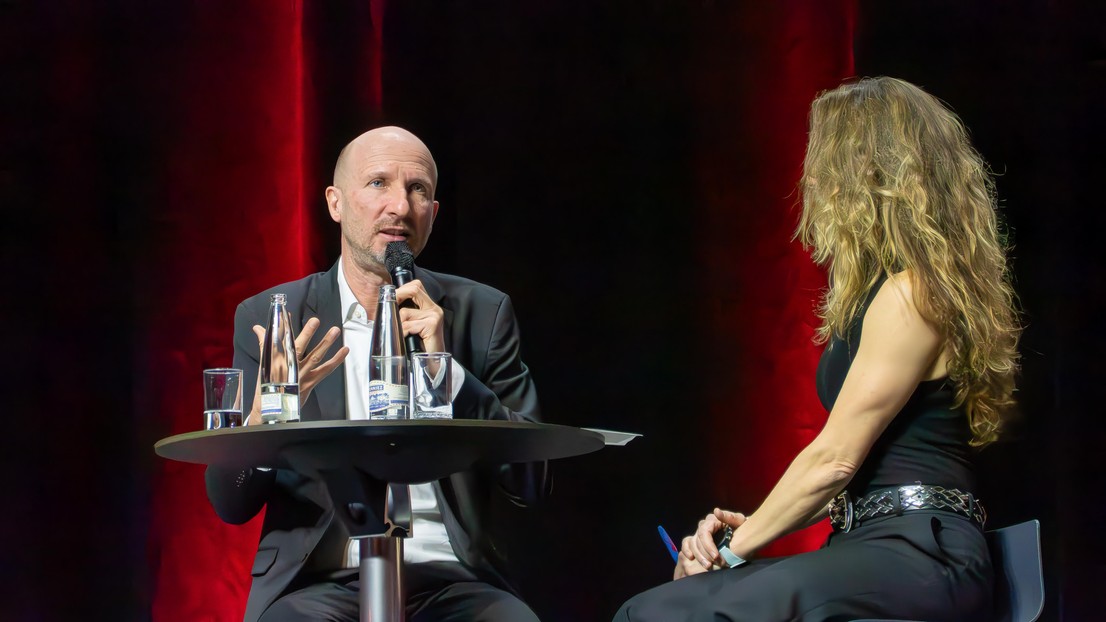
Philippe Bihouix, ingénieur spécialiste des ressources naturelles était l'invité de la cérémonie du Grand Témoin 2026. © 2026 EPFL/Gabriel Papaux
Each year, the Grand Témoin ceremony introduces new students to the EPFL Social Sciences and Humanities Programme. This year’s speaker, engineer and author Philippe Bihouix, invited the more than 1,500 students in attendance to reflect on growth, resource use, and the race for technological innovation.
What is the value, at the point of extraction, of the raw materials contained in a smartphone? “Three euros,” says Philippe Bihouix, director of the AREP group and a specialist in mineral resources who authored the graphic novel Ressources, un défi pour l’humanité. In other words, the return on investment offers little incentive to recycle an object that contains around forty different metals. At the Grand Témoin ceremony, Bihouix was interviewed by RTS journalist Anne Laure Gannac and discussed how we use the resources in everyday objects and the role engineering plays in addressing sustainability.
“The more high-tech our devices are, the further away they move from a circular economy,” he explains. “The way we design and use objects makes proper recycling extremely difficult. Metals are rarely used in their pure form, but rather as alloys, which causes recycling to be much more complex. Scientific studies show that around half of all metals (out of roughly 60) have a global recycling rate below 1%. While mineral resources may not in themselves constitute a planetary limit, we are nevertheless constrained by them, as their extraction requires increasing amounts of fossil energy.”
The more high-tech our devices are, the further away they move from a circular economy.
The engineer’s compass
Held at the start of the spring semester, the Grand Témoin ceremony marks the start of the Social Sciences and Humanities Programme (SHS) and launches the sustainability course taken by all first-year Bachelor’s students. Each year, a leading voice on environmental issues is invited to speak at the event, during which the SHS awards are also presented (see below and the interview with the SHS Prize winner).
To contribute positively to changing the world, you must first understand it. Understanding human beings should be the engineer’s compass.

“The main objective of the SHS Programme is to introduce EPFL students to the humanities and social sciences, so they can discover other ways of producing knowledge and take into account the human, social, and economic contexts,” notes Rudolf Mahrer, programme director and professor at EPFL and Unil. “It is essential that they are able to consider these dimensions in their future professions. We also develop transversal skills such as communication, creativity, and ethics. In EPFL’s sections, students learn how to do things; we also teach them to ask why they do them. To contribute positively to changing the world, you must first understand it. Understanding human beings should be the engineer’s compass.”
Technological discernment
In this spirit, the sustainability course aims to provide a shared foundation of knowledge and introduce students to a systemic approach to problem-solving. “We also want to highlight the importance of technological discernment. Before creating something, you need to think about its impact and the lifespan of the components used,” points out Jérôme Chappellaz, EPFL professor, director of the SENSE laboratory, glaciologist, and academic lead of the sustainability course. “We want students to reflect on the purpose of their actions, not just from an economic perspective.” Eleven teachers contribute to this interdisciplinary course. “This year, to ensure coherence, we chose a central theme, artificial intelligence, and explored it from different angles depending on our respective areas of expertise.”
We also want to highlight the importance of technological discernment. Before creating something, you need to think about its impact and the lifespan of the components used.

The rebound effect that continues to shape our world
Artificial intelligence is now everywhere, highly efficient, yet extremely energy intensive. “Being more efficient has never meant consuming less. That’s been the story of technological development for the past two centuries,” points out Philippe Bihouix. “The rebound effect, or Jevons paradox, continues to catch up with humanity, and we’re unable to capture efficiency gains. In aviation, for example, efficiency has never been higher, and CO₂ emissions per passenger kilometre have dropped significantly. But that has also enabled the rise of low-cost air travel, and the overall environmental footprint of the sector keeps increasing. That’s why solutions can’t be purely technical; they must be socio-technical. They inevitably raise questions about how technologies are used. When technology enriches our lives, it often leads to a diffuse and irreversible consumption of resources.”
How, then, can future engineers, scientists, and architects contribute to a more sustainable transformation of society? Beyond better sizing and more responsible resource use, Philippe Bihouix advocates for systemic sobriety, which requires “organizational innovation.” “If you take telecommunications as an example, it’s the only network-based industry where we’ve allowed multiple parallel networks to coexist. A single access network would work perfectly well.” Taking risks, exploring new pathways toward a more sustainable world while taking resource constraints into account: that is the message Philippe Bihouix shared with students. Because while a smartphone may contain only three euros’ worth of raw materials, its environmental cost is far higher.
“SHS courses open up new horizons”
The Grand Témoin ceremony also provides an opportunity to present the SHS awards. The SHS Prize is awarded for the best Master’s thesis (see the winner’s interview), while the “Global Issues” course poster awards recognise work by second-year Bachelor students. Fourteen posters were selected from around 300 submissions. One of the winning teams presented their poster during the ceremony, titled “Drought in a Sub-Saharan Village: From Impacts to Solutions”, produced as part of the course “Climate Change A: Causes, Impacts and Challenges.” Interview with Ariane Bardy, Nils Bouvet, Leen Joujou and Eléna Pellier, second-year Bachelor students in physics at EPFL.
What did you take away from the course and your project?
The course helped us broaden our knowledge beyond topics typically covered in physics. Having several instructors with different perspectives was particularly enriching. On a personal level, working in a group taught us how to organise ourselves with people who have different approaches, make compromises, and communicate more effectively.
Why did you choose this topic?
It’s a concrete and highly relevant issue that affects thousands of people, and it allowed us to think in terms of real-world solutions. We chose it out of empathy and a desire to contribute, even in a modest way, to improving living conditions in Sub-Saharan Africa.
Do you think SHS courses are important in an engineering curriculum?
Yes, absolutely. They help broaden our horizons and prevent us from focusing solely on the “hard sciences.” SHS courses contribute to shaping more well-rounded engineers, capable of better understanding the world around them. They also help us become more aware of the societal challenges linked to our future roles as engineers and scientists.