
AquaShield: AI-Driven Water Leak Detection
© 2026 EPFL
AquaShield is a fast-growing research and innovation project developing AI-based monitoring systems for building water distribution networks, with the aim of detecting and localizing leaks before they lead to structural damage, downtime, or costly repairs. The project addresses a critical blind spot in building operations: despite being a major source of risk, internal water networks are largely unmonitored.
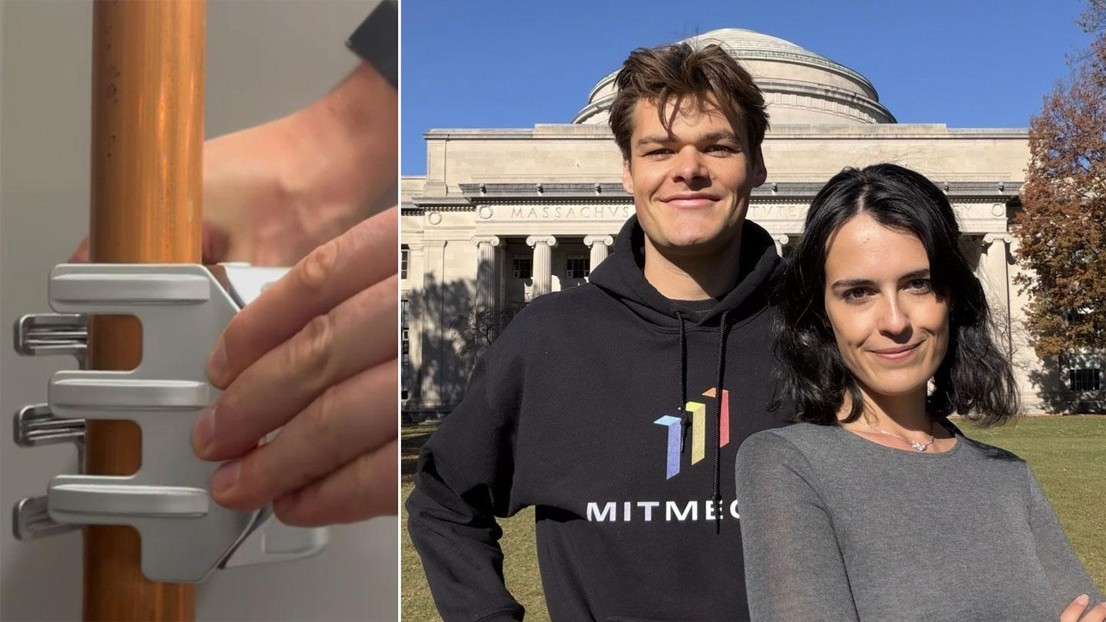
The initiative is led by Marguerite Benoist and Paul Beckers, whose expertise spans machine learning, anomaly detection, robotics, and digital twins, with academic backgrounds from MIT, EPFL, Harvard, RWTH Aachen, and Tsinghua University. AquaShield sits at the intersection of physical infrastructure systems and advanced time-series machine learning, translating cutting-edge research into real-world impact.
Why focus on building water networks?
Undetected water leaks are now the third most common global insurance claim for buildings, often remaining hidden for weeks behind walls and shafts. The result is severe structural damage, operational disruption, and escalating repair costs. This challenge is intensifying due to aging building stock, rising labor and material costs, and a shrinking maintenance workforce, prompting insurers to increase premiums and deductibles.
Beyond financial losses, water leaks also represent a significant sustainability issue, wasting both water and the energy used to heat and distribute it. From a research standpoint, building water networks are particularly challenging due to sparse sensing, complex network topologies, stochastic demand patterns, and strict constraints on sensor installation.
A software-first, AI-driven technical approach
AquaShield rethinks leak detection as a data and intelligence problem rather than a hardware-heavy one. The system combines advanced AI with sparse, non-invasive sensing:
Sensors - Off-the-shelf flow measurements at the building water meter, complemented by optional clamp-on ultrasonic sensors on selected pipe segments, no pipe cutting or service interruption required.
Machine learning - Transformer-based time-series models trained on real sensor data and large-scale synthetic hydraulic data generated from digital twins built using plumbing schematics.
Leak localization - Formulated as a graph inference problem, where Graph Neural Networks (GNNs) exploit building topology to infer faulty pipe segments from limited measurements.
Sensor optimization - Genetic algorithms identify sensor placements that maximize observability while minimizing hardware.
Human-in-the-loop & explainability - Facility teams validate detected events, continuously improving model performance, while large language models (LLMs) generate clear, interpretable explanations of anomalies for non-expert users.
Partnerships and pilot deployments
AquaShield combines applied research with operational validation through academic and industry collaborations:
MIT Facilities - A live pilot deployment on campus buildings is using real flow data and building documentation to evaluate detection and localization performance.
EPFL – CEAT Lab - The project is supported by the CEAT Lab and has received an AI Project Grant from the EPFL AI Launchpad.
Germany real-estate pilot - In parallel, AquaShield is deploying sensors with a large real-estate company to test the system at scale in operational buildings.
Join the project
AquaShield is actively recruiting highly motivated students and researchers for semester projects, Master’s theses, internships, and full-time research or engineering roles. Opportunities include state-of-the-art machine learning development, signal processing, LLM integration, and the design and construction of a hydraulic system testbench. Contributors work directly on live, real-world deployments.
Interested candidates:[email protected]