
An exciting new experimental campaign is underway in our lab!
© 2026 EPFL
As part of INDOAIRTOX project funded by Swiss National Science Foundation SNSF, we are bringing together researchers from EPFL ENAC, Paul Scherrer Institute, Max Planck Institute for Chemistry in Germany and Adolphe Merkle Institute to investigate indoor ultrafine particles (UFPs) and their effects on lung health.
UFPs are smaller than 100 nm. Understanding their health implications means looking beyond how many are in the air. We need to understand their composition, how they change indoors and how those changes influence their effects on lung cells.
At EPFL Fribourg, we are connecting controlled experiments in our indoor environmental chamber with detailed aerosol measurements and exposures of a 3D human lung tissue model. These experiments will help us follow particles from indoor sources through their transformations to their biological effects, under different environmental and building operating conditions.
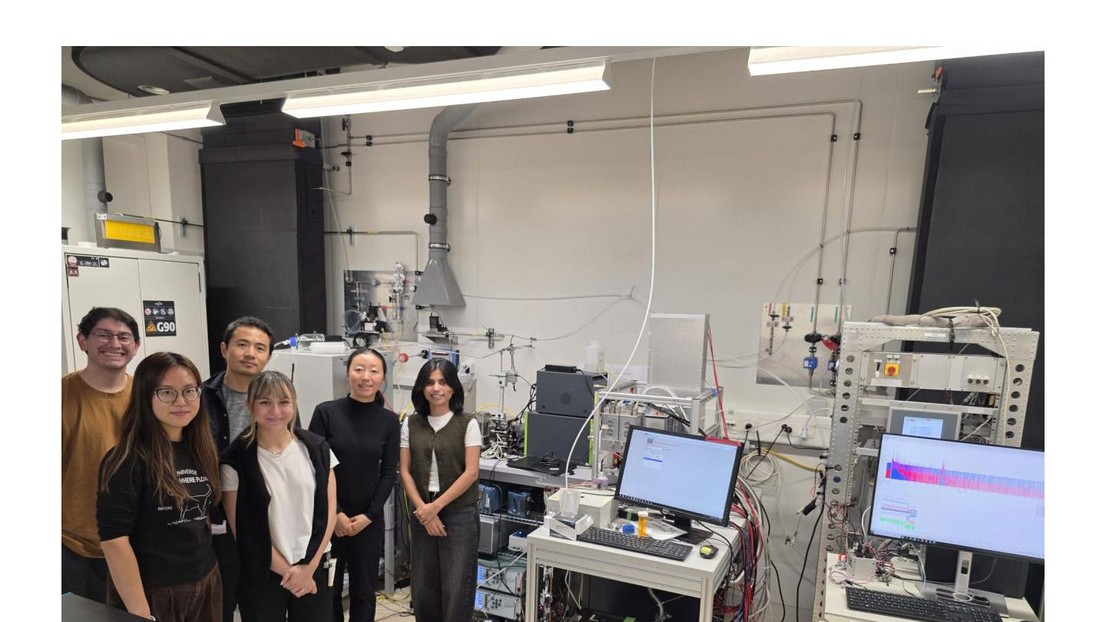
The people making it happen, pictured from left to right:
- Ruijie Zhu, EPFL PhD student, investigating ultrafine particle physics.
- Adrian Castro, PSI PhD student supervised by Dr. David Bell and Prof. Imad El Haddad, investigating particle chemical composition.
- Dr. Kristen Yeh, EPFL postdoctoral researcher, coordinating the campaign and investigating volatile organic compounds and environmental persistent free radicals in aerosols.
- Dr. Ruiwen He, Adolphe Merkle Institute scientist working with Prof. Barbara Rothen, investigating aerosol toxicity in lung cells.
- Dr. Nijing Wang, Max Planck Institute for Chemistry scientist working with Prof. Jonathan Williams, characterizing volatile organic compounds in real time.
- Khadija Sharaf Din, EPFL PhD student, investigating aerosol composition in real-time.
The instruments, pictured from left to right: a lung cell exposure chamber; an Airmodus PSM and CPC to detect and count the smallest particles; an SMPS to measure particle size distributions; other aerosol spectrometers; and inorganic gas analyzers. Completing the setup are an EESI mass spectrometer to track aerosol composition and a PTR TOF mass spectrometer to measure volatile organic compounds, both in real time.
It is wonderful to work with such brilliant, generous colleagues. We hope this campaign will deepen our understanding of human exposure to indoor ultrafine particles and their effects on lung health, helping build the evidence needed for healthier indoor environments.
Good luck to the whole team for the campaign ahead! Look forward to seeing what we discover together.