
Altered interoceptive mechanisms in Functional Neurological Disorder
© 2026 EPFL
Functional Neurological Disorder is associated with altered interoceptive processing and attenuated heartbeat-evoked potentials
We are pleased to announce the publication of a new article in Brain Communications, led by Natascha Stoffel and conducted in collaboration with Prof. Selma Aybek from the University of Fribourg (Switzerland).
In this study, Stoffel and colleagues investigated the role of interoception—the perception and processing of internal bodily signals—inFunctional neurological disorders (FND). FNDare characterized by neurological symptoms such as motor and sensory dysfunction, as well as dissociative or functional seizures, arising from alterations in brain network functioning. Historically, FND symptoms were interpreted as the physical manifestation of suppressed psychological stress, following the Freudian model of conversion. More recent research has shown that trauma is neither necessary nor sufficient for the development of FND. Nonetheless, stressful and traumatic experiences are recognized risk factors, suggesting their involvement in the disorder’s pathophysiology.
While altered interoception has been proposed as a key mechanism in FND, previous findings have been inconsistent and largely limited to self-report or behavioural measures. Importantly, neural markers of interoceptive processing and the role of attention have remained largely unexplored.
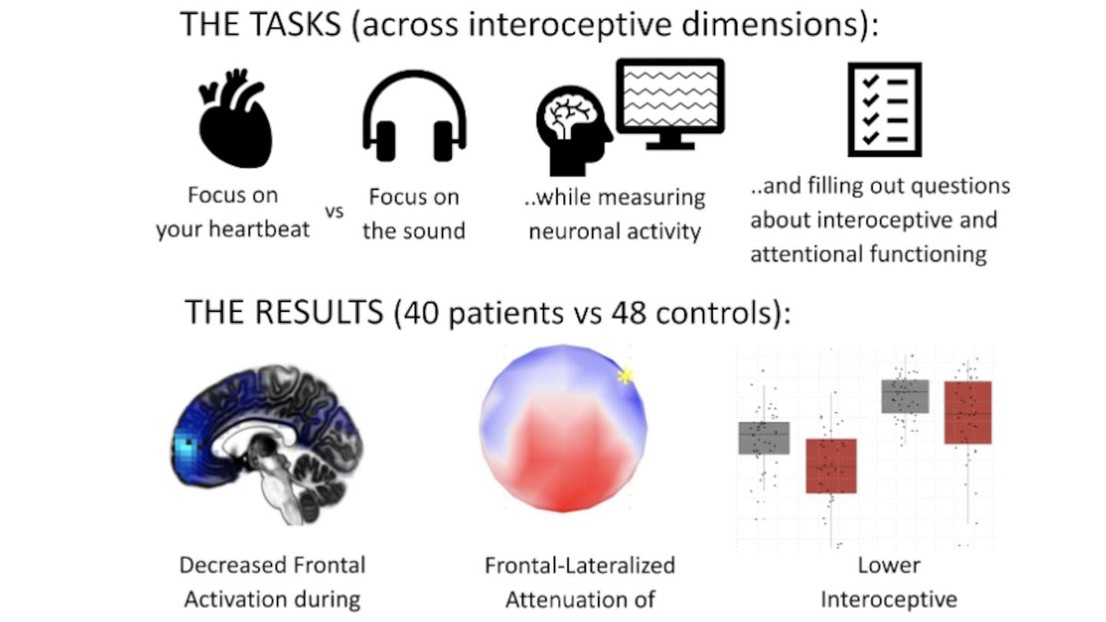
In a cohort of 44 FND patients and 48 age- and sex-matched healthy controls, we combined behavioural measures, self-report questionnaires, and neurophysiological markers of cardiac processing. Participants performed an attention task (requiring attention either to their heartbeat (interoceptive focus) or to an external sound (exteroceptive control)), while heartbeat-evoked potentials (HEPs) were recorded using high-density EEG.
Patients with FND had reduced interoceptive awareness and greater difficulty focusing on their heartbeat, but no impairment in interoceptive accuracy. At the neural level, FND patients showed attenuated heartbeat-evoked potentials, particularly over frontal brain regions and specifically during interoceptive attention. These effects persisted after controlling for cardiac factors such as heart rate and heart rate variability.
Together, these findings provide neural evidence of altered interoceptive processing in FND, highlighting the critical role of attention and frontal interoceptive brain mechanisms. The findings support a multi-dimensional approach to interoception in FND, integrating subjective experience, behaviour, and neurophysiology, and contributes to a deeper understanding of the disorder’s altered brain mechanisms.
This work was supported by the Swiss National Research Foundation Professorship Grant PP00P3_176985.
Stoffel, N., Mouthon, M., Yang, H., von der Weid, L., Concetti, C., Blanke, O., & Aybek, S. (2026). Attenuated heartbeat-evoked potentials in functional neurological disorder. Brain Communications, fcaf503. https://doi.org/10.1093/braincomms/fcaf503